

Choosing to install an air source heat pump is a major financial decision, a bit like buying a highly efficient car. The sticker price is higher than a standard gas boiler, but the real value becomes clear over years of lower running costs. The final figure you see on a quote is never one-size-fits-all; it depends on the type of system you choose, the size of your home, and how well-insulated it is.
To really get a feel for the investment, you need to see where the money goes. Air-to-air systems, which function a bit like air conditioning units for heating and cooling, typically cost between £4,000 and £9,500. However, the far more common choice for UK homes are air-to-water systems, which connect to your radiators and hot water tank, and these range from £8,250 to £15,500 fully installed.
A First Look at the Numbers
Before we get into the nitty-gritty, let’s establish a clear baseline. The total cost isn’t just for the heat pump unit itself. It covers the essential labour from certified installers, potential radiator upgrades, and any other bits and pieces needed to get the system running perfectly.
This initial outlay is often the biggest hurdle for homeowners, but it’s crucial to know that there’s significant government support available to soften the blow.
The Boiler Upgrade Scheme (BUS) in England and Wales offers a grant of £7,500. This isn’t something you have to apply for separately; your MCS-certified installer deducts it directly from your installation quote, massively reducing your upfront expense.
This grant completely changes the financial picture, making the switch to renewable heating a much more realistic option for thousands of households.
To put all this into context, here’s a quick summary of the typical costs you can expect. Think of this as a handy reference point as we explore what drives your final price up or down.
Air Source Heat Pump Cost Summary at a Glance
This table breaks down the common expenses involved in a typical UK installation, giving you a clearer idea of the individual components that make up the total cost.
| Cost Component | Typical Price Range (£) |
|---|---|
| Air Source Heat Pump Unit | £3,000 – £8,000 |
| Professional Installation Labour | £3,000 – £6,000 |
| Hot Water Cylinder (If required) | £1,000 – £2,500 |
| Radiator Upgrades (Per radiator) | £200 – £500 |
| Total Estimated Cost (Before Grants) | £7,200 – £21,500 |
As you can see, the final cost is a combination of hardware and skilled labour. Factoring in the £7,500 BUS grant brings the total investment down into a much more manageable range.
Deconstructing Your Installation Quote
Getting your first quote for an air source heat pump can feel a bit like reading a foreign language. The final figure is a sum of several distinct parts, and getting your head around each one is the key to making a confident decision. This isn’t just about buying a box; it’s an investment in a complete heating system built specifically for your home.
Think of it like having a bespoke suit made. You’re not just paying for the fabric. You’re paying for the tailor’s expertise, the hours of skilled labour, and all the specific adjustments that make it a perfect fit. In the same way, a heat pump quote bundles together the unit itself, the specialist installation, and any upgrades needed to get your home running efficiently.
For a typical 3–4 bedroom home in the UK, you can expect the total installed cost to land somewhere between £7,000 and £15,000. That figure covers the pump and all the associated work. Air-to-water pumps, which handle both your central heating and hot water, will naturally sit at the higher end of that scale, as you can see in this detailed breakdown of air source heat pump expenses on greenmatch.co.uk.
The Heart of the System: The Heat Pump Unit
The biggest single item on your quote will, of course, be the heat pump unit. The price tag here is really driven by two things: the brand and its capacity. Just like with cars or boilers, you’ve got your premium brands that come with more advanced features and longer warranties, and that’s reflected in the price.
More importantly, the unit’s capacity – measured in kilowatts (kW) – is a huge factor. This isn’t a number you can just guess at; it has to be calculated properly based on your home’s unique heating demand. A larger, poorly insulated house bleeds heat much faster and will need a more powerful, and therefore more expensive, unit to stay comfortable.
One of the most common mistakes is choosing an undersized unit to save a bit of cash upfront. This is a classic false economy. A pump that’s too small will be forced to run flat-out, struggling to heat your home, racking up higher energy bills, and wearing itself out much faster.
Getting the capacity right involves a proper heat loss survey of your property. To really understand why this step is so vital, take a look at our guide on the correct sizing of heat pumps to ensure you get the best performance.
Essential Labour and Expertise
The second major chunk of your costs comes from the installation labour. Make no mistake, this isn’t a job for a standard plumber. It demands an MCS (Microgeneration Certification Scheme) accredited installer who has gone through specialised training to design and fit these renewable systems.
Their expertise is what guarantees the system is installed correctly, safely, and is set up to run as efficiently as possible. The labour costs will cover several days of work by a qualified team, including:
- System Design: Doing the maths on heat loss and correctly sizing the pump and radiators.
- Physical Installation: Siting the outdoor unit and fitting the indoor components.
- Pipework and Electrics: Connecting everything up to your heating and electrical systems.
- Commissioning: Firing up the system and fine-tuning it to make sure it’s operating at peak performance.
Trying to cut corners with an uncertified installer is a massive risk. Not only could you end up with a shoddy installation, but you also won’t be eligible for any government funding like the Boiler Upgrade Scheme.
Upgrades for Optimal Performance
Finally, don’t be surprised if your quote includes costs for system upgrades. Air source heat pumps are at their best when they run at lower flow temperatures than old-school gas boilers – think 35-55°C instead of 60-80°C. This gentle, constant warmth is incredibly efficient, but it needs a bigger surface area to heat a room effectively.
What does that mean in practice? Your existing radiators might not be big enough for the job. Your installer will assess each room and will likely recommend swapping some, or all, of your radiators for larger, more efficient models. While it adds to the initial bill, it’s absolutely vital for the system’s performance and your future running costs. Ignoring this advice is a surefire way to end up with a system that just can’t keep you warm on the coldest days of the year.
What Really Drives Your Final Heat Pump Cost?
It can be baffling to see such a wide range of quotes for an air source heat pump. Why would one installation cost thousands more than another, even for a similar-sized house? The answer almost always comes down to the unique character of your property. More than anything else, your home’s energy efficiency is what shapes the final bill.
Think of it this way: your home is a bucket, and you’re trying to keep it full of warmth. A modern, well-insulated home is like a solid bucket; it holds onto that heat with ease. An older, draughty property, on the other hand, is like a bucket riddled with tiny holes. You need a much bigger, more powerful system constantly topping it up just to keep it warm.
Your Home’s Thermal Efficiency
Any good installer will start with a proper heat loss survey. This isn’t a quick guess; it’s a detailed assessment to measure how quickly your property leaks heat to the outside. They’ll be looking closely at your insulation, the quality of your windows, and how airtight the building is.
A house with modern cavity wall insulation, at least 270mm of loft insulation, and decent double or triple glazing will have a low heat loss figure. This is great news, as it means a smaller, less expensive heat pump can do the job comfortably. Conversely, a property with solid walls, patchy insulation, and old single-glazed windows will lose heat like a sieve, demanding a larger, more powerful, and pricier unit to keep up.
Upgrading your home’s insulation before getting a heat pump isn’t just a nice-to-have; it’s a financial necessity. Spending a bit on insulation first often means you can install a smaller, cheaper heat pump, and you’ll slash your running costs for years to come.
Improving your home’s thermal envelope is the single best thing you can do to manage both the upfront price and the long-term expense. It’s fundamental to making ASHPs work efficiently.
How Property Features Impact Heat Pump Costs
To see how this plays out in the real world, let’s compare two different scenarios. The table below shows just how much the features of your home and the choices you make can swing the total installation cost.
| Factor | Low Cost Scenario (e.g., Small, Modern Home) | High Cost Scenario (e.g., Large, Older Home) |
|---|---|---|
| Property Size & Age | Small, well-insulated new build (under 100m²) with low heat demand. | Large, solid-wall period property (200m²+) with high heat loss. |
| Insulation | High levels of existing loft and wall insulation; modern double glazing. | Minimal insulation; single-glazed windows requiring extensive upgrades. |
| Radiator System | Existing radiators are already oversized and suitable for lower flow temps. | Requires all new, larger radiators and significant pipework adjustments. |
| Hot Water Cylinder | Existing cylinder is compatible or only requires a minor upgrade. | Needs a brand new, larger heat pump-specific cylinder installed. |
| Installation Complexity | Simple ground-floor location for the outdoor unit, close to the cylinder. | Complex setup requiring scaffolding, long pipe runs, and electrical upgrades. |
| Labour Costs | Lower regional labour rates. | Higher labour costs (e.g., London/South East). |
| Estimated Total Cost | £7,000 – £10,000 | £14,000 – £20,000+ |
As you can see, two homes can end up with vastly different final bills. A well-prepared, efficient property keeps things simple and affordable, while an older, less efficient home needs more work and a more powerful system, pushing the price up significantly.
Installation Complexity and Location
Beyond insulation, the nuts and bolts of the installation itself have a big say in the cost. A straightforward job where the outdoor unit sits conveniently near the indoor tank with simple pipe runs will naturally keep labour costs down.
But things can get complicated, and that’s when the price starts to climb. This might involve:
- Difficult Access: Needing scaffolding to hoist the unit onto a high wall.
- Long Pipe Runs: Having to run refrigerant pipes a long way between the indoor and outdoor units.
- Electrical Work: Your existing fuse box (consumer unit) might need an upgrade to handle the heat pump’s electrical load.
- Groundworks: Pouring a solid concrete base for the outdoor unit to sit on securely.
On top of all this, where you live matters. Labour rates vary across the UK, so you can expect to pay more for a certified installer in London and the South East than you would in other parts of the country. This will be baked into your final quote.
The image below breaks down how these different components—the equipment itself, the installation, and ongoing maintenance—all add up over time.
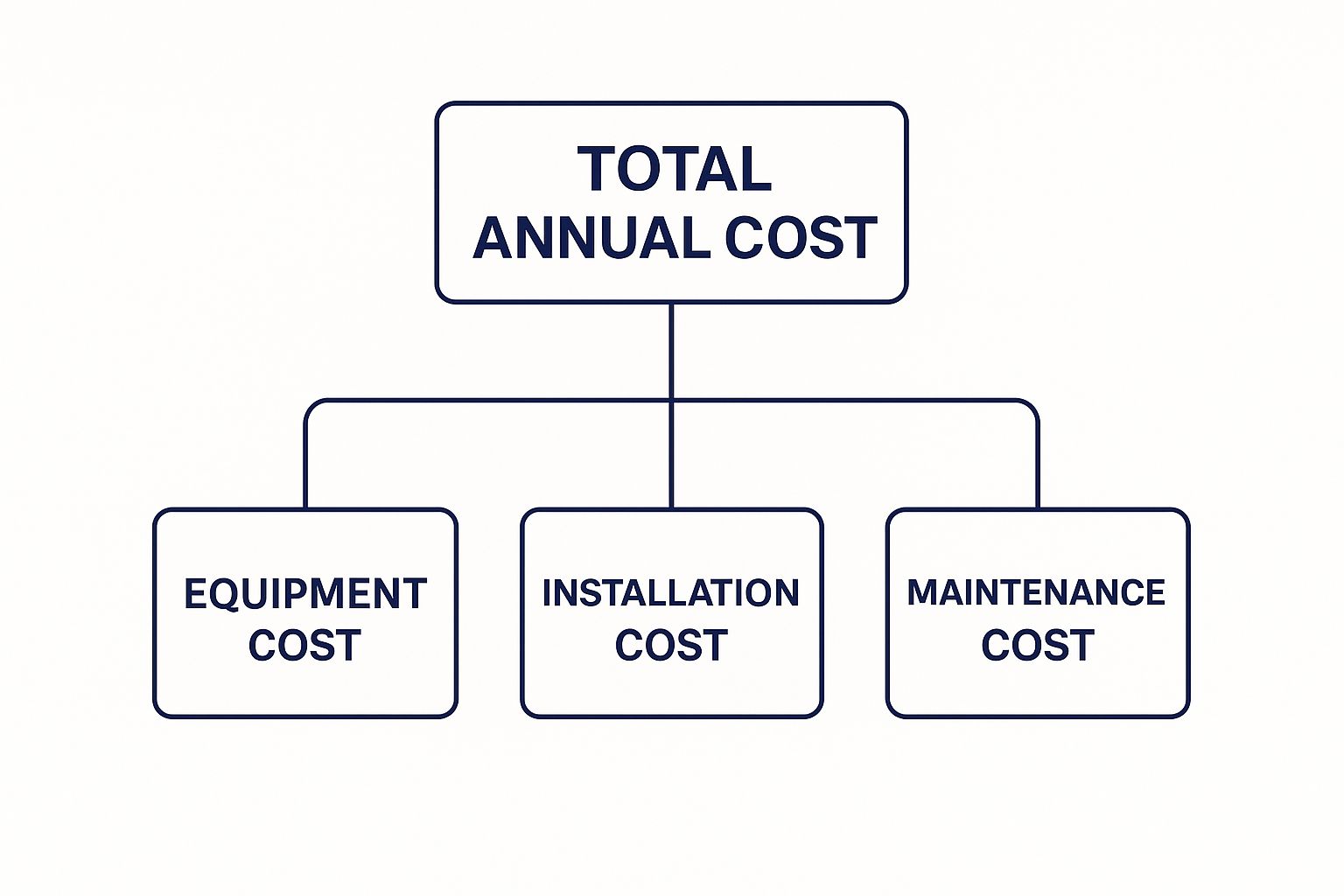
It’s a good reminder that while the heat pump unit is a big upfront purchase, the complexity of the install and the long-term running costs are just as important in the overall financial picture.
The Brand and Model You Choose
Finally, just like buying a car or a boiler, the specific brand and model of the heat pump you pick will influence the price. Premium brands often cost more, but in return, you might get better efficiency ratings (a higher Coefficient of Performance), smarter controls, quieter operation, and longer warranties.
It’s tempting to just go for the cheapest unit you can find, but this is often a false economy. A highly efficient model from a well-known manufacturer might have a higher sticker price, but it will save you far more on your energy bills over its 15-20 year lifespan. A good installer will walk you through the options, helping you weigh the upfront cost against the long-term savings to find the best value for your home.
So, What Are the Ongoing Running Costs?
While the initial installation price is what everyone focuses on first, the real financial story of an air source heat pump plays out over its lifetime. The day-to-day running costs are where this technology really comes into its own, and understanding them is key to seeing the true value of your investment.
The secret to a heat pump’s low running costs is something called the Coefficient of Performance (CoP). Think of it as an efficiency multiplier. For every single unit of electricity the heat pump uses to run its internal parts (like the compressor), it pulls in several units of heat from the outside air.
It’s an incredibly efficient way to heat your home. A decent, modern air source heat pump will have a CoP of somewhere between 3 and 4. In simple terms, this means for every 1 kilowatt-hour (kWh) of electricity you pay your supplier for, the system actually delivers 3 to 4 kWh of useful heat into your home. This is a world away from old-school electric heaters, which have a CoP of 1 (you pay for 1 kWh of electricity, you get 1 kWh of heat out).
The Power of Efficiency
This clever process is what leads directly to lower energy bills compared to systems that burn fossil fuels like gas, oil, or LPG. Yes, you’re using electricity, but you’re using it far more intelligently to move heat, not create it from scratch.
The key takeaway is that a heat pump doesn’t create heat with electricity; it uses a small amount of electricity to move a large amount of existing heat from the outside into your home. This fundamental difference is what makes it a far cheaper way to keep your house warm.
Of course, the final figure on your electricity bill will be influenced by a few things – how well-insulated your home is, its size, your specific electricity tariff, and your own heating habits. But for a well-insulated property, the savings can be massive, year after year.
Annual Maintenance: A Smart Investment
Just like you wouldn’t run a car for years without a service, your heat pump needs a bit of professional TLC to keep it running at peak efficiency. This isn’t a huge expense, but it’s vital for protecting your investment and making sure it has a long, healthy life.
An annual service from a qualified engineer is all it takes. During the visit, they’ll typically:
- Check components: Give the fans, coils, and electrical connections a thorough inspection for any wear and tear.
- Clean filters: Make sure the airflow is totally clear to keep efficiency high.
- Test performance: Verify the system is still hitting its target CoP.
- Look for potential issues: A sharp eye can spot small problems before they grow into expensive repairs.
This peace of mind doesn’t cost the earth. Industry data shows that an annual maintenance check-up for an air source heat pump typically falls somewhere between £120 and £245. Most experts recommend getting it serviced once a year to keep it in tip-top condition. For a deeper dive into these ongoing expenses, you can explore guides on heat pump costs at whatcost.co.uk.
By budgeting for this small annual check, you’re ensuring your system keeps delivering those brilliant energy savings it was designed for, protecting its efficiency for years to come.
How Government Grants Bring Down Your Upfront Cost
Let’s be honest: the initial price tag for an air source heat pump is often the biggest hurdle for most UK homeowners. The government gets this. That’s why they’ve put some pretty significant financial incentives in place to make the switch to renewable heating a more realistic option for more people. These grants are designed to chip away at your upfront costs, completely changing the financial picture.
The main player here is the Boiler Upgrade Scheme (BUS), which is the cornerstone of the UK’s strategy for cleaner heating. This scheme gives households in England and Wales a hefty, fixed grant to help cover the installation bill. Think of it as a powerful tool designed to bridge the gap between sticking with a traditional boiler and upgrading to a modern, efficient heat pump.
A Closer Look at the Boiler Upgrade Scheme
The great thing about the Boiler Upgrade Scheme is its simplicity. This isn’t some complicated rebate you have to chase up months down the line. Instead, your MCS-certified installer handles the whole thing. They apply on your behalf and simply deduct the full grant amount from your final quote, which makes the money side of things much less of a headache for you.
Here are the key points:
- You get a grant of £7,500 towards the cost of an air source or ground source heat pump.
- The property needs a valid Energy Performance Certificate (EPC) without any outstanding recommendations for loft or cavity wall insulation.
- It’s available for homes and small non-domestic properties across England and Wales.
This upfront discount makes a massive difference. If your installation is quoted at £13,000, that grant immediately brings your cost down to just £5,500. Suddenly, the investment feels a lot more manageable from day one.
The whole point of this initiative is to tackle the high initial air source heat pump costs. It directly slashes the amount you need to pay out of pocket, making that decision to upgrade far easier.
While this funding is a huge help, it’s wise to be realistic. The UK Government’s £7,500 grant is designed to partially offset the cost, but for many homeowners, it still means covering at least half the installation price from their own savings. For a wider view on the numbers, some UK heat pump statistics can help paint a clearer picture of the financial landscape.
Are There Other Funding Options Available?
The BUS is definitely the main event, but it’s not the only scheme out there. Depending on where you live and your personal circumstances, other support might be available. It’s always worth checking every possible avenue to get the best deal.
Energy Company Obligation (ECO)
The ECO scheme is a wider government programme focused on energy efficiency, usually targeting lower-income households. While its main focus is on things like insulation and boiler upgrades, it can sometimes include funding for heat pumps. Eligibility is typically based on receiving certain benefits, so it’s worth checking if you qualify.
Support in Scotland and Wales
Scotland does things a bit differently and runs its own funding programmes. Home Energy Scotland offers a mix of grants and interest-free loans to help homeowners make their properties more energy-efficient, and this definitely includes heat pump installations. The support can be quite generous, so if you live in Scotland, looking into these specific options is a must. Our guide offers a detailed look at the Home Energy Scotland Grant to give you more information.
Wales also has its own initiatives, like the Nest scheme, which offers free advice and, for eligible households, free energy efficiency improvements. By exploring these regional and income-based schemes, you can make sure you’re tapping into every bit of support available to bring that installation cost down as much as possible.
When Will a Heat Pump Pay for Itself?

This is the big question on every homeowner’s mind: when does the investment in an air source heat pump actually start paying me back? The answer is what we call the payback period, and it’s a pretty simple idea. You just compare what you paid upfront against what you save on your energy bills each year.
Of course, the calculation is unique for every single property. The real savings kick in depending on what kind of heating system you’re leaving behind.
If you’re ditching an ancient, inefficient oil or LPG boiler, you’ll see a much shorter payback period than someone switching from a modern, A-rated gas boiler. It stands to reason—the bigger the gap between your old running costs and your new ones, the faster you get your money back.
For example, even with the initial outlay, analysis shows heat pumps can slash annual heating bills by around £290 compared to a typical gas boiler. That alone makes them a pretty compelling choice for anyone looking to cut their bills and their carbon footprint.
Calculating Your Payback Period
To get a handle on your own timeline, you can use this simple framework. It helps turn abstract figures into a concrete forecast for your return on investment.
- Work Out Your Net Installation Cost: Take the total quote from your installer and knock off the £7,500 from the Boiler Upgrade Scheme (BUS) grant. That final number is your actual out-of-pocket expense.
- Calculate Your Annual Energy Savings: Dig out last year’s heating bills (whether for oil, gas, or LPG) and compare them to the projected running costs for your new heat pump. The difference between the two is your estimated annual saving.
- Divide Cost by Savings: Now, just divide your net installation cost by your annual savings. The number you get is your payback period in years.
Payback Period = (Total Installation Cost – Government Grants) ÷ Annual Energy Savings
This simple formula gives you a clear financial picture. For a home with a net installation cost of £6,000 and annual savings of £750, the payback period works out to be 8 years.
A Tale of Two Homes: A Payback Comparison
Let’s put this into practice with a couple of real-world examples:
- Home A (Switching from Oil): This household currently spends £1,800 a year on oil. After the grant, their heat pump installation cost comes to £7,000. With projected running costs of just £900 per year, they’re saving a tidy £900 annually. Their payback period? A little under 8 years (£7,000 ÷ £900).
- Home B (Switching from Modern Gas): This home has a newer gas boiler, with annual bills running at £1,200. Their net installation cost is the same at £7,000. The heat pump is projected to cost £950 a year to run, saving them £250. In this case, their payback period is much longer at 28 years (£7,000 ÷ £250).
The Value Beyond the Bills
But the financial return isn’t just about what you save on energy. A heat pump adds value in other important ways, too. It future-proofs your home against the notoriously volatile prices of fossil fuels and can give your property’s Energy Performance Certificate (EPC) rating a healthy boost, making it far more appealing to potential buyers down the line.
To really squeeze the most out of these returns, your home’s thermal efficiency is key. Getting to grips with things like the benefits of Low-E glass for thermal performance shows how upgrading windows and insulation can dramatically reduce heat loss. This doesn’t just lower your running costs—it actively shortens your payback period.
Your Heat Pump Questions Answered
When you’re exploring a switch to an air source heat pump, it’s natural to have plenty of questions about the practical side of things. Let’s tackle some of the most common queries we hear from homeowners to give you a clearer picture of what to expect.
Getting to grips with these details will help you feel much more confident about the whole process, from the initial installation right through to the day-to-day running of your new system.
Do I Need to Replace All My Radiators for a Heat Pump?
Not always, but it’s a very common – and often essential – upgrade. Heat pumps really hit their stride when they run at lower, more consistent flow temperatures. To get the same comfortable warmth into your rooms, you often need radiators with a bigger surface area to gently radiate that heat.
A certified MCS installer won’t guess this. They’ll conduct a proper heat-loss calculation for your home to figure out if your current radiators are up to the job. For many properties, especially older ones, swapping out some or all of them is the key to making sure the system runs efficiently and keeps your home properly cosy.
Trying to get by with undersized radiators is a classic false economy. It forces the heat pump to work much harder and run at higher temperatures, which hikes up your running costs and puts unnecessary strain on the entire system.
Are Air Source Heat Pumps Noisy?
Modern air source heat pumps are surprisingly quiet. A typical unit hums along at a sound level between 40-60 decibels, which is about the same as a new fridge or a dishwasher running in the next room. You’ll know it’s on, but it’s more of a background whir than an intrusive noise.
Better yet, in the UK, fitting a heat pump is usually considered ‘permitted development’, meaning you won’t need to apply for planning permission. This comes with a condition, though: the unit has to meet strict rules about noise levels at your property boundary. Any qualified installer worth their salt will make sure your unit is sited correctly to comply with all the regulations, so you won’t have any noise issues to worry about.
What Are the Typical Annual Running Costs?
This is the big one, and the honest answer is: it depends. The final figure on your electricity bill is shaped by three main things:
- How well-insulated your home is: A draughty house leaks heat, forcing the pump to run more often to keep up. Good insulation is your best friend.
- The size of your property: It simply takes more energy to heat a larger space.
- Your electricity tariff: The price you pay per kilowatt-hour for electricity has a direct impact on your bills.
As a ballpark, a well-insulated, three-bedroom home in the UK could see annual running costs between £700 and £1,200. For many, this is a significant saving compared to heating with oil, LPG, or old-fashioned direct electric systems.
The magic is in the efficiency. A heat pump doesn’t create heat from scratch; it moves it. For every 1 kWh of electricity it uses, it delivers 3-4 kWh of heat into your home. If you can pair this with a smart or off-peak electricity tariff, you can push those running costs down even further.
At Luths Services, we specialise in guiding businesses and organisations through the complexities of renewable heating. Our expert team offers detailed feasibility studies and project management to ensure your move to low-carbon technology is smooth, efficient, and makes financial sense.
Find out how we can help you hit your sustainability targets by visiting us at https://www.luths-services.com. or contacting us at info@luths-services.com


