
Picture a building as a human body. The concrete and steel structure is its skeleton, but the building mechanical services are the vital organs—the circulatory, respiratory, and nervous systems that keep it alive, comfortable, and functional. These are the hidden networks that ensure everything from clean air to safe water runs exactly as it should.
The Living Systems Inside Every Structure

At its heart, building mechanical services refers to the engineered systems designed to create comfortable, safe, and efficient indoor environments. While it sounds technical, the idea is quite simple. It’s all the machinery and infrastructure that makes a building more than just bricks and mortar—it makes it habitable.
This complex network is often simply called MEP, which stands for Mechanical, Electrical, and Plumbing. These three distinct but deeply interconnected disciplines form the operational backbone of any modern building.
Breaking Down The Core Functions
The primary components of building mechanical services look after different aspects of a building’s performance and the wellbeing of its occupants. They work in concert, much like the organs in a body, to maintain a perfectly balanced internal environment.
Key functions include:
- Climate Control: This is the most obvious part, handled by the Heating, Ventilation, and Air Conditioning (HVAC) systems. Their job is to manage temperature, humidity, and airflow to keep the atmosphere comfortable all year round.
- Water Management: Plumbing systems deal with everything water-related. This means delivering clean, potable water for drinking and sanitation, and just as importantly, safely removing wastewater and managing drainage.
- Life Safety Systems: Fire protection is a non-negotiable part of mechanical services. This includes critical systems like fire alarms, sprinklers, and smoke control mechanisms designed to protect people and property during an emergency.
The intricate nature of these systems means that their design, installation, and upkeep absolutely require the expertise of skilled MEP professionals.
Why Understanding These Systems Matters
For architects, property developers, and facilities managers, a solid grasp of building mechanical services isn’t just helpful—it’s essential. These systems have a direct impact on everything from initial construction budgets to long-term running costs and sustainability ratings.
A poorly designed mechanical system can quickly lead to sky-high energy bills, frequent breakdowns, and an uncomfortable, unproductive environment for everyone inside.
A building’s performance, efficiency, and even its lifespan are fundamentally tied to the quality of its mechanical services. Getting these systems right from the start is one of the most critical investments in a property’s future.
Ultimately, these services are what transform a static structure into a dynamic, responsive, and healthy space. Pulling this off requires specialised knowledge, which is where expert guidance becomes invaluable. To see how this expertise is put into practice, you can learn more about the role of professional building services consultants in bridging the gap between architectural vision and functional reality.
A Closer Look at the Core Mechanical Components
To really get to grips with building mechanical services, you need to look past the broad definitions and dig into the individual systems doing the heavy lifting. These core components are the workhorses that make a building comfortable, safe, and functional. While they are distinct disciplines, they’re designed to operate in perfect harmony.
It’s a bit like an orchestra. The strings, brass, and percussion each have a specific role, but it’s only when they play together that you get a beautiful symphony. The exact same principle applies to a building’s mechanical, electrical, and plumbing (MEP) systems.
The image below breaks down the primary systems that form the backbone of building mechanical services.
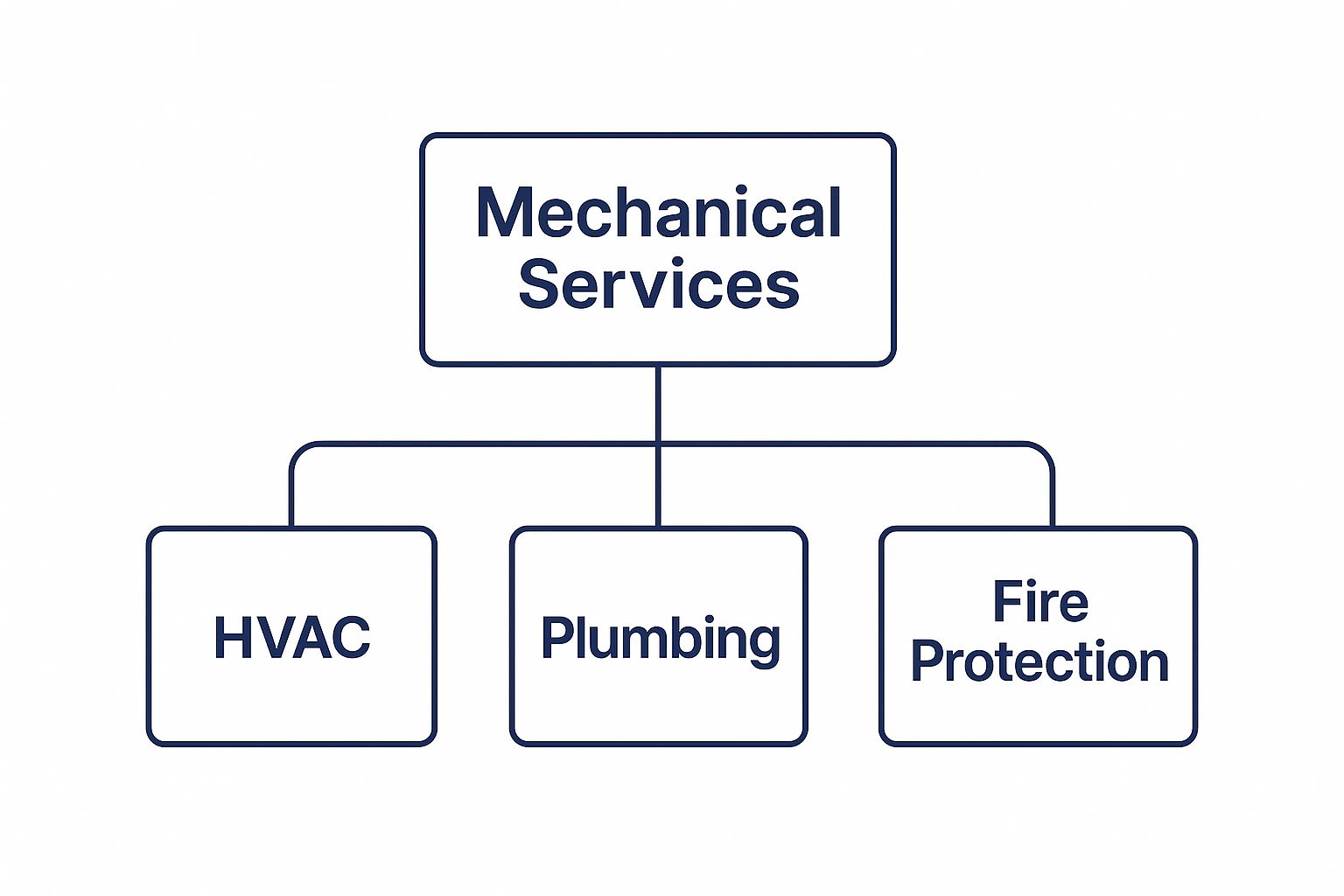
As you can see, HVAC, plumbing, and fire protection are the three main pillars. Each one is responsible for a critical aspect of the building’s internal environment and safety. Let’s explore what each of these actually does.
To help clarify, this table summarises the primary systems, their roles, and what we need to consider when designing them.
Overview of Key Mechanical Service Components
| System Component | Primary Function | Key Design Consideration |
|---|---|---|
| HVAC | Manages indoor climate, including heating, cooling, and air quality. | Balancing thermal comfort with energy efficiency and ensuring adequate fresh air exchange. |
| Plumbing | Distributes clean water and safely removes wastewater and sewage. | Ensuring sufficient water pressure, preventing contamination, and designing for efficient drainage. |
| Fire Protection | Detects, contains, and suppresses fires to protect occupants and property. | Integrating active (sprinklers, alarms) and passive systems for rapid response and occupant safety. |
Each of these systems is a complex field in its own right, but understanding their fundamental purpose is the first step.
HVAC: The Lungs of the Building
Heating, Ventilation, and Air Conditioning (HVAC) systems are probably the most noticeable of all mechanical services. Their main job is to manage the indoor climate, but their function runs much deeper than just keeping rooms warm or cool.
A modern HVAC system is a sophisticated air management network. It doesn’t just tweak the temperature; it actively controls the quality of the air we breathe. This involves several key processes working in tandem.
- Heating: This provides warmth during colder months, using systems like furnaces, boilers, or heat pumps to maintain a comfortable temperature.
- Ventilation: This is all about replacing stale indoor air with fresh outdoor air. It’s vital for removing pollutants, odours, and moisture, which has a direct impact on the health and productivity of everyone inside.
- Air Conditioning: This cools the air during warmer periods, but just as importantly, it helps to dehumidify the space, preventing the growth of mould and mildew.
Effective ventilation is especially crucial for creating healthy indoor spaces. Advanced solutions, like those we cover in our guide to heat recovery ventilation systems, not only guarantee a constant supply of fresh air but also recover energy from the outgoing air to slash energy waste.
Plumbing: The Circulatory System
If HVAC systems are the lungs, then plumbing is the building’s circulatory system. It manages the flow of all water-based services, making sure clean water gets where it needs to go and waste is removed safely and efficiently. It’s really a tale of two distinct networks.
First, you have the potable water system. This network of pipes delivers clean, fresh water to taps, toilets, and appliances throughout the building. The design must ensure there’s always adequate pressure and flow while completely preventing contamination.
The second part is the drainage and wastewater system. This is responsible for carrying away used water and waste to the municipal sewer or an on-site treatment facility. Proper design here is essential to prevent blockages, leaks, and hazardous gases from creeping back into the building.
A well-designed plumbing system is a silent hero. When it’s working perfectly, you barely notice it’s there. But when it fails, it can cause some of the most disruptive and costly damage a building can experience.
Fire Protection: The Guardian System
The final core component, fire protection, is the building’s dedicated guardian. These are the active and passive systems engineered to detect, contain, and suppress fires, protecting both human life and the property itself. Though often hidden from view, these systems are always on alert.
Key elements of fire protection include:
- Fire Sprinkler Systems: A network of pipes and sprinkler heads designed to automatically release water when the heat from a fire is detected.
- Fire Alarms and Detection: These are the early warning systems, using smoke, heat, or flame detectors to alert occupants and emergency services at the first sign of trouble.
- Smoke Control Systems: These mechanical systems manage the movement of smoke during a fire, keeping escape routes clear and stopping smoke from spreading to other parts of the building.
Together, these three pillars—HVAC, plumbing, and fire protection—form the essential foundation of building mechanical services. They are deeply interconnected, and a failure in one can easily cascade and impact the others. This is precisely why a coordinated, expert approach to their design, installation, and maintenance isn’t just a good idea—it’s absolutely essential for any modern building.
The Future of HVAC in UK Buildings
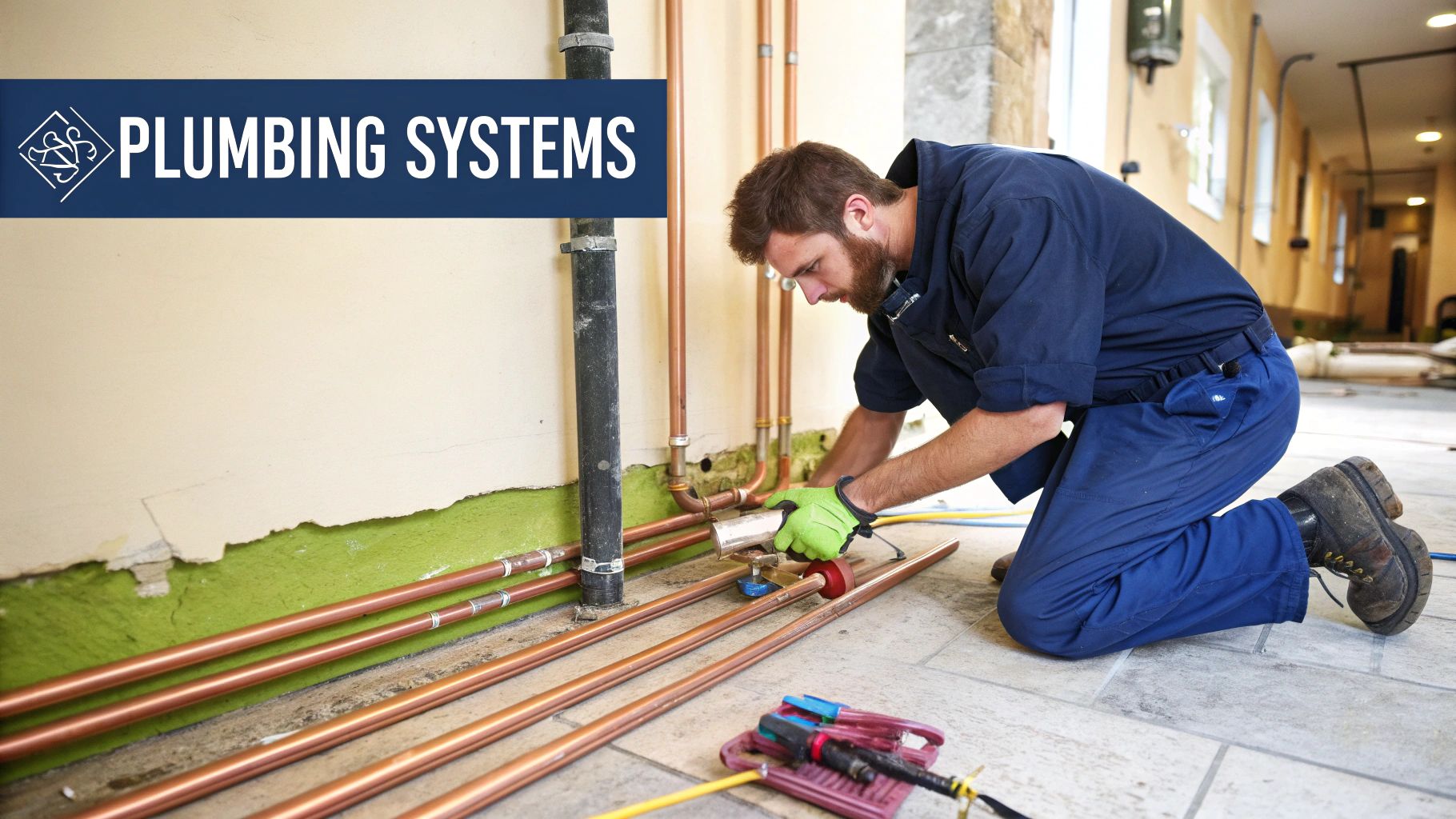
The world of heating, ventilation, and air conditioning (HVAC) is in the middle of a massive shake-up, especially here in the UK. Spurred on by ambitious national decarbonisation targets, the industry’s focus is pivoting hard towards sustainable, highly efficient solutions. This isn’t just a minor trend; it’s a fundamental change in how we think about heating and cooling our buildings.
At the heart of this shift is the government’s push for heat pumps. They’re being positioned as the go-to technology to slash carbon emissions from properties, effectively making them the successor to the traditional gas and oil boilers we’ve relied on for decades. This strategic move is sending ripples through the entire market, influencing everything from new-build standards to retrofit projects.
The Decarbonisation Drive
The UK government is actively nudging the market away from fossil fuels. A big part of this strategy involves new rules that will phase out old-school heating systems in new builds while promoting cleaner alternatives for existing homes and commercial properties. This has created a real hotbed for innovation in building mechanical services.
For instance, regulations are getting tighter and financial incentives are being rolled out to encourage the switch to low-carbon tech. For developers and building managers, this means getting to grips with systems like air-source and ground-source heat pumps is no longer a niche specialism. It’s now a core requirement for future-proofing any asset. For a closer look at these legislative changes, our article on the ban of direct emission heating systems in Scotland offers some crucial context.
This top-down push is fuelling some serious market growth. The UK’s HVAC market is set to climb from USD 2.67 billion in 2025 to USD 3.27 billion by 2030. The services side of things—which covers the tricky commissioning and maintenance of these new heat pump systems—is expected to grow fastest, at an impressive 7.8% each year. This boom is directly propped up by incentives like grants of up to GBP 7,500 per unit to help people make the switch.
But this rapid transition isn’t all smooth sailing. The very technology being promoted is creating a major bottleneck that could seriously slow things down if we don’t tackle it head-on.
Addressing the Critical Skills Gap
While the ambition is there and the technology is ready, the whole transition is hitting a major wall: a severe shortage of qualified engineers. The skills needed to properly install, commission, and maintain a modern heat pump are a world away from those required for a simple boiler swap. This has opened up a huge ‘skills gap’ right across the industry.
The UK currently has only around 3,000 trained heat-pump installers. To hit our national targets, we’ll need an estimated 230,000 by 2030. This shortfall is one of the biggest single threats to the UK’s decarbonisation strategy.
This gap is both a problem and an opportunity. For the market to thrive, we need a massive, nationwide effort to upskill and train a workforce that can actually deliver these advanced building services.
There are a few key areas where expertise is desperately needed:
- System Design: Sizing a heat pump correctly is absolutely critical for efficiency. Unlike a boiler, a ‘one-size-fits-all’ approach just doesn’t cut it.
- Specialised Installation: The installation itself is far more complex, demanding real knowledge of refrigerants, hydraulics, and intricate electrical systems.
- Commissioning and Optimisation: Getting a system to run at peak performance requires careful fine-tuning and calibration by a trained professional.
For consultancies and service providers like us, closing this gap means investing heavily in training and development. For our clients, it underscores just how important it is to partner with a firm that has proven, hands-on expertise with these modern systems. Successfully navigating this new landscape will depend on aligning policy, technology, and—most importantly—the skilled people needed to make it all happen.
Powering High-Growth Sectors Like Data Centres
While they often work behind the scenes, building mechanical services are now taking centre stage in some of the UK’s fastest-growing industries. No sector demonstrates this shift more dramatically than data centres—the physical heart of our digital world.
These facilities are much more than just warehouses for servers. They are precision-engineered environments where uptime is everything, and the mechanical, electrical, and plumbing (MEP) systems aren’t just a component of the build; they are the main event. In fact, their role is so fundamental that they often represent the single largest slice of the entire project budget. For a typical office, MEP might account for 20-30% of the cost. In a data centre, that figure can easily rocket past 60%.
Why the heavy investment? It all comes down to one core challenge: managing colossal amounts of heat. Every single server stack generates a constant, concentrated thermal load that, if left unchecked, would lead to catastrophic equipment failure in minutes.
The Unseen Engine of the AI Revolution
The demand for these specialised facilities is exploding, largely fuelled by the phenomenal growth of artificial intelligence (AI). Training large language models and running complex AI applications requires staggering computational power, which in turn generates unprecedented levels of heat.
As a result, the building mechanical services inside these facilities have become incredibly sophisticated. We’re not just talking about standard air conditioning anymore. Data centre cooling involves a complex suite of solutions engineered for maximum efficiency and absolute reliability.
These mission-critical systems often include:
- Chilled Water Systems: Large-scale networks that circulate cold water to pull heat from the server halls.
- Computer Room Air Handlers (CRAHs): Specialised units that control airflow, humidity, and temperature with surgical precision.
- Liquid Cooling Solutions: Advanced methods that bring coolant directly to the server racks—or even the chips themselves—for hyper-efficient heat removal.
This technological arms race in cooling is directly tied to our growing reliance on data. The Building Engineering Services Association (BESA) has noted a sharp rise in UK data centre construction over the last five years, driven almost entirely by AI’s computing demands. In this booming market, MEP services regularly account for over 60% of the total project value.
The UK data centre construction sector, valued at around £2.3 billion in 2025, is forecast to grow exponentially. You can read the full research about these market projections and learn why expertise in building mechanical services is so critical for this expansion.
MEP Contractors Taking the Lead
This complexity has completely flipped the traditional construction hierarchy on its head. In data centre projects, it’s common for MEP contractors and consultants to be brought in at the earliest stages, sometimes even leading the project. Their expertise is essential to shaping the building’s design, layout, and even its very structure from day one.
In the world of high-tech construction, the building is often designed to serve the mechanical systems, not the other way around. The success of a multi-million-pound data centre rests almost entirely on the performance and resilience of its MEP infrastructure.
This reality highlights a broader trend: as technology becomes more integrated into our built environment, the importance of building mechanical services skyrockets. From the complex ventilation needed in advanced healthcare facilities to the intricate climate control in vertical farms, mechanical experts are no longer just supporting players. They are the architects of the high-performance environments that power modern life, ensuring the UK’s technological infrastructure remains robust, efficient, and ready for whatever comes next.
Why Proactive Maintenance Is a Smart Investment
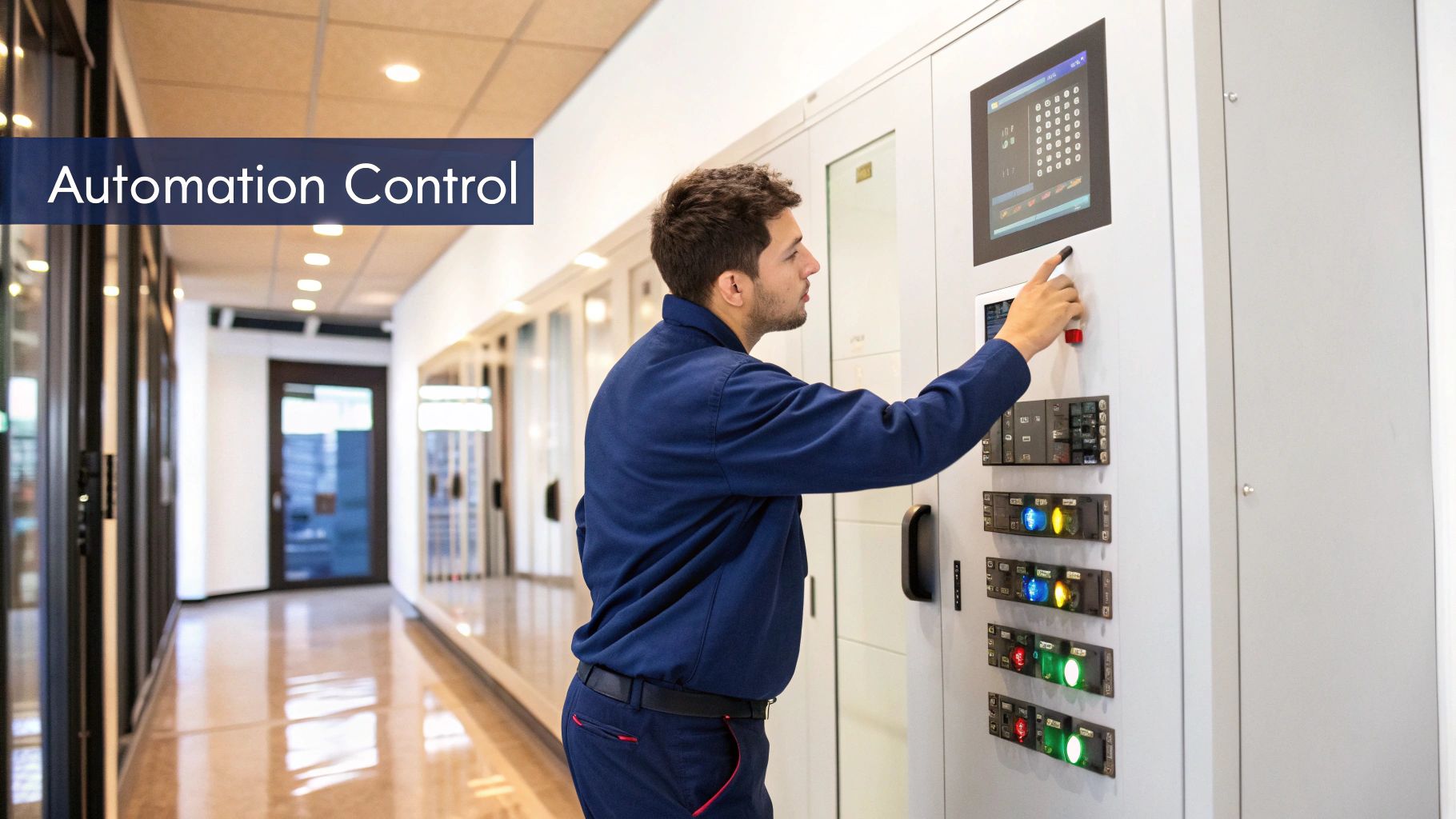
Once the last pipe is fitted and the commissioning is signed off, the real work begins. The long-term performance and efficiency of your building mechanical services depend entirely on what happens next. It’s a common trap to view maintenance as just another recurring cost to be squeezed. A far smarter approach is to see it as a critical investment in your building’s future.
Proactive maintenance is the line between a system that runs like a dream for decades and one plagued by early failures, sudden downtime, and ever-climbing energy bills. It’s about ditching the reactive “fix it when it breaks” mindset for a strategic, preventative one that actually protects your asset’s value.
This isn’t just our view; the construction industry itself highlights the importance of this work. Look at the figures from the UK’s Office for National Statistics—while new builds grab the headlines, it’s the repair and maintenance sub-sector that often provides steady, substantial growth. For example, a 1.2% increase in these activities was the main driver for overall construction growth in June 2025. It’s the economic backbone of the industry, and you can see more on these construction output trends for yourself.
The Tangible Benefits of a Maintenance Plan
A proper maintenance plan isn’t about ticking boxes on a clipboard. It delivers real, measurable returns that directly benefit your bottom line and keep your occupants happy. Catching small issues before they snowball into major problems is where the real savings are found.
The main benefits speak for themselves:
- Improved Energy Efficiency: A system that isn’t regularly serviced has to fight to do its job. Simple, regular cleaning, calibration, and tuning can slash energy consumption by 15-20%, cutting your utility bills straight away.
- Extended Equipment Lifespan: Your mechanical systems are huge capital investments. Just like a car, they last longer with proper care. A proactive plan can dramatically extend the working life of your boilers, chillers, and air handling units.
- Enhanced Safety and Compliance: Regular checks on gas lines, fire suppression, and other critical systems are non-negotiable for safety and compliance. It also means you’re prepared for the unexpected, like needing an emergency gas line repair, keeping everyone safe.
- Reduced Risk of Costly Failures: An unexpected system failure, especially in a commercial or healthcare setting, can be catastrophic. The disruption and financial loss can be huge. A preventative plan drastically cuts that risk.
What Does a Solid Maintenance Plan Look Like?
A robust maintenance strategy for building mechanical services is more than a quick annual check-up. It’s a bespoke schedule of inspections, testing, and servicing designed around the specific equipment you have.
A typical plan is built around a few key activities:
1. Regular Scheduled Inspections
This is the frontline defence against wear and tear. It involves visual checks, cleaning filters, lubricating moving parts, and just making sure everything is in good working order.
2. Performance Testing and Analytics
Here, technicians measure how your system is performing against its original design specs. This data-driven approach is fantastic for spotting efficiency losses and pinpointing where optimisation is needed.
3. Predictive Maintenance
Using modern tools like thermal imaging and vibration analysis, engineers can actually predict when a component is likely to fail. This means you can schedule a replacement during planned downtime, completely avoiding those stressful emergency call-outs.
Think of proactive maintenance as a health plan for your building. Regular check-ups and preventative care keep the systems strong, resilient, and performing at their peak, ensuring a long and productive life.
At the end of the day, investing in professional maintenance is one of the most cost-effective decisions a building owner or facilities manager can make. It protects the integrity of your building mechanical services, drives down your operational spending, and creates a safer, more reliable environment for everyone inside.
Designing for a Sustainable Future
These days, modern building mechanical services are driven as much by responsibility as they are by function. The game has changed. It’s no longer just about delivering comfort; it’s about engineering systems that actively look after our environment. This shift in thinking, grounded in sustainable and green engineering, is reshaping the entire industry.
It’s not enough for a system to be energy-efficient on its own anymore. Real sustainability requires a much broader perspective, pulling together everything from water conservation and renewable energy to the very materials we use to build. It’s a move towards designing buildings that work with nature, not against it.
Lighter Loads Through Passive Design
Long before a single piece of equipment gets specified, smart design can dramatically slash the need for mechanical systems to do the heavy lifting. This is the whole idea behind passive design—using a building’s architecture, its position, and its materials to maintain a comfortable climate as naturally as possible.
Think of a building like a high-tech thermos flask. With top-notch insulation, airtight construction, and thoughtfully placed windows, it can keep itself warm in the winter and cool in the summer with very little outside help.
Some of the key passive strategies we look at include:
- Building Orientation: Positioning a building to soak up the winter sun for warmth while shielding it from the intense summer sun to prevent overheating.
- Natural Ventilation: Cleverly designing airflow paths that let cool breezes move through the building, cutting down the need for air conditioning.
- High-Performance Glazing: Using advanced windows that let the light pour in but block unwanted heat from getting in or out.
These techniques don’t get rid of building mechanical services altogether. They just lighten the load, which means we can install smaller, more efficient, and more affordable systems.
The Role of Smart Building Management
Once we’ve squeezed every last drop of performance out of the passive design, technology takes over to fine-tune the rest. This is where a Building Management System (BMS) comes in. It acts as the building’s central brain, intelligently coordinating all the mechanical and electrical systems to run at their absolute best.
A BMS transforms a building from a collection of separate systems into a single, responsive organism. It’s constantly monitoring conditions and making real-time adjustments to save energy, cut costs, and keep everyone inside comfortable.
This data-driven approach is absolutely fundamental if we’re serious about hitting ambitious sustainability goals. By analysing how the building is performing, a BMS can spot tiny inefficiencies and find opportunities for improvement that would otherwise be completely invisible. This cycle of continuous optimisation is crucial for reaching net-zero targets and earning top-tier green building certifications like BREEAM.
Ultimately, designing for a sustainable future is all about creating intelligent, resilient buildings where every component works in harmony to minimise our impact on the planet.
Got Questions? We’ve Got Answers
Digging into the world of building mechanical services often brings up a few questions. We see these pop up time and again from property owners, developers, and facility managers, so we’ve put together some straightforward answers.
What Is the Difference Between Mechanical and Electrical Services?
Think of it like this: mechanical services handle everything to do with the physical environment. We’re talking about heating, cooling, and ventilation (your HVAC system) which control air quality and temperature, plus all the plumbing that manages water and waste.
Electrical services, on the other hand, are the building’s power and data backbone. This covers everything from power distribution and lighting to data cabling and critical life-safety systems like fire alarms. They’re two sides of the same coin—distinct, but needing to work in perfect harmony for a building to function properly.
A simple way to remember it is that mechanical services move air and water, while electrical services move power and data. Getting them to integrate seamlessly is the hallmark of truly expert building design.
How Often Should Mechanical Systems Be Serviced?
There’s no one-size-fits-all answer here, as the right maintenance schedule really depends on the system’s type, its age, and how hard it works. That said, there are some solid rules of thumb that will help you keep things running smoothly and for longer.
Generally speaking:
- Major HVAC Systems should get a professional look-over at least twice a year. It’s best to do this before the main heating and cooling seasons kick in.
- Plumbing and Fire Systems typically need a comprehensive annual check to make sure they’re compliant with regulations and ready to perform when needed.
A proper professional maintenance plan will always be tailored specifically to your building’s setup, creating a schedule that makes sense for you.
Why Are MEP Services So Expensive in Data Centres?
Data centres are the very definition of mission-critical. They generate a colossal amount of heat and simply cannot afford any downtime. The high cost of their building mechanical services comes down to the need for incredibly sophisticated and resilient systems. They represent a disproportionately large portion of the construction cost due to high power and cooling requirements.
We’re talking about redundant cooling infrastructure to stop servers from overheating, highly specialised fire suppression systems that protect sensitive electronics without using water, and ultra-robust power distribution with multiple backup generators. In a data centre, these mechanical services aren’t just another component; they are the facility’s life support system.
At Luths Services, we specialise in designing and implementing sustainable, efficient building mechanical services that deliver real long-term value. Discover how our expert consultancy can guide your next project.


