
Why Smart UK Businesses Are Embracing Commercial Solar
The discussion around commercial solar has officially left the corporate social responsibility reports and landed squarely in the boardroom. For years, installing solar panels was viewed primarily through an environmental lens. Now, for sharp UK business owners and facility managers, it’s a strategic decision driven by the bottom line. They’re looking for a solid defence against a volatile energy market that’s putting a squeeze on their margins.
A commercial solar panel installation is no longer just a nice-to-have. It has become a practical tool for building a more resilient, competitive, and forward-thinking business.
More Than Just a Green Badge of Honour
Let’s be direct: while cutting your carbon footprint is a great benefit, the main reason most businesses are making the switch is for financial predictability. When you generate your own electricity, you shield a large part of your operating costs from unexpected grid price hikes and global market shifts. This is a deliberate move toward financial stability.
Imagine being able to forecast your energy expenses with a high degree of accuracy for the next 25 years. That’s the kind of strategic edge solar offers. It transforms a fluctuating, unpredictable cost into a fixed, manageable asset. I’ve spoken with many facility managers who say their only regret is not doing it sooner, pointing to the immediate positive impact on their annual budgets and the end of worrying about the next energy bill.
A National Shift You Can See in the Data
This isn’t just talk; the trend is visible across the country. The UK has experienced a massive increase in solar adoption. As of early 2025, the nation’s total operational solar capacity shot past 18 gigawatts (GW), spread across more than 1.7 million installations. The pace is quickening, with a 6.8% capacity increase since February 2024 alone.
What’s crucial for businesses is that a huge portion of this growth is from commercial-scale projects. By the end of 2024, standalone and ground-mounted systems—which are almost always commercial—made up 43% of all installed capacity. You can explore the complete government data here.
The chart below from the UK government shows this remarkable uptake:
The steep curve makes it clear that commercial solar installation is no longer a niche idea but a mainstream business strategy.
Finding the Right Fit for Your Premises
Figuring out the best installation approach for your business is a key first step. Your choices typically fall into two main categories:
- Rooftop Arrays: This is the go-to option for businesses with plenty of roof space. It’s a smart solution that turns a dormant asset into a power-generating one. This is especially true for warehouses, logistics centres, manufacturing plants, and large retail stores. The best part is that the installation has a minimal impact on your daily ground-level operations.
- Ground-Mounted Systems: If your business owns adjacent land, a ground-mounted system can provide a much larger capacity for energy generation. We often see these implemented by agricultural businesses, data centres, or manufacturers with expansive campuses. They also allow for more flexibility in positioning to capture maximum sunlight and are generally easier to access for cleaning and maintenance.
This adaptability is a major strength of solar technology. The uses now go far beyond just powering the main building. For instance, some businesses are installing standalone systems for site security, a topic covered well in this guide to Solar Security Cameras. It’s all about seeing solar as a versatile energy source for your entire operation. This is more than just going green; it’s a smart investment in your company’s financial health and operational independence.
Your Feasibility Assessment: Beyond the Obvious Checklist
This is where a commercial solar project is either set up for success or headed for expensive problems down the line. It’s easy for businesses to glance at their energy bills, measure their roof, and think they’re ready to go. But a proper feasibility study is a deep investigation that uncovers potential deal-breakers before you spend a penny on panels.
Digging Deeper Than the Roofline
The first question isn’t just “Is our roof big enough?” but rather, “Can our roof structurally support a commercial solar panel installation for the next 25 years?” A detailed structural survey is completely non-negotiable. An engineer must evaluate the roof’s age, what it’s made of, and its load-bearing capacity, factoring in the weight of panels, mounts, and even forces like wind.
I remember a logistics company with a massive warehouse roof that looked perfect on paper. The initial quote was attractive, but a proper structural assessment found the underlying frame couldn’t handle the load without major, costly reinforcement. That discovery completely changed the project’s financial picture and saved them from a huge mistake.
The Dynamic Nature of Sunlight and Shadows
Looking at your site on a sunny afternoon tells you almost nothing. Shading is a dynamic problem that changes with the seasons. A distant line of trees or a neighbouring building might seem harmless in June, but the low winter sun in December could cast long shadows that cripple your system’s output when you need the power most.
A professional assessment uses software to model an entire year’s worth of sunlight and shading patterns across your property. This analysis is vital for designing the system correctly and, more importantly, gives you a realistic forecast of energy generation and your return on investment, not just an optimistic, best-case-scenario guess.
Matching Generation to Your Real-World Rhythm
Your annual electricity bill is a blunt instrument. To size a system for the best financial outcome, you need to analyse your half-hourly consumption data, which you can get from your energy supplier. This data shows the true rhythm of your business’s energy use. Are you a 9-to-5 office that’s quiet on weekends, or a 24/7 manufacturing plant with machines running all night?
The goal is to maximise self-consumption—using the solar power you generate the moment you generate it. If you oversize a system for a business that closes at 5 PM, you’ll end up exporting a ton of power to the grid, often for a much lower price than you pay to buy it back later.
To help you navigate this, here’s a checklist of the core areas to investigate before you commit to a design.
| Assessment Category | Key Factors | Impact Level | Required Action |
|---|---|---|---|
| Structural Integrity | Roof age, material, and load-bearing capacity. | High | Commission a formal structural engineer’s report. |
| Solar Access & Shading | Year-round sun path, potential obstructions (trees, buildings). | High | Conduct a professional shading analysis with solar modelling software. |
| Energy Consumption | Half-hourly usage data, peak demand times, daily/weekly patterns. | High | Obtain and analyse at least 12 months of detailed utility data. |
| Financial Viability | Total project cost, available incentives, electricity rates, ROI. | High | Develop a detailed budget and financial forecast. |
| Future Planning | Planned building expansions, roof replacement schedule. | Medium-High | Review long-term business and facility maintenance plans. |
Thinking through these points moves your project from a hopeful idea to a well-grounded business case. It’s the difference between guessing and knowing.
Planning for Tomorrow, Not Just Today
Finally, a solid feasibility study has to look ahead. A solar installation should work for your business today and a decade from now.
- Business Expansion: Are you planning to build a new extension in five years? You need to ensure it won’t cast a new shadow over your expensive solar array.
- Roof Lifespan: If your roof is due for a major overhaul in the next few years, stop right there. Installing a system with a 25-year lifespan on a roof that needs replacing in seven is a recipe for a logistical and financial nightmare.
- Installer Scrutiny: When proposals come in, it’s time to dig in. Don’t be afraid to grill your potential installers. Ask them how they performed their shading analysis. Question their choice of panels and inverters. A credible installer will welcome these questions and have detailed answers ready, giving you confidence that their plan is built on solid data, not just sales talk.
Making the Numbers Work: Real-World Financial Strategies
Alright, let’s get down to what really matters: the money. A commercial solar project lives or dies by its financial planning. Anyone can send you a quote with a big number on it, but a smart investment means looking far beyond that initial price tag. The true cost includes everything from the panels and labour to potential grid upgrades and future maintenance—details that don’t always make it onto the first page of a proposal.
Unpacking the Full Investment Picture
When you’re reviewing a quote, you’ll see the obvious big-ticket items: the solar panels, the inverters, and the mounting hardware. But a truly comprehensive budget for a commercial solar panel installation goes much deeper. For instance, has your installer factored in potential structural work if your roof needs reinforcing to handle the weight? What about the costs of scaffolding, complex electrical wiring, or the fees for the Distribution Network Operator (DNO) application to get connected?
These “soft costs” can quickly add up. A DNO application for a large-scale system, for example, could require specialist grid studies, adding thousands to your bill before a single panel even arrives. You also have to think long-term. Inverters typically need replacing every 10-15 years, and professional panel cleaning is essential to keep everything running at peak efficiency. A solid financial model plans for these expenses from the start, so there are no nasty surprises down the road.
Structuring Your Solar Investment
Deciding how to pay for your system is just as crucial as the technology itself. Most businesses go down one of three main paths, each with its own benefits.
Direct Purchase: This is the most straightforward option. You buy the system outright, using either business capital or a loan. The biggest perk here is that you own the asset completely. This means you pocket 100% of the energy savings, keep all the revenue from selling excess power, and can take advantage of capital allowances. If you have the capital, this route delivers the highest long-term return.
Solar Lease: Think of this as simply renting out your roof. A solar company installs and maintains the system at its cost. You just pay a fixed monthly fee for the equipment, which is usually set lower than your current electricity bill. This gives you immediate savings without the hefty upfront cost. You don’t own the system, but it’s a very low-risk way to cut your operational expenses.
Power Purchase Agreement (PPA): With a PPA, a developer installs a solar system on your property for free. In exchange, you agree to buy the electricity it produces at a fixed, discounted rate for a long-term period, often 15-25 years. This rate is guaranteed to be cheaper than your utility’s price, locking in savings from day one. It’s a fantastic choice for organisations that can’t take on capital risk, like schools, hospitals, or non-profits.
Maximising Your Returns in the UK Market
The financial argument for going solar in the UK is stronger than ever. On average, businesses see a full payback on their investment within just 4 to 5 years, with long-term returns on investment often falling between an impressive 16% and 45%. These numbers are fueled by huge savings on electricity bills, income from selling surplus energy, and minimal maintenance needs.
To see how this plays out in the real world, let’s look at a few common system sizes and what you can expect in terms of costs and returns.
Commercial Solar Investment Returns Comparison
Breakdown of costs, savings, and returns for different commercial solar system sizes
| System Size (kW) | Average Cost (£) | Annual Savings (£) | Payback Period | 20-Year ROI |
|---|---|---|---|---|
| 30 kW | £28,500 | £6,000 | 4.75 years | 321% |
| 50 kW | £45,000 | £10,500 | 4.3 years | 367% |
| 100 kW | £85,000 | £20,000 | 4.25 years | 370% |
| 250 kW | £200,000 | £45,000 | 4.4 years | 350% |
As you can see, the economies of scale often mean that larger systems can deliver a faster payback and a higher overall return on your investment over the life of the system.
A big driver of these returns is the Smart Export Guarantee (SEG), a government scheme that compels large energy suppliers to pay you for the extra electricity you export to the grid. It provides a reliable, additional income stream. On top of that, current VAT rules often apply a zero or reduced rate for installing energy-saving materials, which can significantly lower your initial outlay. For a deeper dive into the numbers, you can discover deeper insights on commercial solar finance. Factoring these incentives into your business case is key to understanding the true financial power of solar.
Smart System Design: Technology Choices That Matter
Once your finances are mapped out, the design stage is where your commercial solar panel installation really starts to take shape. This isn’t just about throwing panels on a roof; it’s a partnership with your designer to create a system that nails the balance between your energy goals, your building’s specific quirks, and your budget for the next 20+ years.
A smart design makes the most of every square metre. In the UK, commercial roofs are often a maze of HVAC units, vents, and skylights. We’ve worked on projects where clever 3D modelling let us “thread the needle,” positioning arrays between obstacles to minimise shading and squeeze out every possible watt of year-round power. It’s a puzzle where every piece counts.
Picking Your Powerhouse: Panels and Inverters
The technology you choose directly impacts your system’s performance. While you’ll see a few different panel types, most modern commercial projects in the UK now rely on monocrystalline panels. Their higher efficiency means you get more power from a smaller area—perfect for getting the most from a limited rooftop.
Just as crucial is the solar inverter, the piece of kit that converts the Direct Current (DC) from your panels into the Alternating Current (AC) your business actually uses. Your main choice here is between a large, central string inverter that manages whole strings of panels, or smaller microinverters or power optimisers that attach to each panel individually. String inverters are great, cost-effective workhorses for big, uniform roofs. However, microinverters are brilliant for complicated layouts or roofs that get patchy shade, as one underperforming panel won’t pull the others down with it.
The image below gives you a look under the hood at the circuitry of a solar inverter, showing how it acts as the brain of the whole system.
This diagram shows the key components that handle the DC-to-AC power conversion, which is the fundamental job of the inverter in any grid-connected commercial solar setup.
Mounting, Monitoring, and Future-Proofing Your System
How the panels are physically attached to your roof is another key decision. A ballasted system uses heavy weights to hold the array down, which means no drilling into your roof. This is the preferred method for protecting your roof’s warranty. On the other hand, a penetrating system is bolted directly into the roof’s structure, giving it extra security in places that get battered by high winds.
Finally, a good design always has one eye on the future. Does it include preparations for battery storage, so you can save excess energy for when the sun isn’t shining? Does the monitoring system give you detailed, panel-level data to track performance and spot issues early? As you think through these tech choices, it’s helpful to see how they affect the numbers. To get a clearer picture, you can use a solar panel savings calculator to estimate your returns based on different system setups. Thinking ahead like this ensures your investment works hard for you today and is ready for what’s next.
Navigating Permits and Compliance: Your Success Roadmap
You’ve got a fantastic solar panel design that looks great on paper, but it’s just a plan until it gets the official green light. The world of planning permissions, building regulations, and grid connections can feel overwhelming, but it’s a well-trodden path. A proactive approach is what separates a smooth project from one that gets tangled in costly delays.
Understanding the Two Pillars: Planning and Building Control
It’s easy to think of “getting permission” as one big task, but you’re actually dealing with two distinct authorities. First is planning permission, which is handled by your Local Planning Authority (LPA). They care about the big picture: the visual impact of the installation, its effect on the local area, and whether it’s a suitable use of the building. For instance, putting panels on a listed building will get far more attention than an installation on a warehouse roof on an industrial estate.
Then you have building regulations. This is all about the technical details and safety. The focus here is on ensuring the installation is structurally sound, protected from fire, and electrically compliant. You’ll need to prove that the roof can handle the added weight and wind forces, and that all the wiring meets the UK’s strict safety standards.
The Critical DNO Grid Connection
This is a big one. Before you can export a single kilowatt of power, you need a thumbs-up from your Distribution Network Operator (DNO). The DNO is responsible for the local electricity grid, and they need to be certain it can handle the extra power your system will produce without causing instability. For any significant commercial solar panel installation, this is a vital step that can often take several months to complete.
We’ve seen projects get tripped up here by a few common mistakes:
- Submitting an application with missing or incomplete technical information.
- Not budgeting for potential grid reinforcement costs, which the DNO may require you to cover.
- Underestimating how long the application process takes, which can throw your entire project timeline off schedule.
Preparing a Watertight Application
Think of your application to the LPA and DNO as your project’s resume. A sloppy, incomplete submission gets pushed to the bottom of the pile, while a professional, thorough one makes it easy for officials to approve. This is especially true as the UK solar market continues its rapid expansion. The UK added over 3 GW of new solar capacity in 2024 alone, a growth rate of over 20%, boosted by incentives like the Smart Export Guarantee (SEG). While this means councils are more accustomed to solar, it also means their desks are fuller. A clean application gets attention faster. Learn more about the drivers of the UK’s solar growth.
Your submission should always contain:
- Detailed site and elevation plans.
- Complete technical specifications for the panels and inverters.
- A structural report from an engineer confirming the roof can take the load.
- Visual impact assessments, particularly if the building is in a sensitive area.
The single most important piece of advice is to treat compliance as a core part of your project from the very beginning, not just a final hurdle. This is the key to a smooth journey from design to generation.
Installation Excellence: Managing Your Project Like a Pro
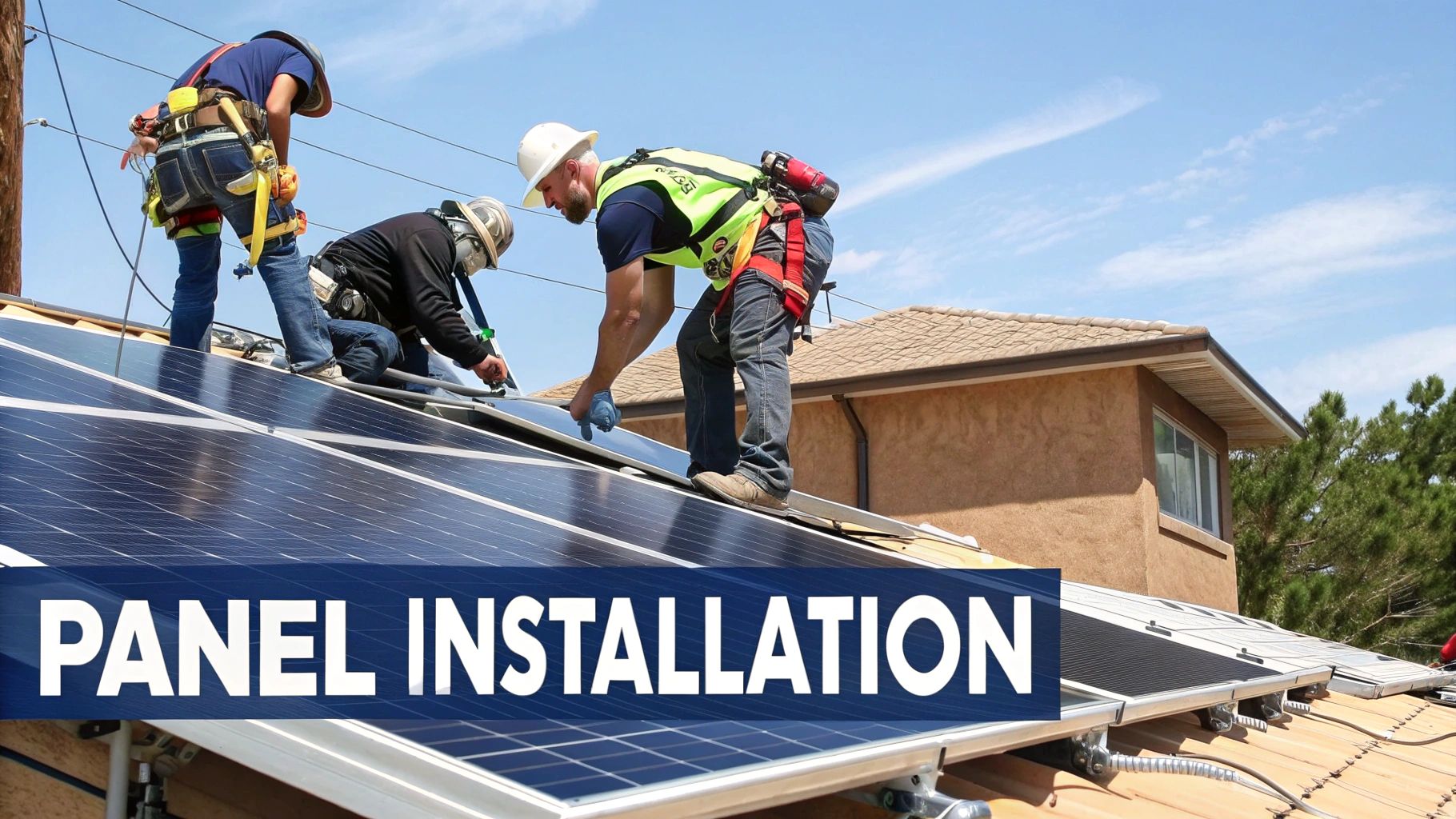
Once the plans are approved and the paperwork is signed, your project moves from the drawing board to your rooftop. This is where all the planning comes to life, but it’s also where things can get disruptive if you’re not careful. A well-managed commercial solar panel installation should barely cause a ripple in your daily operations. The aim is to get your new power station built without interrupting the work happening below.
Keeping Your Business Running Smoothly
Your installer’s project manager will be your main point of contact, and it’s their job to work with you on a schedule that makes sense. We once advised a logistics warehouse where their biggest concern was HGV traffic. The solution was simple but effective: all crane lifts for the panels were scheduled for a Sunday, completely avoiding any conflict with their weekday operations. This kind of forward-thinking is a clear sign you’re working with an experienced crew.
Consistent communication is your most powerful tool. A quick, daily check-in with the site foreman can prevent small issues from turning into major disruptions. Whether it’s a temporarily blocked access route or concerns about noise, these brief chats keep everyone on the same page and your business moving.
On-Site Quality and Safety Standards
You can learn a lot about the quality of the work just by taking a walk around the site. Look at the details. Are electrical cables managed neatly inside containment trays, or are they messy and exposed? Are the mounting brackets for the panels perfectly aligned and securely fastened? These details show a team that takes pride in their work, which usually translates to a system built to last.
Site safety is a shared responsibility. The installation team should have its own clear safety protocols, which means you should see proper use of harnesses and clearly marked work zones. This is also a good moment to review your own safety procedures. It’s vital to ensure the installation work doesn’t block critical routes for your own staff, so checking some guidance on Fire Exit Safety Compliance is a smart move.
From Final Fix to Full Commissioning
After the last panel is locked into place, the project moves into its final, crucial stage: commissioning. This isn’t just a matter of flipping a switch. It’s a detailed process where engineers run a series of meticulous tests on every part of the system. They check every connection, confirm voltages are correct, and ensure the inverters are communicating properly with the grid. This is your guarantee that the system is safe and ready to perform as expected.
This testing process ends with a final inspection and connection approval from your Distribution Network Operator (DNO). Once they give the green light, you should receive a complete handover pack. This folder is essentially the owner’s manual for your new solar array and should include:
- All equipment warranties from the manufacturers
- The final electrical schematics and system diagrams
- A recommended schedule for future maintenance
- Performance test certificates confirming the system’s output
The project isn’t truly complete until you have this documentation in your hands. It’s the final piece of the puzzle and your assurance of a job well done.
Maximising Your Solar Investment: Long-Term Success Strategies
So, the panels are on the roof, the system is live, and the installation team has packed up. While that feels like the finish line, it’s actually the starting point for maximising your investment. The real financial worth of your commercial solar panel installation isn’t realised on day one; it’s built up over decades of smart energy management. You’re shifting from managing a project to managing an asset.
Proactive Monitoring and Maintenance
That monitoring software you received isn’t just a set of fancy graphs; it’s the live pulse of your new power plant. Get a designated person on your team into the habit of checking it weekly. The goal is to get a feel for your system’s rhythm and establish a baseline of normal energy generation for different times of the year. Once you know what “good” looks like, problems become obvious.
A sudden, unexplained 10% dip in output might seem minor, but it could signal a single faulty panel or just a thick layer of grime. Left unchecked for months, that small dip can quietly eat away at your projected savings. A straightforward maintenance plan is your best defense against this.
- Quick Visual Checks: Once a month, take a look at the panels from the ground. You’re just looking for any obvious debris, like leaves or bird droppings, or any visible damage.
- Professional Cleaning: Depending on how dusty or polluted your area is, scheduling a professional clean every one to two years is a smart move to keep efficiency high.
- Annual Professional Inspection: A yearly check-up by a professional ensures all the wiring is sound, connections are tight, and the inverters are functioning correctly.
Optimising Your Energy Consumption
Generating your own power is fantastic, but using it effectively is where the real savings happen. The aim is to maximise self-consumption—using the solar electricity your panels are producing in real-time. This means aligning your high-energy tasks with peak sunshine hours.
For instance, we worked with a warehouse that used to charge its electric forklift fleet overnight, paying peak prices for grid electricity. We helped them shift the charging schedule to midday. This simple operational tweak meant they were now powering their fleet with free solar energy, dramatically cutting operational costs without any new investment. This also makes your revenue from the Smart Export Guarantee (SEG) more efficient, as you’re only exporting what is truly surplus power.
Planning for the Long Haul
Your solar array is a long-term asset, and it pays to think ahead. Don’t just file away the paperwork for your performance guarantees and equipment warranties. Take the time to understand what’s covered, for how long, and what the claims process looks like. This isn’t just bureaucracy; it’s the instruction manual for protecting your investment.
It’s also a good idea to train your facilities team on the system’s basics. They don’t need to become solar engineers, but they should know how to read the monitoring portal and who to call if something looks off. This internal ownership is incredibly valuable. Think about the future, too. Will your business need to expand the system in five years? Is battery storage something you might consider later? Planning for these possibilities now ensures your solar asset can evolve with your business.
Ready to build a long-term energy strategy that delivers real value? The experts at Luths Services can guide you. Contact us today to start planning.