
Think of a condition report survey as a complete, impartial MOT for a building. It’s an in-depth inspection that captures the exact state of a property at a single point in time, documenting everything from tiny cosmetic scuffs to more worrying structural faults. This report becomes the definitive baseline for property deals, tenancies, and planning future maintenance.
The Definitive Guide to a Condition Report Survey

Imagine you could take a high-resolution, 360-degree photograph of a property. It would capture all the good bits—the fresh paint, the gleaming floors—but it would also catch the little scuff mark on the skirting board or that tiny crack in a windowpane. A condition report works just like that, only it’s a full album packed with detailed notes, not just a single picture. It creates an undisputed record of the property’s condition on a specific day.
But this document is much more than a simple snagging list. It’s an objective, factual account that sets a clear, agreed-upon starting point. For anyone with a stake in the building, having this reliable snapshot is absolutely essential.
Who Needs a Condition Survey Report?
The uses for a detailed condition survey are wide-ranging, but they are most critical for people and businesses carrying significant financial and legal weight. Seeing its role clearly is the first step to heading off expensive disputes down the line.
Here’s who relies on them the most:
- Landlords and Tenants: Before a tenancy starts, a survey locks in the property’s condition. When the lease ends, it provides the hard evidence needed to fairly judge any damage that goes beyond normal wear and tear. It’s what protects a tenant’s deposit and a landlord’s investment.
- Property Buyers and Sellers: For a buyer, this report can uncover potential deal-breakers or issues that might influence their offer. For sellers, it offers complete transparency and can help justify the asking price by proving the property has been well-maintained.
- Construction and Development Firms: Before breaking ground on a project next to existing buildings, a survey of the neighbouring properties is a must. It documents their current state and protects the firm from any false claims of damage caused by vibrations, excavation, or other construction work.
- Facility and Property Managers: If you’re managing a portfolio of properties—be it commercial, industrial, or residential—regular condition surveys are the bedrock of proactive maintenance. They help you budget accurately for repairs and ensure your buildings stay safe and compliant with UK regulations.
Think of a condition report survey as a kind of insurance policy against arguments. It replaces foggy memories and personal opinions with cold, hard, documented facts. This builds a foundation of trust and accountability for everyone involved.
At the end of the day, this survey is all about protection. It stops potential “he said, she said” disagreements dead in their tracks and turns them into straightforward, evidence-based discussions. By creating this impartial record, you’re not just looking at a building; you’re managing risk, protecting assets, and making sure everyone gets a fair deal from the very beginning.
The True Value of a Property Condition Report
Looking at a condition report survey might feel like just another line item on a long list of expenses. I get it. But its real worth isn’t in what it is, but in what it prevents. Think of it less as a cost and more as a strategic investment—one that pays serious dividends in financial, legal, and operational peace of mind. This document is so much more than a simple checklist; it’s a powerful tool for managing risk, planning your budget, and ensuring everyone’s on the same page from day one.
At its core, the report serves as an impartial, factual baseline. For landlords and tenants, this is gold. It shifts potential arguments over security deposits from a messy “he said, she said” scenario into a straightforward, evidence-based conversation. By meticulously documenting the state of every room, fixture, and fitting before a tenancy kicks off, the report protects both parties. Tenants don’t get stung with unfair deductions for pre-existing wear and tear, and landlords can confidently claim for any damage that actually happened on their watch.
Securing Legal and Financial Peace of Mind
The report is your legal shield. In the UK, deposit protection schemes don’t operate on guesswork; they need clear evidence to sort out disputes. Without an independent inventory and condition report, landlords often find it an uphill battle to justify their claims. In fact, studies show that when a report is missing, disputes are far more likely to be settled in the tenant’s favour.
This legal protection is absolutely crucial. It’s the difference between a smooth, professional end-of-tenancy process and a drawn-out, costly conflict. Having a detailed, professionally compiled report means any deductions from a security deposit are based on tangible changes to the property’s condition, not on hazy memories or personal opinions.
A Foundation for Proactive Maintenance
Beyond its legal muscle, a condition report survey is an indispensable tool for smart property management. It gives you a detailed snapshot of maintenance needs, allowing you to shift from a reactive, firefighting mode to a proactive, strategic one. Catching small issues early is the name of the game.
For instance, a minor leak noted in a report can be sorted for a small sum. Left to its own devices, that same leak could spiral into a major damp problem, landing you with a bill for thousands in structural repairs, redecoration, and mould remediation. The survey highlights these ticking time bombs before they have a chance to go off.
A detailed condition report empowers you to forecast and budget for future maintenance with accuracy. It turns property management from guesswork into a data-driven strategy, extending the building’s lifespan and preserving its value.
This information is the bedrock of a solid long-term maintenance schedule and budget. When you understand the current condition of key elements—like the roof, windows, and boiler—you can plan for capital expenditures instead of being blindsided by sudden failures. It’s estimated that proactive maintenance, guided by condition reports, can slash overall repair costs by up to 30% over a property’s lifetime.
Ensuring Compliance and Accurate Valuations
Finally, the report is a cornerstone of regulatory compliance. For landlords and social housing providers in the UK, it offers documented proof that a property meets required living standards, like the Housing Health and Safety Rating System (HHSRS). This paperwork is vital during inspections and for demonstrating that you’ve done your due diligence.
The survey also has a say in property valuation. A well-documented history of good maintenance can positively influence a property’s market value. On the flip side, a report that details significant defects gives potential buyers or investors the hard data they need to make an informed offer. It adds a layer of transparency that ultimately benefits everyone involved in a transaction.
How the Condition Survey Process Works
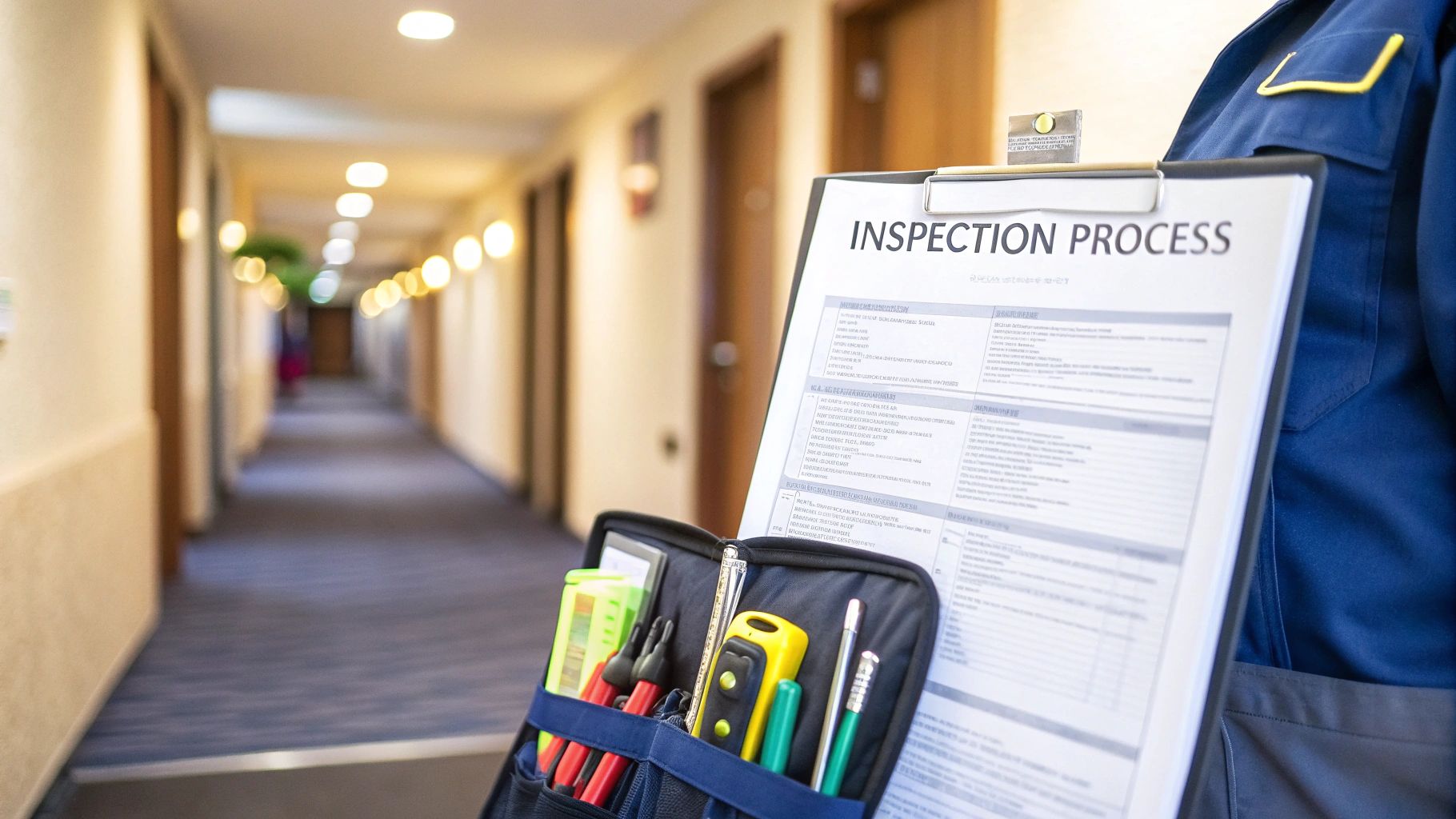
A proper condition report survey isn’t just a quick look-around. It’s a methodical process, almost like a detective investigation, where every clue is carefully pieced together to build a complete picture of a property’s state.
Understanding how it all works, from the first phone call to getting the final report in your hands, takes the mystery out of it. We can break the whole thing down into three clear phases. Each one builds on the last, giving you a final document that’s both exhaustive and easy to act on.
Phase One: The Pre-Inspection Stage
Long before a surveyor steps onto the property, a lot of important work has already been done. This first phase is all about preparation and planning, setting the stage for an efficient and focused inspection. Think of it as the mission briefing.
It all starts by defining the scope. You’ll have a detailed chat with the surveyor about exactly what you need the report for. Is it for a new tenancy, a pre-purchase check, or to monitor a building next to a construction site? This conversation is key because it determines the depth and focus of the survey.
Next, the surveyor will ask for any relevant paperwork you have, which could include:
- Old condition reports to see how things have changed.
- Building plans or blueprints.
- Records of any recent repairs or upgrades.
- Legal documents about property lines or access rights.
Getting all this information upfront means the surveyor arrives on-site fully prepared. They’ll already know about past issues or specific areas that need a closer look. For bigger jobs, especially with local councils, knowing the specific guidelines is also vital, something any professional providing building assessment reports for https://luths-services.com/angus-council/ would be familiar with.
Phase Two: The On-Site Inspection
This is where the real hands-on work begins. The on-site inspection is a meticulous, systematic assessment of the property’s physical condition. The surveyor will comb through every accessible part of the building, leaving no stone unturned.
During this stage, the surveyor is an impartial observer. They’ll examine everything from structural elements like walls and roofs to the finer details of the building fabric, such as windows and doors. They’ll also check mechanical systems—plumbing, electrics—and look at external areas like gardens and boundaries.
A core principle here is objectivity. The surveyor isn’t there to point fingers or assign blame. Their job is to record the facts as they see them, backing up every observation with clear photographic evidence to create an undeniable visual record.
Surveyors come equipped with a range of tools for this. A high-resolution camera is a must for capturing detail, while a moisture meter can uncover hidden damp problems you’d never see with the naked eye. Spirit levels and measuring tapes help spot any structural quirks. Every single finding is logged, creating the raw data that will become the final report. A detailed commercial property inspection checklist can provide a solid framework for ensuring nothing gets missed.
Phase Three: The Post-Inspection Report
With the on-site inspection complete, the final phase kicks off. This is where all the clues—the notes, measurements, and often hundreds of photos—are brought together into a clear, structured, and legally robust document. Raw data gets turned into actionable insight.
The surveyor organises the findings, usually room by room or element by element. Every observation is described in plain language, avoiding jargon, and is cross-referenced with the photos. This creates a powerful, easy-to-follow story of the property’s condition at that specific moment in time.
The final condition report survey is then compiled and delivered to you. A good report will be logically laid out, often using a simple “traffic light” system to highlight the severity of any issues. This allows you to instantly see what needs urgent attention and what’s just minor wear and tear. The result is a clear, impartial document that stands as your definitive record.
Decoding Your Condition Survey Report
Getting your completed condition report survey can feel like someone’s just handed you a complex technical manual for your own property. It’s often dense with jargon, detailed observations, and a rating system that isn’t always self-explanatory. But this document is designed to give you clarity, not confusion.
The trick is learning how to read it. A well-structured report breaks the property down into logical, bite-sized sections. It lets you see the big picture without losing sight of the crucial details. Think of this section as your guide to navigating that report, turning a surveyor’s findings into your clear, confident action plan.
Understanding the Core Components
A condition survey report is essentially a health check for your building, with each chapter focusing on a different part of its anatomy. While the exact layout might differ between firms, you’ll almost always find these core areas covered to give you a complete picture.
The main sections typically include:
- Structural Integrity: This is all about the building’s skeleton—the foundations, walls, and roof structure that hold everything up.
- Building Fabric: This covers the property’s ‘skin’, the elements that protect it from the outside world. Think windows, doors, external cladding, and the roof covering itself.
- Mechanical and Electrical Systems: Here, the report dives into the services that make the building usable, like the plumbing, heating, ventilation (HVAC), and all the electrical wiring.
- Health and Safety: This section flags potential hazards, from fire safety compliance and asbestos to simple trip hazards that could cause problems down the line.
- External Areas: The inspection doesn’t stop at the walls. It also covers gardens, pathways, boundary walls, and drainage systems outside the building.
Each part of the report is meticulously detailed, with surveyors noting both what’s right and what’s wrong.
From Minor Defects to Significant Issues
As you go through the report, you’ll notice that not all problems are created equal. Issues are categorised by their severity, which helps you figure out what to tackle first. For example, a single cracked roof tile might be flagged as a ‘minor defect’. It’s something that needs a simple, low-cost fix, but it’s not a five-alarm fire.
On the other hand, finding evidence of significant damp in a load-bearing wall is a major red flag. This kind of ‘significant issue’ points to a much deeper problem that could threaten the building’s stability if ignored. Knowing the difference is absolutely critical for prioritising your repairs and your budget.
Damp, for instance, is a classic example of an issue that needs early attention. It’s not just about a bit of peeling paint; it can lead to serious mould growth and poor indoor air quality. If damp is a recurring theme in your report, a more focused investigation might be the next logical step. You can learn more about how a condensation risk assessment helps pinpoint and solve these complex moisture problems.
It’s crucial to remember the report isn’t just a catalogue of faults. It’s a risk management tool. It helps you separate routine maintenance from urgent repairs that protect your asset’s value and keep occupants safe.
To make this even easier, most surveyors use a very simple, visual system to highlight the urgency of each issue.
Interpreting the Traffic Light System
Many modern reports use a ‘traffic light’ system to quickly show you how urgent their findings are. This simple, colour-coded shorthand is incredibly helpful for getting a quick overview of the property’s health without getting lost in technical details.
While the exact wording can vary, it’s a simple system that’s easy to get the hang of.
Understanding the Condition Rating System
Here’s a quick guide to the common ‘traffic light’ system surveyors use to highlight the urgency of issues found in a property.
| Condition Rating (Color) | What It Means | Typical Example |
|---|---|---|
| Green (Condition Rating 1) | No repair is currently needed. The element is in good shape and just needs normal, routine maintenance. | A recently installed, fully functional boiler. |
| Amber (Condition Rating 2) | Defects that need repairing or replacing, but they aren’t considered urgent or serious right now. | A dripping tap, stiff window hinges, or peeling paintwork on non-essential surfaces. |
| Red (Condition Rating 3) | Defects that are serious and need to be repaired, replaced, or investigated urgently. | Evidence of active structural movement (large cracks), a leaking roof, or faulty electrical wiring. |
This rating system lets you scan the report and immediately pick out the red-rated problems that need your immediate attention. From there, you can address the amber items as part of a medium-term maintenance plan, knowing that the green elements are all in good working order.
It’s a straightforward approach that transforms a potentially dense document into a practical, actionable roadmap for your property’s future.
How National Surveys Shaped Modern Reports
The detailed, evidence-based condition report survey we know today didn’t just spring into existence. It’s the result of decades of refinement, with its origins in huge national projects aimed at understanding and improving the UK’s housing stock. These pioneering efforts literally wrote the book on modern property assessment.
Think of it like this: before a doctor can diagnose a patient, they need a vast body of medical research to draw on. In the same way, today’s surveyors rely on standards and methods that were hammered out through massive national surveys. These studies were the first to prove the value of systematically tracking property conditions on a grand scale.
This wasn’t just about collecting data for dusty reports. It was used to shape public policy, raise living standards, and create safer, healthier homes across the country. The rigorous, data-first approach they perfected has since become the gold standard in the private sector.
The Influence of the English Housing Survey
The English Housing Survey (EHS) is a perfect example. First launched way back in 1967, this wasn’t just a simple checkbox exercise. It was a massive undertaking, combining physical inspections with detailed interviews to build a true picture of the nation’s homes.
For decades, the EHS has meticulously tracked everything from structural problems to energy efficiency. For instance, by 2015-16, the survey showed that owner-occupiers made up 63% of households, with social and private renters at 17% and 20% respectively. You can dive into the full history and findings in the EHS 50th Anniversary Report.
The techniques developed for the EHS—like standardised inspection criteria and objective data collection—set a new benchmark. They demonstrated that a systematic approach was the only way to get reliable, comparable results. That principle is now the bedrock of every professional condition report survey.
From Public Policy to Private Practice
You can see the legacy of these national surveys in every report commissioned by homeowners and businesses today. The emphasis on impartiality, detailed evidence, and a consistent methodology is a direct inheritance from those early public studies. They created a culture of thoroughness that is now simply expected in the industry.
This structured approach is what gives a modern condition report survey its power. When a surveyor inspects your property, they’re not just winging it; they are following a process refined over more than half a century.
The rigorous, evidence-based principles pioneered by national housing surveys transformed property assessment from a subjective opinion into a disciplined, data-driven science. This foundation ensures that today’s reports are credible, reliable, and legally robust.
What this evolution means for you is that any report you receive is built on a solid foundation of proven methods. The way surveyors classify defects, back up findings with photos, and present information in a clear, structured way can all be traced back to the demands of those national-level projects.
Understanding this history is key, as it highlights the real value of a professional survey. You’re not just paying for one person’s opinion. You’re getting the benefit of a systematic process, tested and improved over decades. These robust principles are also at the heart of more specialised assessments, which you can read about in our guide to building assessment reports BAR. Ultimately, this rich history gives today’s reports the credibility to stand up to scrutiny in any situation.
How Surveying Is Adapting to New Challenges

The world of property surveying is anything but static. It’s a field that’s constantly evolving to meet new demands and navigate fresh hurdles. The ability to adapt is everything, whether that means responding to global disruptions or embracing new technology that makes the job safer and more efficient.
It’s this resilience that ensures the condition report survey remains a truly vital and reliable tool for property professionals today.
A perfect example of this in action was during the COVID-19 pandemic. Widespread restrictions made traditional, in-person property inspections incredibly tricky, forcing the industry to get creative and find new ways to gather essential data.
Shifting Methods During Global Events
The English Housing Survey for 2021-22 tells the story well. Face-to-face interviews were swapped for telephone calls, and full internal inspections were pared back to external-only assessments. This was then bolstered with information gathered at the doorstep and the use of predictive models to fill in the gaps on certain internal conditions.
This response didn’t just keep things moving; it showed the industry’s capacity for continuity even when faced with huge, unprecedented challenges. The whole period fast-tracked the adoption of remote assessment techniques, proving that valuable insights could still be gathered without ever setting foot inside a property.
The Growing Role of Technology
But it’s not just about reacting to crises. Technology is actively reshaping how a condition report survey gets done, making the whole process safer, faster, and more thorough than ever before. New tools aren’t just novelties anymore; they’re becoming standard practice.
Here are a few of the key game-changers:
- Drones for High-Level Inspections: Not so long ago, inspecting a steep or fragile roof was a high-risk job that demanded scaffolding and specialist gear. Now, drones with high-resolution cameras can capture incredibly detailed images and videos from a safe distance, spotting issues like cracked tiles or damaged flashing without anyone leaving the ground.
- Advanced Reporting Software: The days of painstakingly writing up reports by hand and trying to match them with a separate camera roll of photos are long gone. Modern software lets surveyors capture data, embed images, and generate comprehensive reports right there on a tablet. This massively speeds up the post-inspection work and keeps everything consistent.
Technology isn’t replacing the surveyor’s expertise; it’s amplifying it. These tools provide better data, slash risks, and free up professionals to focus on the analysis and interpretation—the stuff that delivers real value to their clients.
If you’re keen to see how tech is enhancing traditional methods, it’s worth exploring modern drone surveying and mapping techniques. These changes highlight a profession that’s forward-looking, resilient, and always pushing to improve.
Got Questions About Condition Reports?
Even after getting the basics down, a few practical questions always seem to pop up when it comes to condition reports. Let’s tackle some of the most common ones head-on. Think of this as the final debrief after the main tour, giving you the last few details you need to move forward with confidence.
Getting this right from the start is crucial. It ensures you pick the right survey for your needs and understand exactly where it fits within the bigger picture of property management and UK tenancy law.
Condition Report vs. HomeBuyer Report: What’s the Difference?
This is easily one of the most common points of confusion, especially for property buyers. While they’re both surveys, they have very different jobs and go into different levels of detail.
Think of it this way: a Condition Report is like a basic health check-up, whereas a HomeBuyer Report is more like a full diagnostic appointment with the specialist.
Here’s a simple breakdown:
RICS Level 1 Condition Report: This is your entry-level survey. It uses a straightforward ‘traffic light’ system to flag the condition of different parts of the property and highlight any major risks. Crucially, it does not give you advice on repairs or a property valuation. It’s best suited for new-builds or modern homes that are in obviously good shape.
RICS Level 2 HomeBuyer Report: This is a much deeper dive. It includes everything from the Condition Report but adds two key things: a market valuation and advice on defects that could impact the property’s value. This is the go-to choice for most people buying a standard property in a reasonable state.
In short, the Condition Report tells you what the condition is. The HomeBuyer Report tells you what the condition is and what it means for your wallet.
How Long Does a Condition Report Survey Take?
The whole process really breaks down into two parts: the visit itself and writing up the findings.
The on-site inspection for an average-sized property is surprisingly quick, usually taking just 1-2 hours. During this time, the surveyor is methodically working through every part of the building, taking detailed notes and snapping hundreds of photos.
The second part, putting the report together, takes a bit longer. The surveyor needs to organise all those notes and photos into a clear, comprehensive document that makes sense to you. You can typically expect the final report to land in your inbox within 3-5 business days after the inspection.
Are Condition Reports Legally Required for UK Landlords?
Here’s the thing: while a condition report (which is often part of a detailed inventory) isn’t a blanket legal requirement for every single tenancy in the UK, it’s considered an absolute necessity in practice. Without one, you’re on shaky ground with deposit protection.
A landlord’s ability to make legitimate deductions from a tenant’s deposit is severely weakened without a comprehensive, impartial condition report from the start of the tenancy. Deposit protection schemes simply won’t rule in your favour without clear evidence.
The report acts as the official baseline. It’s the proof of the property’s condition before the tenant moved in. If a dispute pops up at the end of the tenancy over damage, this document is the impartial evidence that separates pre-existing issues from fair wear and tear or actual tenant-caused damage. For a landlord, it’s probably the single most important piece of paper for protecting their asset.
At Luths Services, we believe that a thorough understanding of a building’s condition is the first step towards creating efficient, sustainable, and well-maintained properties. Our expertise in building assessments provides the data-driven insights you need to manage your assets effectively. Discover how our consultancy can support your property goals at https://www.luths-services.com.


