
Before you pour a single bit of concrete or invest a hefty sum into a new project, how can you be sure it’s actually set up to succeed? That’s the core question a feasibility study answers. It’s a deep dive to figure out if a proposed project is practical, viable, and worth pursuing before you commit serious time and money.
What Is a Feasibility Study, Anyway?
Think of a feasibility study as a full dress rehearsal for your project. It’s a structured process designed to properly explore a project’s potential, uncovering both its strengths and its weaknesses before you even think about breaking ground.
A simple analogy helps here: building a house. You wouldn’t just start pouring the foundation without first checking the soil, securing the right permits, and making absolutely sure your budget is realistic. A feasibility study does exactly that for your sustainable building project, giving you a solid, reliable blueprint before the work begins.
This initial investigation is a critical step in both the private and public sectors. In the UK, for instance, it’s a standard part of assessing major government projects. Back in 2023, a feasibility assessment was commissioned for two major funding programmes to determine their viability and potential impacts before full investment was released. You can see a summary of this government assessment of major funding programmes on the GOV.UK site.
Ultimately, a feasibility study is all about answering that fundamental question of project viability, much like the process of proving business viability through financial reports. It forces you to address several non-negotiable questions head-on:
- Is there a genuine market need for what we’re planning?
- Do we have the technical resources and in-house expertise to pull this off?
- Will the project deliver a worthwhile return on investment?
- Can we operate it effectively and sustainably once it’s complete?
Answering these questions honestly is the first step. It sets the stage for a much deeper look into the study’s different components and makes it clear why this is a non-negotiable step for any serious venture.
The Four Pillars of Feasibility Analysis
A proper feasibility study isn’t just a single tick-box exercise; it’s a deep dive into your project’s potential from several angles. To really get it right, we need to break the process down into four distinct pillars. Each one answers a critical question that, when you put them all together, gives you a complete picture of whether your project is actually viable.
Think of it like inspecting a classic car before you buy it. You’d check the engine (Technical), figure out the running costs against its value (Financial), make sure it has a valid MOT (Legal), and confirm you have a garage and the skills to maintain it (Operational). Skip any one of those, and you could be looking at a very expensive mistake.
Technical and Financial Viability
First up, a study has to determine technical feasibility. This pillar asks a very basic question: can we actually build this thing? It looks at the resources, technology, materials, and expertise needed to get the project over the line. For a sustainable building, this might involve checking if new eco-friendly materials are structurally sound, or if your team has the skills to install a complex geothermal heating system.
Next is financial feasibility, which answers the all-important question: will this project be profitable or offer good value for money? This goes way beyond just the initial costs and involves a detailed look at:
- The initial capital needed and all setup costs.
- Projected running costs over the project’s entire lifespan.
- Expected return on investment (ROI) and how long it’ll take to pay back.
- Potential funding sources and cash flow forecasts.
This analysis is absolutely crucial for justifying the higher upfront costs of green technology by proving you’ll make significant long-term energy savings down the line.
Legal and Operational Checks
The third pillar is legal feasibility. This is where you confirm your project sticks to all the relevant laws, regulations, and standards. It asks: are we legally allowed to do this? This covers everything from local zoning laws and building codes to environmental regulations. Missing a key permit can stop a project in its tracks.
Finally, operational feasibility looks at whether the project can be run effectively day-to-day once it’s finished.
It gets into the practical, on-the-ground realities of your project. The best-laid plans are useless if the organisation can’t sustain them once they go live.
This means assessing if your current company structure can support the new venture, if you have the right people for the job, and if the proposed workflows are actually efficient. It’s what ensures your project doesn’t just launch successfully but actually thrives for years to come.
To pull these concepts together, here’s a quick summary of how each pillar applies to a sustainable building project.
Comparing the Four Types of Feasibility Analysis
| Type of Feasibility | Core Question It Answers | Example in Sustainable Building |
|---|---|---|
| Technical | Can we physically and technologically build it? | Assessing if a Passivhaus design can be achieved with locally sourced materials and the available construction skills. |
| Financial | Does it make financial sense and will it provide a return? | Calculating the ROI of installing a solar PV array, factoring in energy savings and potential feed-in tariffs. |
| Legal | Are we compliant with all laws and regulations? | Verifying that the building’s design meets BREEAM certification requirements and local planning permissions. |
| Operational | Can our organisation run and maintain it effectively long-term? | Ensuring the facilities management team is trained to operate and service the building’s advanced heat recovery system. |
By examining a project through these four lenses, you get a holistic view that moves beyond just a simple ‘yes’ or ‘no’. It gives you the confidence to move forward, the insight to make necessary adjustments, or the wisdom to know when it’s time to head back to the drawing board.
Building Your Feasibility Study From the Ground Up
So, you have a promising idea. The next step is to move from theory to action, and that means building a robust feasibility study. Think of it as creating a detailed blueprint before you start laying foundations. It’s a systematic process of gathering data and asking tough questions to turn that initial spark into a solid, data-backed plan.
This whole process gives you a clear roadmap, making sure no critical detail gets missed before you commit serious time and money.
The journey always starts with defining your project’s scope and objectives. What exactly are you trying to achieve? What does a successful outcome actually look like? Once you’ve pinned that down, it’s time to dive into market research to see if there’s genuine demand. Understanding the market is absolutely vital; at the start of 2025, the UK was home to around 5.7 million private sector businesses, yet sectors like construction have seen a noticeable dip since 2020. This kind of data immediately tells you where to focus your analysis on a project’s viability.
Key Components for Your Study
After you’ve got a handle on the market, the next steps are all about the technical and financial details. This is where you get down to the brass tacks and answer the really practical questions.
- Technical Needs Analysis: Do we have the right technology, materials, and expertise to pull this off? It’s a bit like conducting an initial technical review during a comprehensive building condition survey.
- Financial Forecasting: This is where you crunch the numbers – detailed cost estimates, revenue projections, and what the potential return on investment might be.
- Risk Assessment: What could possibly go wrong? Here, you’ll plan for potential bumps in the road, like supply chain hiccups for green materials or navigating the ever-changing landscape of environmental laws.
This infographic neatly sums up the interconnected pillars that form the foundation of any solid feasibility assessment.
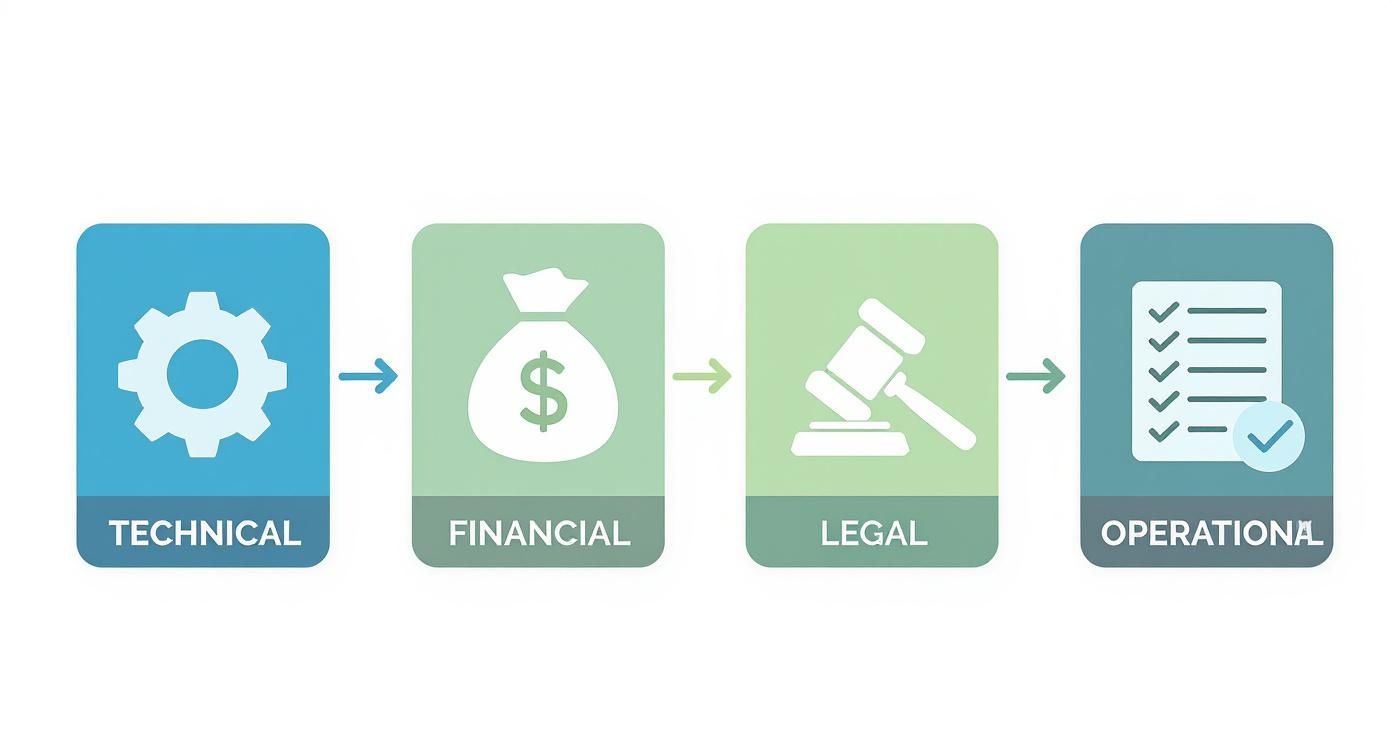
As you can see, a project needs to stand firmly on all four legs—technical, financial, legal, and operational—to be truly viable. When you’re putting together your study, especially for a real estate venture, a good commercial property due diligence checklist can be an invaluable tool. Looking at all these elements together ensures your study isn’t just a document, but a powerful guide for your most critical decisions.
Why a Feasibility Study Is Your Best Investment
Spending time and money on a study before a single shovel hits the ground might feel like a delay. In reality, it’s one of the smartest investments you can make. A feasibility study is far more than a simple ‘go’ or ‘no-go’ signal; it transforms your assumptions into a solid, data-backed business case.
This initial analysis forces you to get specific, defining clear and measurable goals right from the start. It sharpens the entire project’s focus. You’ll also uncover hidden opportunities and potential pitfalls that are easy to miss otherwise—things like a niche market you hadn’t considered or an unexpected regulatory hurdle. It’s the difference between planning based on guesswork and planning based on strategy.
Justifying Costs and Securing Funding
For sustainable projects, the value of a feasibility study is even clearer. These ventures often involve higher initial costs—think of installing a geothermal heating system, for example. A detailed study gives you the hard evidence needed to justify these expenses by proving the significant long-term savings on running costs and the clear environmental benefits.
A well-researched feasibility study is often the key that unlocks funding. It provides investors and lenders with the confidence that your project is not just a good idea, but a viable, thoroughly vetted investment.
This evidence-based approach is exactly what stakeholders want to see. They need a clear return on their investment, and that’s what a feasibility study delivers. It can even point you towards funding sources you hadn’t thought of. In fact, exploring options like energy efficiency grants for businesses is a crucial part of the process and can make a sustainable project even more compelling.
Ultimately, this preliminary work turns your proposal into an undeniable business case. It demonstrates that your project is well-planned, financially sound, and locked into your long-term goals, making it an investment that pays for itself by preventing expensive mistakes down the line.
Feasibility Studies in Action Across the UK

The best way to get your head around the value of a feasibility study is to see how they work in the real world. Across the UK, these assessments are the quiet foundation for everything from huge infrastructure projects to forward-thinking local housing policies. They’re the bridge between a bold idea and a successful reality.
Think of them as a developer’s or policymaker’s vital reality check before committing serious money—public or private—to a project. A good study flags up the big problems early on. It might highlight logistical headaches for a new railway line or point out that the local grid can’t handle a new renewable energy project.
Getting this analysis done upfront is what keeps large-scale projects on track and on budget, preventing those all-too-common costly overruns. It’s the critical link between solid planning and a successful outcome.
Informing National and Local Strategy
Feasibility studies don’t just give a thumbs-up or thumbs-down to individual projects; they help shape wider UK policy. The 2025 UK Growth Survey, for example, pinpointed housing and infrastructure as key national priorities. The evidence gathered from countless feasibility studies directly feeds into legislation, helping to unblock the complex planning process for these vital sectors. You can read the full growth survey findings to see how these big-picture decisions are made.
But these principles are just as crucial on a local level. Let’s say a community wants to set up its own energy project.
By running a proper feasibility assessment, that community can figure out the best renewable technology for their exact spot, making sure the project is sustainable and actually benefits the residents financially for years to come.
This is exactly what we see with ground source heat pump installations. Our work on the GSHP Islay project demonstrates how an initial study provided the hard evidence of technical viability and financial payback needed to make a compelling case for investment. The same core principles that steer national infrastructure decisions are what will make your own project a success, no matter the scale.
So, How Do You Make Smarter Project Decisions?
When it comes down to it, a feasibility study is all about charting a clear course to success before you commit serious money and time. Think of it as your project’s most powerful tool for getting a handle on risk, putting funds where they’ll work hardest, and making decisions based on solid data, not just a hunch. It’s what turns a promising idea into a properly thought-out plan.
A thorough study is a proactive deep dive, testing your project’s viability on all the critical fronts: technical, financial, legal, and operational. It forces you to ask the tough questions early on, which is exactly how you avoid costly mistakes further down the line.
Make this assessment a non-negotiable first step. I can’t stress this enough. The initial investment in a proper feasibility study will pay for itself many times over by ensuring your project isn’t just ambitious, but actually achievable, profitable, and built to last. It’s the very foundation of a successful venture.
Frequently Asked Questions
When you’re looking into a feasibility study, a few common questions always seem to pop up. Getting straight answers is the best way to feel confident about the process and understand its real value from the get-go. Here’s a look at what project managers and developers often ask.
How Long Does a Feasibility Study Typically Take?
There’s no single answer here—it all comes down to the scale and complexity of your project. For something straightforward, like a small commercial retrofit, we might only need a few weeks. But for a major infrastructure project or a large-scale housing development, you’re looking at several months to do the job properly.
A few key things influence the timeline:
- Depth of Data Collection: The more market research and technical data we need to gather, the longer it will take.
- Stakeholder Involvement: Getting input from multiple parties—investors, community groups, planners—naturally extends the schedule.
- Level of Analysis: If your project involves new technologies or intricate financial modelling, that demands a much deeper, and more time-consuming, investigation.
Is a Feasibility Study the Same as a Business Plan?
No, but they work hand-in-hand. It’s an easy mistake to make, but they serve very different purposes, and knowing the difference is vital for smart project planning.
Think of it like this: a feasibility study is the investigative part. It asks, ‘Should we even do this project?’ Its whole purpose is to figure out if an idea is viable. A business plan comes after you get a green light, and it answers, ‘How, exactly, are we going to do this?’
The study is your critical inspection before you commit time and money. The business plan is the detailed operational blueprint you follow once you’ve decided to move forward.
Can a Project Move Forward After a Negative Study?
It’s not a definite ‘no’. A negative result doesn’t automatically kill a project. More often than not, the study shines a light on specific weaknesses that you can actually fix.
It might lead you to tweak the project’s scope, find alternative sustainable technologies, or rework the financial model to turn a high-risk idea into a genuinely viable one. In that sense, the study acts as a roadmap for improvement, not just a stop sign. It gives you the insights needed to pivot and come back with a much stronger proposal.
At Luths Services, we specialise in conducting the detailed feasibility studies that turn ambitious sustainable building concepts into practical, successful projects. Contact us today to discuss your project’s potential.


