
At its core, engineering design services are what turn a brilliant idea into a detailed, functional, and manufacturable blueprint. Think of them as the essential bridge that connects a conceptual vision to a tangible, real-world product or system.
What Exactly Are Engineering Design Services?
Let’s say you’ve got an idea for a high-performance electric bicycle. You know what you want it to do, but how do you figure out the best material for the frame? Or the ideal power output for the motor, or where to place the battery for perfect balance? This is precisely where engineering design services come into their own.
These services aren’t about guesswork; they apply solid scientific and mathematical principles to methodically solve very practical problems. It’s a structured process that goes far beyond simple aesthetics to guarantee the final product is safe, efficient, and cost-effective to produce.
The Blueprint for Innovation
You can think of it as the master plan for creation. An engineering design team digs into every single variable, from material strength and thermal dynamics to electrical loads and user ergonomics. This meticulous planning is the secret to avoiding incredibly costly mistakes down the line during production or construction.
The scope of these services is huge, covering everything from the initial feasibility studies right through to the final manufacturing schematics. But the core purpose never changes: to create a comprehensive and validated design package. This is what ensures that what gets built performs exactly as it was meant to.
The ultimate goal of engineering design is to create a solution that not only works but works well—balancing performance, cost, and safety to meet a specific need in the most effective way possible.
Core Components of the Service
At its heart, the service provides a detailed roadmap for everyone else—from manufacturers to builders—to follow. Key deliverables you’ll almost always see include:
- Conceptual Sketches: These are the early-stage visualisations used to explore different approaches and hammer out ideas.
- Detailed CAD Models: Precise 3D digital models of every component, which allow the team to run virtual assemblies and analysis.
- Technical Drawings: The formal blueprints containing exact dimensions, materials, and tolerances needed for manufacturing.
- Simulation and Analysis Reports: Hard data that proves the design can handle expected stresses and environmental conditions.
For a deeper dive into what these professional activities involve, it’s worth exploring dedicated engineering design services online. Ultimately, this foundational work is what separates a wildly successful project from a failed concept.
Digging Into the Core Engineering Disciplines
Engineering design isn’t one giant, catch-all field. It’s more like a collection of highly specialised disciplines. Think of it like a team of medical consultants—you wouldn’t ask a heart surgeon to set your broken arm. In the same way, getting your project right means bringing in the specific type of engineer with the exact expertise the job demands.
While these different branches of engineering often work together, each one has its own distinct focus. Knowing who does what is the first step in putting the right team on the field. Let’s break down the main specialisms you’ll likely come across.
Mechanical Engineering: The Engine of Motion
At its heart, mechanical engineering is all about things that move. It’s the driving force behind engines, power-generating kits like turbines, and the complex robotics you see on modern factory floors. Mechanical engineers use the principles of physics and materials science to design, build, and analyse mechanical systems.
Take a new HVAC system for a commercial building, for instance. A mechanical engineer is the one calculating airflow, heat transfer, and energy efficiency. Their work makes sure the system doesn’t just work, but that it works sustainably. This focus on long-term performance and community impact is now central to good practice; you can read more about combining ME engineering with sustainability in our detailed guide.
Civil and Structural Engineering: The Foundation of Our World
Though they’re closely linked, civil and structural engineering have different jobs when it comes to shaping the world around us. Civil engineering is the broader of the two, covering the design and construction of infrastructure, both public and private. We’re talking about everything from roads and railways to the water supply and sewage systems we all rely on.
Structural engineering is a specialised slice of civil engineering. Its focus is much tighter: guaranteeing the strength, stability, and integrity of structures. A structural engineer is the one who calculates all the loads and stresses on a building’s foundations or a bridge’s support columns, making sure they can handle everything from daily use to extreme weather.
Simply put, a civil engineer might design an entire railway network, but a structural engineer is responsible for making sure every single bridge along that route is safe and sound.
Electrical Engineering: The Power Behind Everything
Electrical engineering is the brains behind almost all modern technology. This discipline is all about the practical application of electricity, electronics, and electromagnetism. Electrical engineers design everything from the tiny microchips in your smartphone to the vast power grids that light up our cities.
They’re the ones who design the complex circuits controlling automated machinery, draw up efficient power distribution plans for new housing developments, and develop the electronic components that are fundamental to countless products. Without their expertise, the modern world would just grind to a halt. The value of their technical advice is huge, and the market reflects this. Consulting is the largest segment in the UK engineering services market, with these services making up 21.45% of total revenue. It just goes to show how critical that expert input really is. You can find more insights on the UK market at grandviewresearch.com.
The Design Journey From Concept to Reality
How does a rough sketch on a napkin become a fully functional, finished product? The journey is a structured, multi-stage process where engineering design services turn that initial spark of an idea into a detailed, buildable reality. It’s a path that ensures nothing is left to chance, managing risks and fine-tuning the final outcome every step of the way.
Each phase builds on the one before it, moving from broad ideas to incredibly specific instructions. Think of it as a logical progression that catches costly errors early, solving problems on paper and screen long before anyone touches a physical piece of material.
Let’s walk through the typical stages of this design journey.
Stage 1: Concept and Feasibility
This is where it all begins, where engineers put on their detective hats. They take the core concept and investigate its viability from every possible angle. The main question is simple: can we actually do this within the technical and financial limits we have?
Engineers will run preliminary analyses, explore different materials, and sniff out potential challenges. A massive part of this is the feasibility study, a deep dive that properly assesses the project’s practicality and chances of success. To get a better sense of what this involves, you can learn more about the key elements of a feasibility study definition in our other guides. The result of this stage is a clear go or no-go decision, backed up by solid preliminary data.
Stage 2: Detailed Design and Modelling
Once a concept gets the green light, the team moves into the detailed design phase. This is where the idea really starts to take shape in a tangible, if digital, form. Using specialised software like Computer-Aided Design (CAD), engineers create precise and intricate 3D models of every single component.
You can think of this as building a virtual prototype. Every bolt, circuit, and structural beam is digitally created with exact dimensions and material properties. This digital model becomes the single source of truth for the entire project, allowing everyone involved to see the design and understand how all the different parts will fit and work together.
The image below shows the typical flow from that initial idea to the creation of detailed plans ready for manufacturing or construction.
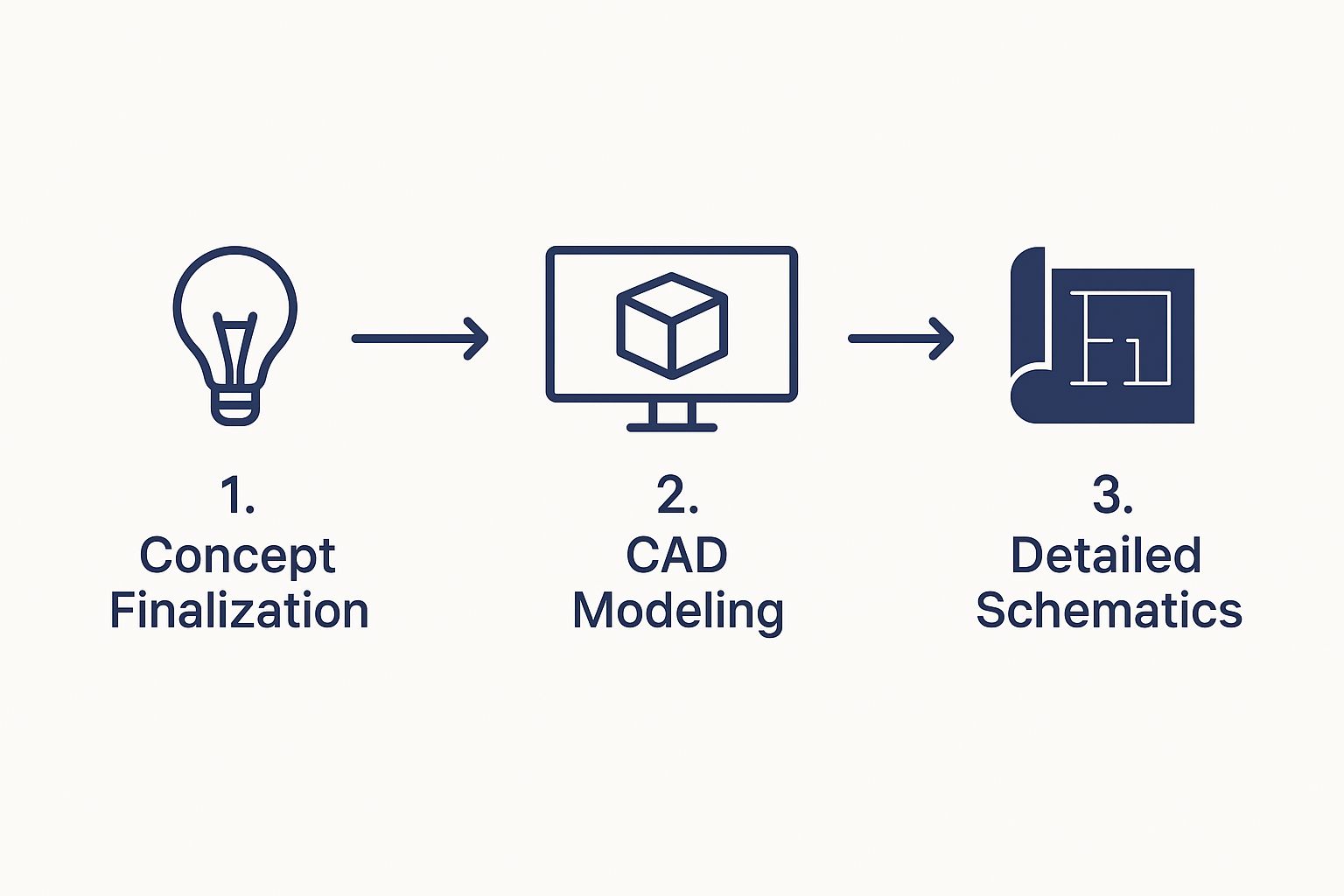
This visual highlights that logical progression, starting with refining the concept, moving to digital modelling, and ending with the creation of actionable blueprints.
Stage 3: Analysis and Simulation
With a detailed digital model ready, the next step is to put it to the test—virtually. Analysis and simulation are absolutely crucial for finding potential weaknesses before a single physical part is made. Engineers use advanced software to apply digital stresses, loads, and environmental conditions to the 3D model.
This process can simulate years of wear and tear in just a few hours. For instance, a structural engineer can test how a bridge design will handle high winds, or a mechanical engineer can analyse how heat dissipates in a new electronic device.
This digital stress-testing is one of the most valuable aspects of modern engineering design. It lets us refine and perfect a design, making sure it’s robust, safe, and efficient without the cost of building multiple physical prototypes.
Stage 4: Prototyping and Final Documentation
After the design has been toughened up through simulation, a physical prototype is often built. This is the first real-world test of how it works, feels, and fits together. Any final tweaks are made based on how it performs.
Finally, the engineering team pulls all the information together into a complete documentation package. This usually includes:
- Final Technical Drawings: The official blueprints for manufacturing.
- Bill of Materials (BOM): A complete list of every part and material needed.
- Assembly Instructions: Step-by-step guides for putting the product together.
This final package provides everything needed to kick off manufacturing or construction, marking the successful end of the design journey.
To give you a clearer picture, here’s a summary of how these stages connect.
Key Stages of the Engineering Design Process
This table breaks down the main phases of a typical project, showing what happens and what the key result is at each step.
| Phase | Key Activities | Primary Outcome |
|---|---|---|
| Concept & Feasibility | Brainstorming, market research, preliminary analysis, risk assessment, and feasibility studies. | A validated concept with a go/no-go decision. |
| Detailed Design & Modelling | Creating 3D models with CAD software, selecting materials, and defining component specifications. | A complete and precise digital model of the product. |
| Analysis & Simulation | Virtual stress testing (FEA), fluid dynamics (CFD), thermal analysis, and performance simulation. | An optimised and validated design, proven to be safe and efficient. |
| Prototyping & Documentation | Building physical prototypes, real-world testing, final design adjustments, creating technical drawings and BOMs. | A full technical package ready for manufacturing or construction. |
As you can see, it’s a carefully planned process designed to move from a simple question—”what if?”—to a confident answer: “here’s how.”
How Technology Is Reshaping Engineering Design
The world of engineering design is shifting fundamentally. Gone are the days of poring over stacks of 2D paper blueprints. Today, technology is making the entire design process faster, smarter, and far more collaborative. It’s a complete rethink of how projects get delivered.
This isn’t just a passing trend. Digital services now make up the largest slice of the UK’s architectural, engineering, and construction (AEC) market, accounting for a massive 48.45% of total revenue. That figure alone shows just how deeply these advanced tools are embedded in modern workflows. You can dig deeper into the UK AEC market stats over on Grandview Research.
A few key technologies are leading the charge, completely changing what’s possible in engineering design.
Building Information Modelling (BIM)
At its heart, Building Information Modelling (BIM) is a collaborative way of working based on a 3D model. But it’s much more than just a pretty picture. Think of it as an intelligent digital database for a building or structure. Every single element—from a hefty steel beam down to a single light fitting—is packed with detailed information.
This creates a single source of truth that architects, structural engineers, and construction teams can all access and work on at the same time. It means clashes and problems can be spotted on a screen long before they become expensive mistakes on a building site.
BIM pulls projects out of the dark ages of disconnected drawings and into a world of a single, integrated digital model. It ensures everyone is on the same page, which dramatically cuts down on errors and improves coordination.
Digital Twins
The concept of a Digital Twin takes this 3D modelling idea and injects it with live data. It’s a virtual, real-time replica of a physical asset, whether that’s a wind turbine, a factory floor, or an entire office block. This digital model is linked to its real-world counterpart by sensors that constantly feed it performance data.
This live stream of information gives engineers and facility managers incredible power. They can:
- Monitor Performance: Keep a close eye on energy use, operational efficiency, and even structural health as it happens.
- Predict Maintenance Needs: Spot when a component is likely to fail before it actually breaks, allowing for proactive, planned repairs instead of costly emergency callouts.
- Simulate Future Scenarios: Test the impact of a change—like a new production process—in the virtual world first, without any real-world risk.
Generative Design
Another powerful tool joining the arsenal is Generative Design. This is where an engineer feeds their design goals and constraints—things like materials, budget, and performance targets—into an AI-powered system. The software then cycles through thousands, sometimes millions, of potential designs, often coming up with solutions a human designer would never even think of.
This doesn’t make the engineer redundant; it amplifies their creativity. It gives them the ability to rapidly assess a huge range of high-performing options, finding the absolute best way to optimise for things like weight reduction or material efficiency. These tools are helping engineering design services deliver solutions that are not just clever, but highly optimised and sustainable right from the very start.
The Real-World Benefits of Expert Engineering
Bringing in professional engineering design services is about much more than just getting a set of technical drawings. It’s an upfront investment that delivers real, tangible value that you’ll see on your bottom line and in your long-term success. Think of it as a way to pay dividends by getting every aspect of a project right from the very start.
These benefits aren’t just abstract ideas; they’re measurable results that come directly from rigorous, data-driven design work. By applying solid scientific principles, engineers turn potential headaches into planned-for solutions. They make sure your project is built on a foundation of reliability and efficiency.
Let’s break down the key advantages that expert engineering really brings to the table.
Significant Cost Savings
Intelligent design is one of the most powerful tools you have for controlling costs. Engineers spot opportunities to cut down on material waste through precise calculations, ensuring you use only what’s needed without ever compromising on strength or safety. A great example is optimising a building’s steel frame – this can reduce tonnage dramatically, leading to direct savings on both materials and transport.
But it goes deeper than that. A properly engineered design considers the entire life cycle of a product or building. This means planning for lower operational costs down the line, like reduced energy bills and simpler maintenance. It’s a forward-thinking approach that helps you avoid the expensive, reactive repairs that so often plague poorly planned projects.
Proactive Risk Mitigation
Every single project has risks baked in, from potential structural failures to falling foul of strict safety regulations. Professional engineering design acts as your first and best line of defence. Using detailed analysis and simulations, engineers can spot and fix design flaws long before a single shovel hits the ground.
This careful, methodical process ensures the final result is not only functional but also safe for everyone who uses it and fully compliant with all relevant UK standards. Managing risk this way protects your investment, your timeline, and, just as importantly, your business’s reputation.
Driving Meaningful Innovation
In a crowded market, innovation is what makes you stand out. Expert engineers bring the technical creativity needed to transform a good idea into a product that genuinely leads the field. They can push the boundaries of what’s possible with materials, mechanics, and systems to give you a real competitive edge.
Whether it’s developing a component that’s lighter and stronger or designing an interface that’s more intuitive, engineering is the engine of practical innovation. It’s a process that moves beyond simple aesthetics to create things that perform better, last longer, and have unique features that grab your customers’ attention.
Engineering transforms a novel concept into a reliable, marketable reality. It’s the disciplined process that ensures an innovative idea can be manufactured efficiently and perform flawlessly in the real world.
Achieving Sustainability Goals
These days, modern engineering places a huge emphasis on environmental responsibility. By building sustainable practices into the design right from the start, engineers can deliver significant carbon savings and help you hit your green targets. This is typically achieved through a few key strategies:
- Energy Efficiency: Designing systems that use as little energy as possible, from high-performance HVAC in buildings to low-power electronics.
- Sustainable Materials: Choosing materials with a lower environmental footprint, such as those with recycled content or options sourced locally.
- Renewable Integration: Creating designs that seamlessly incorporate renewable energy sources like solar panels or geothermal systems.
This focus doesn’t just help protect the planet; it also resonates with an increasingly environmentally conscious market, giving your brand a real boost.
How to Choose the Right Engineering Partner in the UK
Picking the right engineering firm is easily one of the most critical decisions you’ll make for your project. It’s a choice that ripples through everything from your budget and timeline right down to the final quality of the build.
The UK market for consultant engineering services is huge. After a small dip, it recently bounced back with 1.5% growth, hitting a value of £69.8 billion. Trying to find the perfect partner in such a crowded field can feel daunting, but a clear strategy makes all the difference. To get a better sense of these market dynamics, you can review the full UK industry report.
Ultimately, a strong partnership comes down to finding a firm that feels like an extension of your own team.
Assess Their Proven Track Record
First things first: look past the sales pitch and dive into their portfolio. A firm’s past projects are the truest indicator of what they can actually deliver. Do they have a solid history of success in your specific sector, whether that’s commercial property, sensitive healthcare environments, or complex heritage buildings?
Don’t be shy about asking for detailed case studies. Better yet, ask to speak with their previous clients. This isn’t just ticking a box; it’s essential due diligence to confirm they genuinely understand the unique challenges and regulations of your industry. That’s non-negotiable for a smooth-running project.
A great portfolio isn’t just a collection of finished projects; it’s a library of solved problems. Look for evidence that they have successfully navigated challenges similar to the ones you anticipate.
Evaluate Technical Skills and Collaborative Culture
Next up, get a feel for their technical capabilities. Are they fluent in modern design tools like BIM and advanced simulation software? Their proficiency with current technology has a direct impact on how efficiently and accurately your project will run. A key part of evaluating partners is understanding their internal processes; you can find good insights in discussions around effective CRM practices for engineering firms.
Just as important, though, is their company culture. The best engineering design services are born from a partnership where communication is clear and the firm integrates seamlessly with your own team. That collaborative spirit is what turns reactive problem-solving into proactive solutions. For certain projects, it’s also wise to engage dedicated specialists, like expert building services consultants, who live and breathe specific systems.
Finally, make sure to verify their commitment to quality and UK standards. Check for relevant accreditations and ask them to walk you through their quality assurance process. This is your safeguard, confirming they adhere to all the necessary regulations and protecting your project from costly compliance headaches down the line.
Got Questions About Engineering Design Services?
To wrap things up, let’s tackle a few of the practical questions that often pop up when clients first start exploring engineering design. Getting these answers straight can clear up a lot of confusion from the get-go.
How Are Engineering Design Services Priced?
There’s no one-size-fits-all answer here; the cost really hinges on the project’s complexity, the level of expertise needed, and the overall scope of work.
You’ll typically see a few different models. A firm might offer a fixed fee for a straightforward, clearly defined task. For more fluid or ongoing work, an hourly rate is common. For larger construction projects, you might see a fee based on a percentage of the total construction cost.
The most important thing is to ask for a detailed proposal that breaks down every single cost and deliverable. No surprises.
What’s the Difference Between an Engineer and a Designer?
This is a great question, and the distinction is crucial. An engineer holds a formal degree and professional accreditation, allowing them to apply scientific principles to create and analyse a design. Critically, they are the ones who take legal responsibility for its safety and performance.
A designer or drafter, on the other hand, usually focuses on producing the detailed drawings and models—often using CAD software—based on the engineer’s calculations and specifications.
You could say an engineer validates why a design works and is safe, while a designer details what the design looks like based on those validated principles.
How Long Does the Engineering Design Process Take?
Again, it all comes down to scale and intricacy. The timeline can vary wildly.
Designing a simple mechanical component might only take a few weeks. But if you’re looking at major infrastructure, like a new power plant or a large hospital wing, the design phase alone can easily stretch across several years. A realistic schedule is something that should be hammered out right at the start, during the initial concept and feasibility stages.
At Luths Services, we specialise in creating sustainable, low-carbon building solutions that deliver both environmental and financial value. Our integrated approach to engineering design ensures your project is efficient, compliant, and ready for the future.
Discover how our expertise can benefit your next project by visiting us at https://www.luths-services.com.


