
So, what exactly is a feasibility report project? Think of it as a formal investigation you conduct before sinking serious time and money into a new venture. It’s a crucial risk-management step where you analyse an idea from every conceivable angle—financial, technical, legal, and operational—to answer one simple but vital question: ‘Should we actually do this?’
Why a Feasibility Report Is Your Project’s Blueprint
We’ve all seen it happen. An exciting new software application gets the green light. The team is buzzing with passion, the concept feels like a game-changer, but six months down the line, the budget is gone, the tech won’t play nice with existing systems, and key stakeholders are getting cold feet. The project fizzles out, not because the idea was flawed, but because nobody asked the hard questions at the start. This is exactly the kind of costly scenario a feasibility report is designed to prevent.
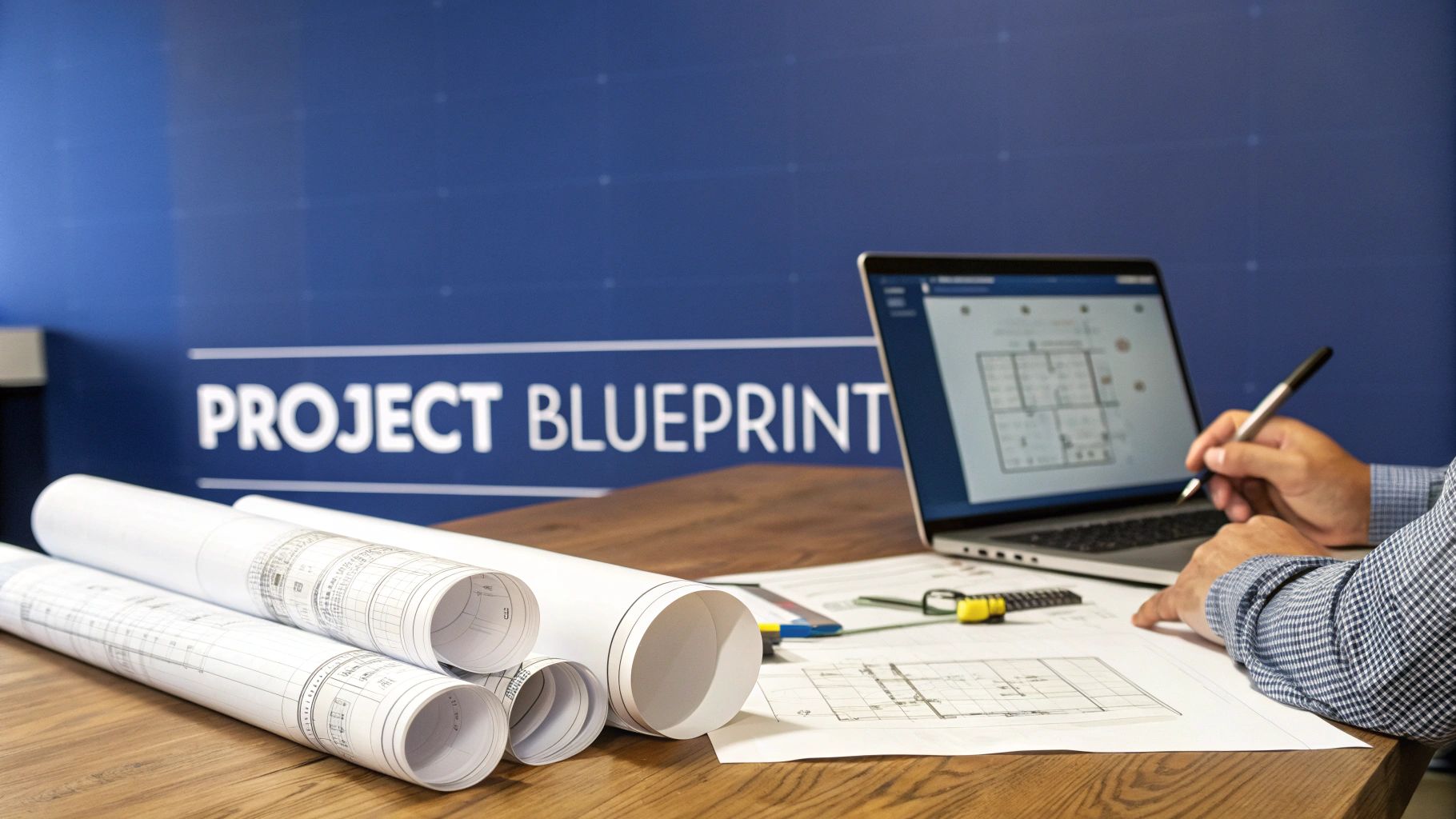
Don’t mistake it for more red tape; it’s the architectural blueprint for your project. No builder would lay a single brick without detailed plans confirming the structure is sound, the materials are available, and the design can actually be built. A feasibility report serves the exact same purpose for your business idea.
The Core Pillars of Feasibility
This initial deep dive is built on several key pillars. Each one offers a different perspective on your project’s chances of success. A proper feasibility report project will put the following under the microscope:
- Technical Viability: Do we have the technology, skills, and resources to pull this off? If not, can we realistically get them?
- Economic Viability: Will the project generate a return that justifies the investment? This is where a detailed cost-benefit analysis comes in.
- Legal Viability: Does the plan comply with all the necessary laws, data protection regulations, and any local zoning requirements?
- Operational Viability: Can this new project actually fit into our current operations? Does it align with our existing workflows and the way our organisation is structured?
- Scheduling Viability: Is the proposed timeline realistic? Or is it a recipe for burnout and missed deadlines?
By methodically working through each of these areas, you transform a hopeful concept into a proposal backed by solid data. It’s the difference between crossing your fingers and making an informed decision.
Ultimately, the report gives you the evidence needed to make that final call. It’s a practical tool that forces you to grasp the full scope of what you’re about to take on. For a closer look at the nuts and bolts, you can learn more about the complete feasibility study definition and what goes into it. This analysis paves the way for a robust business plan, making sure that if you do move forward, you’re doing it with your eyes wide open to the risks and a clear plan for success.
Nailing Down Your Project’s Scope and Objectives
Before you can even begin to think about whether a project is viable, you need to know exactly what “it” is. I’ve seen it time and time again: a vague or fuzzy scope is the number one cause of ‘scope creep’. That’s the slow, silent killer of projects, where uncontrolled expansion quietly drains the budget and sends deadlines spiralling. Getting this first part right is everything.
Your first job is to write a crystal-clear project description. This isn’t a marketing brochure; it’s a tight, no-nonsense statement outlining the project’s real purpose, what you’ll actually deliver, and where the boundaries lie.
Let’s say you’re proposing a new community centre. A good description would specify exactly what it will offer (e.g., after-school programmes, elderly social clubs), who it’s for, and the physical area it will cover. No ambiguity.
Figure Out Who Matters and What They Want
With a solid description in hand, your next move is to identify every single person or group with a stake in this project. And when I say stakeholders, I don’t just mean the investors or the client. I’m talking about the end-users, community groups, local government, and your own internal team.
For our community centre example, this means you need to be talking to:
- Local Government: What are the planning permissions? Are there funding requirements we need to know about?
- Community Residents: Will the services we’re planning actually meet a real, local need?
- Potential Staff and Volunteers: Is this thing even practical to run day-to-day?
Seriously, grabbing a coffee and having informal chats at this stage is a game-changer. These conversations almost always uncover hidden needs or potential conflicts early on. It lets you align everyone’s expectations before you’ve sunk weeks into detailed analysis. This is especially true for any project looking for public support.
A classic mistake is to sit in a room and assume you know what people want. Just asking them directly not only gives you priceless insights but also starts building buy-in from day one. It makes the whole process so much smoother down the line.
Use SMART Goals to Keep Your Analysis on Track
Okay, so you understand the scope and you know what your stakeholders need. Now, you have to turn all that into goals you can actually measure. The SMART framework is an oldie but a goodie for a reason—it forces you to be specific and keeps your feet on the ground.
- Specific: Don’t say “increase local youth engagement.” Say “launch a weekly coding club for 25 teenagers aged 13-17.”
- Measurable: How will you know you’ve succeeded? Define it with clear metrics, like participant numbers or satisfaction scores.
- Achievable: Do you actually have the resources, time, and expertise to pull this off? Be honest.
- Relevant: Does this goal directly contribute to the project’s main purpose?
- Time-bound: Give it a deadline. For instance, “achieve full enrolment within six months of opening.”
Setting these kinds of clear targets is absolutely vital. Just look at the evaluations of UK community initiatives. Studies of projects backed by the Community Ownership Fund showed that a massive 75% of them were explicitly targeting measurable improvements in wellbeing and reducing social isolation. These were clear, policy-aligned goals.
You can read more about the evaluation of the Community Ownership Fund feasibility study. Adopting this structured approach stops your feasibility study from becoming a vague wish list and keeps it focused on delivering real, tangible results.
Conducting Market and Technical Analysis

Alright, with your project’s scope nailed down, it’s time to get into the real detective work. We’re looking at two things: the market you want to enter and your own ability to actually pull this off. It’s a classic one-two punch for any solid feasibility report project—first, look out the window to see if there’s an audience, then look in the mirror to see if you’re ready for the stage.
Getting a real feel for the market is more than just having a “good idea.” You need to systematically pull together the data that shows your project has a place to land. Who are you selling to? What problem are you really solving for them? And why you?
Finding Your Place in the Market
The first order of business is an honest look at the industry you’re about to step into. This means getting a handle on the current trends, figuring out who the big players are, and clearly defining what makes your project stand out from the crowd. What’s your unique selling proposition (USP)?
To get there, you’ll need to answer a few fundamental questions:
- Who is my real customer? Get granular. Think demographics, behaviours, and the specific frustrations they face.
- Is this market big enough? You need to know if there are enough of these people to make your project viable for the long haul.
- Who am I up against? Size up your competitors. What do they do well? Where are their weak spots?
- What’s on the horizon? Are there tech shifts, new regulations, or changing consumer tastes that could help or hinder you?
It’s incredibly easy to underestimate the competition or just assume people will want what you’re offering. The goal here isn’t to confirm your biases; it’s to gather cold, hard data that either backs up your vision or gives you a chance to pivot before you’re in too deep.
Choosing Your Market Research Method
So, how do you get this information? The method you choose really comes down to your budget, how much time you have, and the kind of detail you’re after. Each approach has its own strengths and weaknesses.
Here’s a quick comparison to help you decide which path is right for your feasibility report.
| Method | Best For | Pros | Cons |
|---|---|---|---|
| Surveys | Getting hard numbers from a wide audience without breaking the bank. | Cost-effective, easy to scale, and gives you clear quantitative data. | Can be a bit superficial and often suffers from low response rates. |
| Interviews | Deep-diving into the thoughts and feelings of specific individuals. | Delivers rich, detailed feedback and helps you build relationships. | Very time-consuming, hard to scale, and the feedback can be subjective. |
| Focus Groups | Understanding how a group of people collectively feels about a concept. | Great for brainstorming and seeing how different opinions interact. | Can be hijacked by strong personalities and are expensive to run. |
| Competitor Analysis | Sizing up what’s already out there to find your opening. | Provides killer strategic insights and helps you spot gaps in the market. | You’re often limited to public data, so you miss the internal story. |
Choosing the right mix of these methods will give you a much more robust and reliable picture of the market you’re stepping into.
Evaluating Your Technical Capabilities
Once you’ve got a green light from the market, the spotlight turns inward. Technical feasibility boils down to one simple question: have we got what it takes to make this happen? This is where you do a frank audit of your team’s skills, the tech you have, and any physical assets the project demands.
This isn’t just an IT checklist. If you’re in construction, a critical step is a comprehensive building condition survey to assess the state of any existing structures you’re working with. For a manufacturer, it means looking at everything from the production line to your supply chain.
In the UK, proving you can deliver is everything, especially when it comes to new ideas. Just look at UK Research and Innovation (UKRI), which has poured funding into over 52 feasibility projects since 2023 for material science alone. They’re helping companies prove their technical and commercial chops before going all in. It’s a powerful reminder that you have to show you can walk the walk. You can read more about UKRI’s commitment to innovation funding on their site.
Mastering Your Financial Feasibility Assessment
Let’s be honest, the financial section of your feasibility report is where most people flip to first. It’s the moment your big idea has to stand up to the cold, hard reality of pounds and pence. This is where you build the economic case for your project, telling a story with numbers that stakeholders, investors, and grant committees can actually get behind.
A proper financial assessment isn’t about guesswork. It means taking a detailed, brutally honest look at every potential cost and every possible revenue stream. Getting this right is non-negotiable—it shows you’ve done your homework and builds confidence that your project has a real chance of succeeding long-term.
Nailing Down Your Initial Investment
Before you even dream about profits, you have to map out every single expense needed just to get off the ground. These are your start-up costs, and they’re always more extensive than you first think. It’s easy to remember the big-ticket items, but the small details can quickly add up and sink a budget.
A good, comprehensive list will always include:
- One-Time Capital Costs: This is the big stuff—equipment, machinery, initial software licences, or any building work needed.
- Initial Set-up Fees: Think legal services, business registration, and securing any necessary permits or licences.
- Marketing and Launch Expenses: How are you telling the world you exist? Factor in costs for initial advertising, social media campaigns, or a launch event.
- Contingency Fund: This is your safety net. Always, and I mean always, build in a buffer of 10-15% of your total start-up costs. It will save you from unexpected headaches down the line.
For projects with a physical footprint, like renewable energy installations, getting these numbers right is absolutely critical. For instance, you can’t move forward with a ground source heat pump system without a complete financial picture. Seeing how it works in the real world is invaluable; for a practical breakdown, check out this GSHP Islay case study which details the application and benefits.
Projecting Your Ongoing Costs and Revenue
Once you’re up and running, the financial focus shifts from one-off investments to the rhythm of day-to-day cash flow. You’ll need to map out your operational expenses (OpEx)—the recurring costs that keep the lights on month after month. This includes salaries, rent, utilities, ongoing marketing, and software subscriptions.
At the same time, you have to forecast your revenue streams. A word of advice: be realistic. Don’t just pluck a hopeful number out of the air. Base your projections on the market analysis you’ve already done. How many customers can you genuinely attract? What’s a sensible price for what you’re offering? It’s smart practice to create best-case, worst-case, and most-likely scenarios. It shows you’ve thought through all the possibilities.
I’ve seen it time and again: people get wildly optimistic with revenue projections while seriously underestimating their operational costs. Ground your forecasts in solid data from your market research. It’s the only way to present a financial plan that’s credible and defensible.
The Key Financial Metrics That Matter
With your costs and revenue mapped out, it’s time to calculate the key metrics that really show if the project is financially viable. These are the numbers an investor will look at to quickly decide if your project is worth their time.
- Break-Even Point: This is that magic moment when your total revenue finally equals your total costs. Knowing this number tells you the absolute minimum you need to achieve to stop losing money.
- Return on Investment (ROI): This is a straightforward percentage that shows how much profit your project could generate compared to its initial cost. It answers the most fundamental question of all: “Is the financial return worth the risk?”
Let’s make this tangible. Here’s a simple table for a hypothetical new café.
| Financial Item | Year 1 Projection | Notes |
|---|---|---|
| Start-up Costs | £75,000 | Includes kitchen equipment, furniture, and licenses. |
| Annual Revenue | £150,000 | Based on 100 customers per day at £5 average spend. |
| Annual OpEx | £110,000 | Includes rent, staff wages, and cost of goods sold. |
| Annual Profit | £40,000 | Revenue minus OpEx. |
| Break-Even Point | Achieved in Month 9 | Based on monthly burn rate vs. projected income. |
Laying out your financials this clearly transforms your report from a collection of nice ideas into a serious business proposition.
A smart plan doesn’t just hope for the best; it prepares for the unexpected. Once you’ve mapped out the technical and financial side of things, it’s time to stress-test your idea against the real world. A proper feasibility report project is all about digging into potential risks before they have a chance to become project-ending problems.
This means looking beyond the spreadsheets to the practical, real-world obstacles that could derail you. I’ve seen time and again that the most successful projects are run by people who anticipate challenges, not just react to them. You need to think about what could realistically go wrong—from a sudden spike in material costs to a key team member walking out the door.
Identifying and Mapping Potential Risks
First things first: get your team together and brainstorm every conceivable risk, no matter how small it seems. A feasibility report worth its salt needs a serious analysis of potential challenges. Using effective risk assessment methods is a good starting point to make sure you cover all the bases, like:
- Financial Risks: What’s the plan if your funding gets delayed or your projected costs turn out to be way off?
- Market Risks: Could a new competitor pop up out of nowhere, or could consumer demand suddenly pivot?
- Operational Risks: Are you exposed to potential supply chain nightmares or critical technology failures?
- Technical Risks: What happens if the shiny new tech you’re banking on doesn’t actually perform as advertised?
Once you have your list, it’s time for a simple but incredibly powerful tool: the risk assessment matrix. It helps you cut through the noise by plotting each risk based on its likelihood of happening against its potential impact if it does. This creates a visual map that instantly shows you which threats need a bulletproof mitigation plan and which you can just keep an eye on.
Don’t just list your risks; give them weight. A high-impact, high-likelihood risk isn’t just a point of concern—it’s a critical threat that demands a detailed, step-by-step response plan right there in your report. This shows stakeholders you’re prepared for reality, not just the rosiest scenario.
Navigating Legal and Regulatory Hurdles
Beyond the day-to-day operational challenges, every project has to operate within a complex web of laws and regulations. Getting legal compliance wrong isn’t just a risk; it can be a complete showstopper. This part of your analysis is where you prove your project is not only viable but also lawful and responsible.
Your legal feasibility check needs to confirm you’ve got everything covered, including:
- Permits and Licences: Pinpoint every single permit you’ll need, from local planning permissions all the way to industry-specific operating licences.
- Health and Safety Standards: Make sure your entire operational plan meets all the required safety regulations for your team and your customers.
- Data Protection: If you’re handling any personal data, compliance with regulations like the General Data Protection Regulation (GDPR) is absolutely non-negotiable.
This kind of due diligence is especially crucial for projects looking for public funding here in the UK. Feasibility reports are a core part of how initiatives funded by frameworks like the UK Shared Prosperity Fund (UKSPF) are evaluated. They need to see that projects will deliver genuine value and are being managed effectively. Addressing these legal points from the outset shows foresight and gives stakeholders the confidence that your project is built on a solid, compliant foundation.
Assembling and Presenting Your Final Report
You’ve done the deep dive, crunched the numbers, and stress-tested your concept. Now comes the moment of truth: telling a compelling story. The final assembly and presentation of your feasibility report project is where all that hard work comes together into a clear, decisive recommendation that stakeholders can get behind.
A well-structured report is so much more than a data dump. Think of it as a persuasive document that walks the reader through your investigative journey. It needs to flow logically from the project’s initial scope and objectives, through the financial and risk assessments, and culminate in a confident go or no-go conclusion. You’re the narrator, building the case piece by piece.
Crafting a Powerful First Impression
Let’s be honest, the executive summary is arguably the most critical part of your entire report. It’s often the only section a busy executive will read in full, so it has to be concise, powerful, and able to stand on its own. Knowing how to write an effective executive summary is a skill that can make or break your project’s approval.
This summary needs to briefly hit on:
- The project’s core purpose and scope.
- The major findings from your market, technical, and financial digging.
- A high-level glance at the key risks you’ve uncovered.
- Your final, unambiguous recommendation.
Structuring Your Narrative with Clarity
Beyond the summary, organise the body of your report into clear, logical sections that mirror your feasibility process. Use headings and subheadings to break everything up, making it easy for readers to jump straight to the information that matters most to them. And please, use visuals.
A common mistake I see is people burying powerful data in dense paragraphs. Use charts, graphs, and tables to make your financial projections and risk assessments instantly understandable. A single well-designed visual can communicate a complex idea far more effectively than a wall of text ever could.
Finally, always tailor your presentation to your audience. The tech team will want to get into the weeds of the operational details, while the finance department will zero in on the ROI and break-even analysis. Anticipate their questions and be ready to present the relevant sections of your report with clarity and conviction.
Of course. Here is the rewritten section, crafted to sound completely human-written and natural, following the style of the provided examples.
Common Questions About Feasibility Reports
Even with the best process mapped out, you’ll always run into practical questions when you’re deep in the details of a feasibility study. Getting these sorted helps keep your analysis focused, effective, and credible.
Let’s walk through a few of the most common questions that pop up.
Feasibility Report Versus a Business Plan
What’s the real difference here? It’s a classic question, and it really boils down to timing and purpose. Think of it like this:
A feasibility report is your investigative stage. It asks one simple, brutal question: “Should we even attempt this project?” It’s a completely objective look at whether an idea stacks up technically, financially, and operationally before you commit serious time and money.
A business plan is the strategic roadmap. This comes after a project has been given the green light. It answers, “How are we going to pull this off?” It gets into the nitty-gritty of marketing, operations, and financial projections for a venture you’ve already decided is viable.
Essentially, one decides if the journey is possible; the other maps out the route.
Identifying the Most Crucial Section
While every part of the report is connected, there’s one section that stakeholders will almost always turn to first: the financial feasibility assessment. Why? Because the numbers don’t lie. They provide the hard evidence needed to justify a major investment.
The financial section translates all your hard work—market demand, technical specs, operational plans—into the language everyone understands: cost, revenue, and return on investment. It’s where the project’s viability is proven in pounds and pence, making it the ultimate go/no-go decider.
Solid financial projections, backed up by thorough research from the other sections, are what give decision-makers the confidence to sign on the dotted line.
Can I Conduct a Feasibility Study Myself?
For smaller, lower-risk projects, absolutely. It’s often perfectly possible to conduct a solid feasibility study on your own. If you follow a structured template and methodically work through the technical, market, financial, and operational questions, you can definitely get the insights needed to make a smart call.
However, for large-scale, complex, or high-risk projects, bringing in external experts is a wise move.
Imagine a complex sustainable building project. You might need specialists in renewable energy systems or someone who knows heritage building regulations inside and out. These experts offer an impartial, experienced eye that can spot risks or opportunities you might have missed. Their involvement makes your feasibility report project far more robust and adds a layer of credibility that’s invaluable when you’re trying to secure major funding or planning approval.
At Luths Services, we specialise in turning sustainable concepts into reality. Our expert team provides the detailed feasibility studies and energy consultancy needed to ensure your low-carbon projects are not just viable but successful. Discover how we can guide your next project from initial assessment to full implementation.


