
Think of a feasibility study as the ultimate “look before you leap” for any major project. It’s a comprehensive investigation designed to answer one critical question before you commit significant time, money, and resources: is this project actually viable?
What Is a Feasibility Study Really?

Let’s ditch the jargon. At its core, a feasibility study is like an architect drawing up a detailed blueprint before a single brick is laid. This blueprint isn’t just about the finished building; it’s about spotting potential cracks in the foundation, checking if the chosen materials are up to the job, and making sure the budget is grounded in reality.
In the same way, a feasibility study is a powerful strategic tool. It gives you the power to make confident decisions backed by solid data by systematically checking if your proposed project is technically possible, financially sensible, and practically achievable.
The Core Objectives
So, what are you actually trying to achieve with this study? It’s about getting clear answers to some tough questions. The table below breaks down the main goals.
Core Objectives of a Feasibility Study at a Glance
| Objective | What It Means for Your Project |
|---|---|
| Validate the Idea | Confirming there’s a real need or market for your project. |
| Identify Roadblocks | Uncovering potential technical, legal, or logistical challenges early on. |
| Assess Financial Viability | Calculating the costs, estimating the return on investment, and securing funding. |
| Define Project Scope | Clearly outlining what the project will and will not deliver. |
| Provide a Go/No-Go Signal | Offering a clear, evidence-based recommendation on whether to proceed. |
Each of these objectives helps build a complete picture, ensuring you’re not just hoping for success, but planning for it.
More Than Just a Box-Ticking Exercise
This isn’t just about filling out forms. A feasibility study is a full-dress rehearsal for your project, allowing you to play out different scenarios in a safe space without putting real capital on the line. By looking at your idea from every possible angle—technical, financial, operational, and legal—you can sidestep expensive mistakes and get a clear sense of whether it can survive in the real world.
A feasibility study isn’t about trying to prove an idea will work. It’s about discovering, with as much certainty as possible, whether it can work.
It’s Not Just About the Numbers
While the financial side is obviously crucial, a proper feasibility analysis goes much deeper. It looks at everything from your team’s capacity to deliver to navigating legal red tape, to gauging actual market demand.
For example, in property development, a feasibility study would extend far beyond just the construction costs. It would involve a deep dive into the site itself, identifying potential issues with the land or existing structures, much like the detailed analysis you’d find in a building condition survey.
This complete, 360-degree view ensures every potential hurdle is flagged right at the start. The final report isn’t just a pile of data; it’s a clear “Go” or “No-Go” recommendation, giving everyone involved the confidence to either push forward decisively or wisely pivot before a costly misstep is made.
The Five Pillars of Feasibility Analysis
A solid feasibility study isn’t just one big task. It’s more like a multi-pronged investigation, looking at your project from five distinct angles to make sure it’s built on firm ground. Think of it like a mechanic giving a car a full MOT before a long road trip; you wouldn’t just check the petrol. You’d look at the engine, the tyres, the brakes, and make sure all the paperwork is in order.
This thorough approach is often remembered with the acronym TELOS, which stands for Technical, Economic, Legal, Operational, and Scheduling. Each of these pillars represents a critical line of questioning. They help you systematically pull your idea apart to find weak spots before they become expensive failures.
This diagram shows how the different parts of a study fit together. You can see how a big-picture market analysis shapes the technical requirements, which then feeds into your financial forecasts.
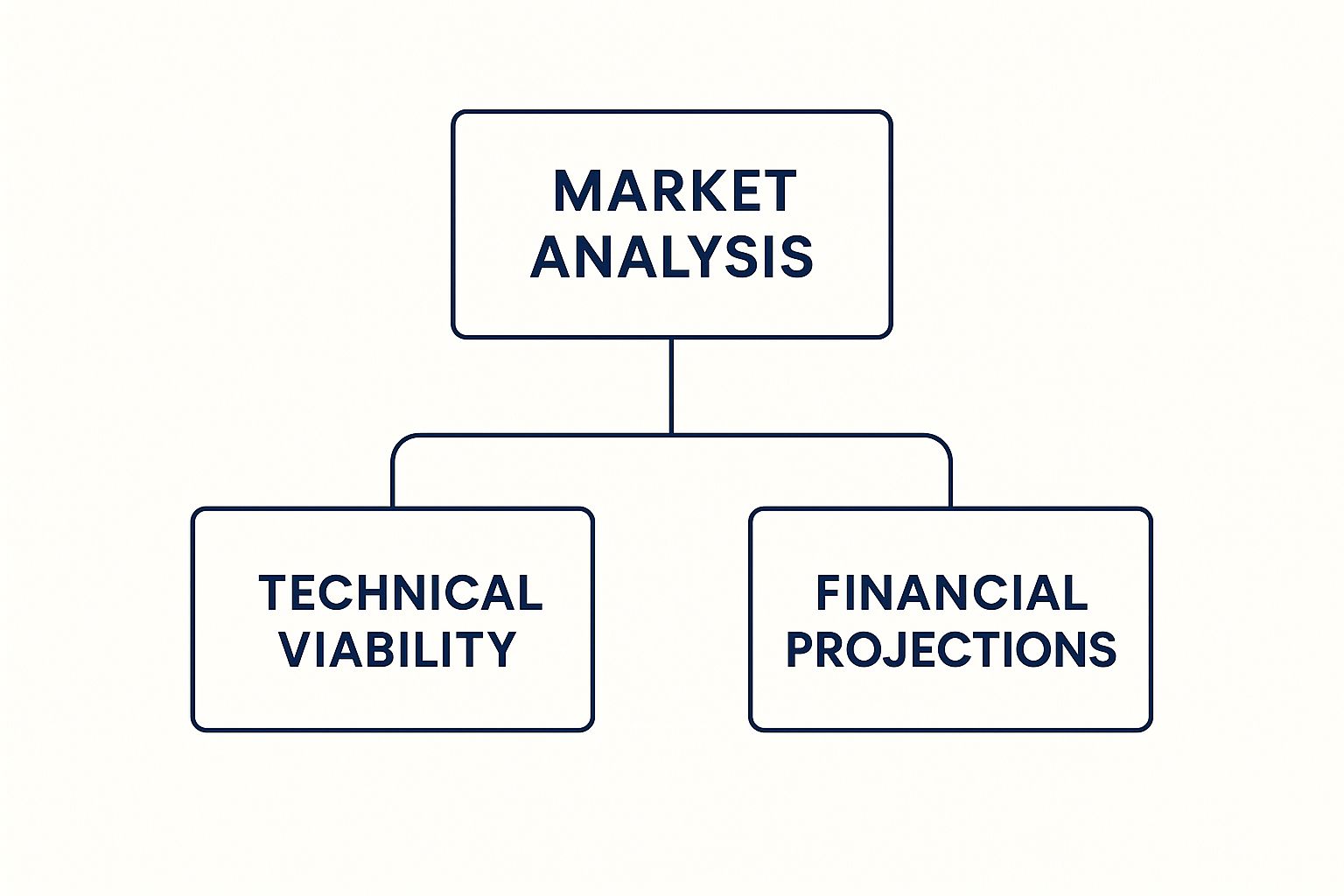
Each layer builds on the one before it, showing how a proper understanding of feasibility depends on these interconnected parts.
Technical and Economic Viability
First up is Technical Feasibility. This boils down to a simple, practical question: do we have what it takes to build this? It’s an honest assessment of whether you have the right technology, resources, skills, and expertise to make the project a reality. This isn’t just about software; it’s your entire technical ecosystem.
Next, we look at Economic Feasibility, which is all about the money. Does the project make financial sense? This is where you run the numbers, conducting a detailed cost-benefit analysis to see if the potential rewards are worth the initial investment. Using a solid financial projections template Excel can give you a structured way to tackle this crucial piece of the puzzle.
The real purpose of a feasibility study is to get you out of the world of assumptions. It forces you to prove, on paper, that your idea isn’t just good in theory—it’s actually workable in practice.
Legal, Operational and Scheduling Checks
Legal Feasibility is absolutely vital, particularly in the UK, where regulations can be quite specific. This part of the analysis ensures your project ticks all the legal boxes, from data protection laws like GDPR to health and safety standards and any local permits or licences you might need. Get this wrong, and you could be facing hefty fines or even a complete shutdown.
Then there’s Operational Feasibility. This pillar looks inwards, asking whether your company can actually handle the project once it’s up and running. Will it fit neatly into your existing ways of working, or will it cause chaos and create bottlenecks? It’s about ensuring your team has the bandwidth and processes to support the new system.
Finally, we have Scheduling Feasibility. This is your reality check on the timeline. Can the project genuinely be finished by the deadline you’ve set? It forces you to consider everything from resource availability to project dependencies. An unrealistic schedule is one of the fastest ways to derail an otherwise promising project.
How Feasibility Studies Fuel UK Innovation

In the UK, a feasibility study is so much more than a box-ticking exercise in risk management. It’s the essential first step that breathes life into new ideas, especially for the nation’s 5.5 million small and medium-sized enterprises (SMEs). For these businesses, taking a punt on a bold new project without solid evidence can feel like a massive gamble.
This is where a proper feasibility study proves its worth. By methodically testing the ground beneath an idea, it turns a promising concept into a concrete, investable plan. Government bodies and funding organisations recognise this power, often offering grants specifically to de-risk this crucial early-stage work.
Think of a feasibility study as the bridge between a brilliant idea scribbled on a napkin and a commercially successful enterprise. It provides the hard evidence needed to secure investment and transform ambition into real-world growth.
The insights gathered from these studies are a cornerstone for fostering innovation and competitive economies across the country.
Turning Risk Into Opportunity
For many UK innovators, successfully completing a feasibility study is the key that unlocks the door to larger grants and private investment. When you can prove your project is viable, even on a small scale, you build a compelling case for the significant funding needed to take it to the next level.
The government actively encourages this. For example, a recent Innovate UK competition set aside up to £2 million just to support feasibility studies for new digital technologies aimed at SMEs. This kind of targeted funding gives businesses the confidence to explore genuinely groundbreaking solutions, as outlined in their innovation funding documents.
This approach delivers some powerful advantages:
- It validates ambitious concepts, proving that a high-risk, high-reward idea has a realistic chance of success.
- It unlocks critical funding, as a positive outcome is often a non-negotiable requirement for investors.
- It drives economic growth by nurturing the new products and services that keep the UK economy competitive.
Ultimately, this process gives SMEs the green light to pursue projects that might otherwise have been shelved as “too risky,” fuelling a powerful cycle of British creativity and commercial success.
Your Step-by-Step Feasibility Study Roadmap
Jumping from a great idea straight into execution can be tempting, but it’s a recipe for disaster. A proper feasibility study needs a clear, logical process. Think of it less as a single, overwhelming task and more as a series of manageable steps that build on one another.
This roadmap will guide you through that process, turning a complex analysis into a straightforward path from idea to decision.
Step 1: Preliminary Analysis & Defining the Scope
Before you dive deep, you need to test the waters with a preliminary analysis. This is a quick, high-level look at your idea. Does it genuinely solve a problem people care about? Does it fit with your organisation’s overall goals? If the answer is a tentative “yes,” you can move on to the crucial part: defining the project’s scope.
Being specific here is non-negotiable. You must clearly map out what the project will deliver and, just as importantly, what it won’t. Getting this right from the start prevents “scope creep” – that gradual expansion of tasks that can derail timelines and budgets.
A well-defined scope is the bedrock of a successful feasibility study. Without clear boundaries, your analysis can become unfocused and your conclusions unreliable.
Step 2: The Deep Dive – Research and Assessment
With your project’s boundaries clearly marked, it’s time to start digging for facts. This research phase is where you gather the hard evidence, and it typically involves looking at a few key areas at once:
- Market Feasibility: Is there a real-world demand for this? You’ll be analysing the market size, checking out the competition, and projecting potential sales or user adoption. Who is your customer, and will they actually want this?
- Technical and Operational Feasibility: Do we have the skills and technology to pull this off? This is an honest look at your internal capabilities. For example, in a building project, this is where you’d assess if you have the right expertise to improve energy efficiency for buildings, ensuring you can deliver on sustainability goals.
- Financial Feasibility: This is where the numbers do the talking. You need to calculate all the costs—the initial investment and the ongoing operational expenses—and weigh them against the expected revenue. The goal is to work out the potential return on investment (ROI).
- Legal and Regulatory Feasibility: What are the rules? You must check all relevant UK laws, local council permits, and zoning regulations. Ignoring just one requirement can stop an otherwise brilliant project in its tracks.
To help you stay on track, it’s useful to frame your research around key questions at each stage.
Key Feasibility Questions for Each Project Stage
This table breaks down the critical questions to ask during different phases of a feasibility study, helping you focus on what matters most at each step.
| Project Phase | Key Feasibility Question to Answer |
|---|---|
| Initial Analysis | Does this idea solve a genuine, pressing problem? |
| Scope Definition | What are the absolute must-haves versus the nice-to-haves? |
| Market Research | Who is our ideal customer, and how big is that group? |
| Technical Review | Can our current team and technology actually build this? |
| Financial Assessment | Will this project make more money than it costs? |
| Legal Check | Are there any regulations that could block or delay us? |
These questions act as a checklist, ensuring no stone is left unturned as you gather your data.
Step 3: Bringing It All Together for the Final Verdict
The final step is to pull all your findings into one clear, concise report. This document brings together your market, technical, financial, and legal research, telling the complete story of your project’s viability.
The report should build towards a direct and unambiguous conclusion: a “Go” or “No-Go” recommendation. This isn’t just a simple thumbs-up or thumbs-down. It’s an evidence-backed judgement that gives decision-makers the confidence they need to commit resources or, just as valuably, to walk away.
Let’s bring this all together with a real-world example. It’s one thing to talk about feasibility studies in theory, but seeing one in action shows just how powerful they can be. We’ll look at the UK’s investigation into Direct Air Carbon Capture and Storage (DACCS) as part of its ambitious plan to reach net-zero emissions.
This wasn’t just a simple “yes or no” question. The study had to figure out if DACCS could actually be rolled out on a massive scale – big enough to genuinely move the needle on climate change. This meant digging deep into every aspect of feasibility.
Weighing Up the Hurdles and Headstarts
What the analysis uncovered was a classic mix of major obstacles and unique advantages. On the plus side, the UK has a significant headstart thanks to its geology; the vast spaces under the North Sea are prime real estate for storing captured CO2 long-term. But the study also put some serious hurdles under the spotlight.
The real job of a large-scale feasibility study isn’t just to green-light a project. It’s to map out the entire terrain, showing you the steep hills you’ll need to climb as well as the open roads ahead.
A key report for the Committee on Climate Change (CCC) laid out the practicalities of getting DACCS up and running. It concluded that a large-scale rollout probably wouldn’t happen before 2030. Even then, it projected a feasible capacity of capturing 20-30 million tonnes of CO2 each year by 2050. You can explore the full findings on UK DACCS feasibility for a deeper dive.
The assessment flagged a few make-or-break constraints:
- Infrastructure: Building the huge network of pipelines needed to transport CO2 is an incredibly expensive and complex undertaking.
- Energy Demands: These DACCS plants are energy-hungry and would put a significant new strain on the national grid.
- Supply Chain: Sourcing the sheer volume of specialised chemicals required for the capture process is a logistical puzzle in itself.
This case study is a perfect illustration of a feasibility study in action. It provides the kind of clear-eyed, evidence-based reality check that’s essential for guiding a country towards its biggest goals, ensuring that bold ambitions are grounded in what’s practically achievable.
Your Top Questions About Feasibility Studies, Answered
To wrap things up, let’s tackle some of the most common questions that pop up when people first dive into the world of feasibility studies. These answers will help clear up any confusion and give you a solid foundation.
Feasibility Study vs. Business Plan: What’s the Real Difference?
This is a classic point of confusion, but the distinction is actually quite simple.
Think of it this way: a feasibility study is the detective work you do before committing to a project. It asks one crucial question: “Is this idea even worth pursuing?” Its entire purpose is to investigate the potential of an idea and deliver a clear “Go” or “No-Go” recommendation.
A business plan, on the other hand, is the detailed blueprint you create after you’ve decided to move forward. It assumes the answer is “Go” and shifts the focus to, “Right, how are we going to make this happen?” It lays out the operational, financial, and marketing strategies for turning the idea into a successful reality.
So, the feasibility study always comes first. You wouldn’t build a house without checking if the ground is stable, and you shouldn’t launch a major project without first confirming it’s viable.
To put it simply: a feasibility study is about investigation—it tests if an idea can work. A business plan is about execution—it maps out how to make it work.
How Long Does a Feasibility Study Typically Take?
There’s no one-size-fits-all answer here; the timeline really depends on the scale and complexity of your project.
For a relatively small, internal initiative, you might be able to get a clear picture within a few weeks. However, for a major undertaking, like assessing different options for improving industrial energy efficiency, the process can easily take several months. This is because it involves deep technical analysis, detailed financial modelling, and extensive market research.
Can I Just Do a Feasibility Study Myself?
For smaller, low-risk projects, a DIY approach can sometimes be enough to get a basic sense of viability. If the stakes are low, you might be able to gather the necessary information on your own.
However, when you’re dealing with significant investments, complex technologies, or projects in heavily regulated sectors, bringing in the experts is nearly always the smarter move. Professionals bring objectivity and specialised knowledge to the table. Their unbiased assessment is not just about avoiding costly mistakes—it’s often essential for securing investment and getting buy-in from key stakeholders.
Ready to turn your sustainable project idea into a viable plan? At Luths Services, we specialise in conducting detailed feasibility studies for low-carbon design and implementation. We provide the clear, data-driven insights you need to move forward with confidence. Learn more about our approach at https://www.luths-services.com.


