
At its core, a grey water recycling system is pretty straightforward. It captures gently used water from places like showers, basins, and laundry, treats it, and then sends it back for non-potable uses. For a commercial property, this simple loop dramatically cuts down reliance on fresh mains water, which translates into substantial cost savings and a much better environmental footprint. It’s moved from being a “nice-to-have” green feature to a strategic investment for businesses staring down the barrel of rising utility costs.
The Real Case for Commercial Grey Water Recycling
For commercial and industrial sites across the UK, the conversation around grey water recycling has fundamentally changed. It’s no longer just a novel “green” initiative; it’s become a core business strategy. With ever-increasing pressure on the UK’s water resources, particularly in areas like the South East of England, the financial and operational arguments for water re-use are more compelling than ever. This isn’t just about ticking an environmental responsibility box—it’s a direct route to making your business more resilient and getting a handle on operational spending.
Getting your head around the different types of water is the first step. Greywater is the relatively clean wastewater from showers, baths, and basins. It’s totally different from blackwater, which comes from toilets and kitchens and is loaded with contaminants that need intensive, expensive treatment. By isolating and recycling greywater, a facility can cover a huge portion of its non-potable needs like toilet flushing, irrigation, and cleaning.
The Financial and Operational Payoff
Let’s be honest, for most businesses, the primary driver is the impact on the bottom line. Pop a grey water recycling system in, and you immediately slash the volume of metered water you’re buying from the local supplier. For places that get through a lot of water—think hotels, leisure centres, or large office blocks—this can mean thousands of pounds in annual savings. These savings only grow as water and sewerage charges inevitably climb.
But it goes beyond direct cost-cutting. Water recycling provides a powerful layer of operational resilience. When droughts or water restrictions hit (an increasingly common scenario), a business with its own recycled water supply can carry on as normal. This protects you from potential shutdowns or the eye-watering cost of trucking in alternative water supplies.
Implementing a grey water system is a proactive move against future resource scarcity. It insulates your business from the volatility of water pricing and availability, turning what could be a vulnerability into a real competitive advantage.
Quantifying the Impact of Water Recycling
The potential for savings here is massive. The Environment Agency points out that the average person in England and Wales uses about 150 litres of water every single day. Drilling into that, research from the College of Estate Management shows a well-sized grey water unit can save a household around 33% of its drinking water. Scale that up to a commercial context, and the numbers get very interesting, very quickly.
To see how these sustainability measures work in the real world, just look at major commercial hubs. A case study on the Bluewater Shopping Centre offers fantastic insight into how large facilities manage their resources. By capturing and treating greywater on-site, a business creates its own circular water economy. This doesn’t just cut costs; it’s a visible demonstration of a commitment to sustainable practices—something that resonates strongly with today’s environmentally conscious customers and stakeholders.
Greywater Sources and Potential Uses
Understanding where your greywater comes from is key to figuring out how you can best reuse it. Here’s a quick breakdown of common sources in a commercial setting and where that water can be repurposed.
| Greywater Source | Typical Contaminants | Suitable Re-use Application |
|---|---|---|
| Showers and Baths | Soap, shampoo, hair, skin cells | Toilet flushing, irrigation, cooling tower make-up |
| Hand Basins | Soap, toothpaste, light dirt | Toilet flushing, general cleaning, vehicle washing |
| Laundry (Rinse Cycles) | Lint, residual detergents | Toilet flushing, irrigation, dust suppression |
| Air Con Condensate | Minimal (often distilled quality) | Cooling tower make-up, irrigation, toilet flushing |
As you can see, the water from these sources is perfect for jobs that don’t require drinking-quality water, offsetting a huge chunk of your overall consumption.
Assessing Your Site and Navigating UK Regulations
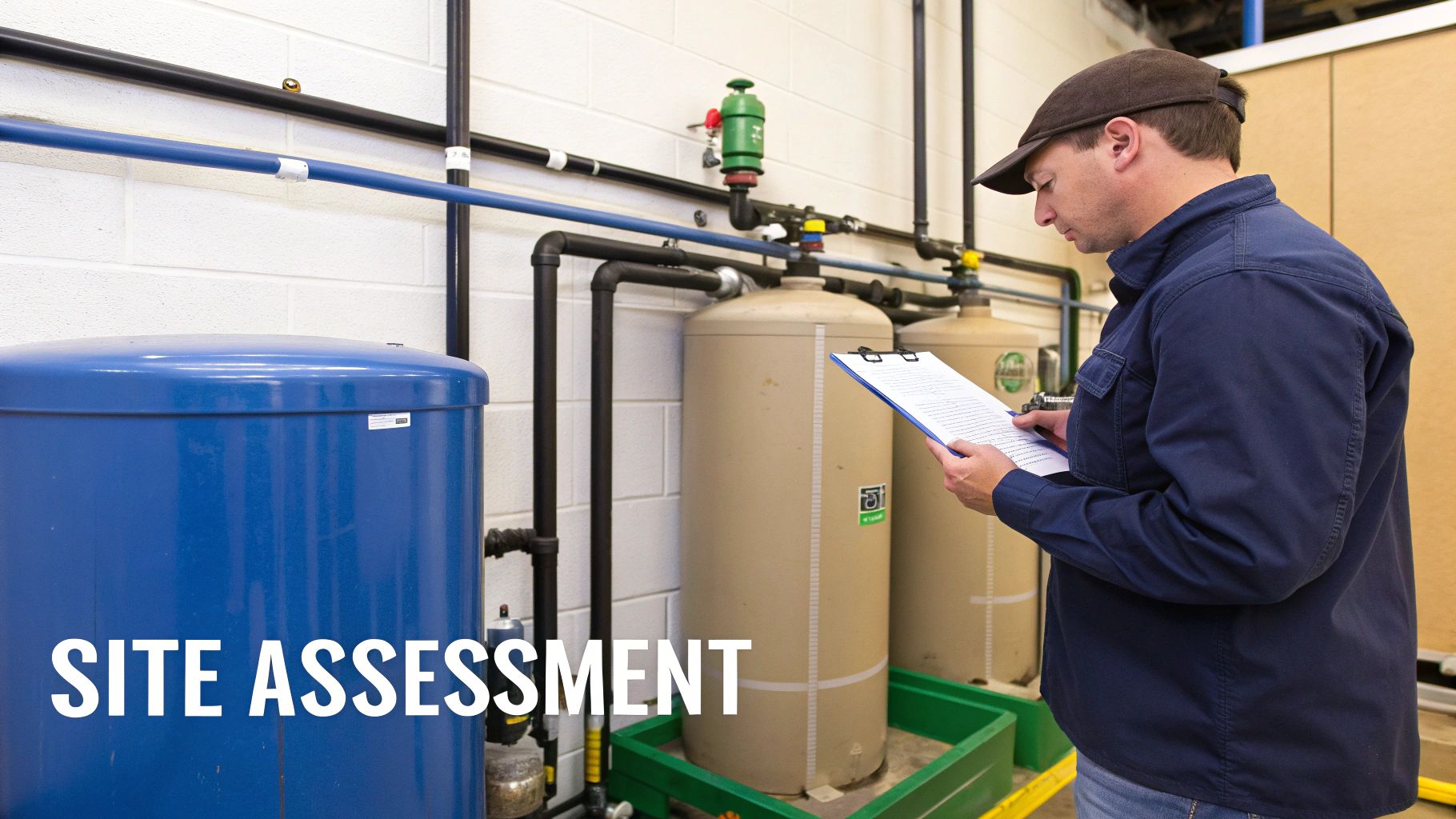
Before a single pipe gets ordered or any designs are finalised, you absolutely have to start with a comprehensive site assessment. This is where the groundwork for a successful greywater recycling project is laid. Getting this initial due diligence right prevents costly surprises down the line and ensures your system is perfectly matched to your building’s unique character. It’s all about asking the right questions to build a crystal-clear picture of your resources and requirements.
The very first thing to do is carry out a detailed water audit. You need to know exactly where your water is going. This means measuring the output from potential greywater sources—think showers in a leisure centre or the hand basins in a large office—and then quantifying the demand from potential uses, like toilet flushing or irrigation. This data is the foundation of your entire system design.
Without this audit, you’re essentially guessing. You could easily undersize the system and miss out on significant savings, or you could oversize it, leading to a huge, unnecessary capital spend and operational headaches. The goal is to create that perfect balance between the supply and demand within your property.
Key Factors for Your Site Evaluation
As you get deeper into the assessment, a few physical and logistical factors will start to dictate the feasibility and design of your system. Nailing these details at the very beginning will make the entire installation process much smoother.
Your evaluation should carefully document the following:
- Existing Plumbing Infrastructure: How is the building’s plumbing set up? Can you easily separate greywater from blackwater? Retrofitting older buildings can be a real headache and might require significant work to install new, dedicated collection pipework.
- Available Plant Room Space: The treatment unit, storage tanks, and pumps all need a home. You’ll have to find a suitable, accessible spot that can house all the equipment and still allow for routine maintenance. Basements or dedicated service areas are often your best bet.
- Water Quality Requirements: What are you going to use the recycled water for? Water for flushing toilets has very different quality standards compared to water used for irrigating delicate plants. The end-use directly shapes the level of filtration and disinfection tech you’ll need.
This phase is also the perfect time to start exploring different system configurations. For a deeper dive into the mechanical services that underpin these installations, our guide on building mechanical services provides some really valuable context on slotting new systems into existing infrastructure.
Demystifying UK Water Regulations
Navigating the UK’s regulatory landscape is a critical part of the process, and it’s not something you can afford to gloss over. Compliance is non-negotiable. It ensures the safety and integrity of both your system and the public mains supply, and getting it wrong can lead to serious legal and financial trouble.
The two most important frameworks you need to be aware of are the Water Supply (Water Fittings) Regulations and British Standard BS 8525. These aren’t just guidelines; they are strict rules that dictate how these systems must be designed, installed, and maintained to prevent any risk of contamination.
A core principle of UK water regulations is preventing cross-contamination. Your greywater system must be designed with an ‘air gap’ or another approved backflow prevention device. This is to guarantee that non-potable recycled water can never, ever mix with the wholesome drinking water supply.
Understanding Core Compliance Rules
To sidestep common pitfalls, your design and installation plan must stick to some very specific requirements. Think of these as the golden rules for any UK-based greywater project.
Here’s what regulators will be looking for:
- Clear Pipework Identification: All pipework carrying treated greywater has to be distinctively marked. This is usually done with green and black labelling to stop anyone from accidentally connecting it to the potable water system during future maintenance.
- Backflow Prevention: As mentioned, a physical air gap is the most common and reliable method. It creates a complete separation between the mains water top-up and the recycled greywater tank, making backflow impossible.
- Water Quality Standards: The system must treat the water to a quality level that’s appropriate for its end-use, as defined in BS 8525-1:2010. This standard gives specific guidance on the design, installation, and maintenance of greywater systems.
By building these regulatory requirements into your initial site assessment and design from day one, you ensure your project starts on a solid, compliant footing. It’s a proactive approach that saves you from costly redesigns and ensures a smooth journey through to commissioning and final sign-off.
Designing Your System and Choosing the Right Technology
Once you’ve got the lay of the land from your site assessment and you’re clear on the regulations, it’s time to get into the technical heart of the project. This is where your greywater recycling system really begins to take shape, matching the right components and treatment methods to what your facility actually needs. Getting these choices right is the difference between a system that just about works and one that delivers real efficiency and value for years to come.
This design process is anything but a copy-and-paste job; it’s all about customisation. A system for a busy city hotel, with a steady, high-volume flow of greywater from showers, will look completely different to one designed for an office block where the demand spikes during the 9-to-5. That initial water audit you did? It’s now your blueprint, guiding every single decision, from the size of your tanks to the capacity of your pumps.
This is where the boom in the global greywater recycling market really benefits UK businesses. We’re seeing huge growth in this sector. In fact, the greywater diversion system segment is expected to grab a 60.7% market share by 2025. This surge, driven by water scarcity and sustainability targets, is pushing technology forward. The global market is pegged to be worth around USD 13.2 billion in 2025 and is predicted to grow at 6.9% each year, hitting roughly USD 21.1 billion by 2032. For a facility manager, this means more advanced, reliable, and automated options are hitting the market all the time.
Centralised vs Decentralised System Architectures
One of the first big calls you’ll have to make is whether to go for a centralised or decentralised setup. Each has its place, depending on your building’s layout and scale.
- Centralised Systems: These are the most common approach for new builds and major retrofits. They collect greywater from all over the building and pipe it to a single, large treatment plant, usually tucked away in a basement or plant room. The big win here is economies of scale and much simpler maintenance.
- Decentralised Systems: This setup uses smaller, self-contained treatment units that serve a specific zone, like one floor of a hotel or a particular wing. It’s often a much more practical option when retrofitting older, more complex buildings where ripping up floors to run new pipework would be a costly nightmare.
Think of it like this: a sprawling university campus could use several decentralised units for individual halls of residence. In contrast, a compact, high-rise office building is the perfect candidate for a single, powerful centralised system. Your choice here has a direct knock-on effect on the plumbing complexity and the overall project budget.
Selecting the Right Treatment Technology
The engine of your greywater system is its “treatment train.” The technology you pick has to reliably clean the water to the BS 8525 standard for whatever you plan to use it for. The options are broad, from simple physical filters to sophisticated biological and chemical processes.
A typical commercial system will follow a multi-stage process:
- Primary Filtration: This is your first line of defence. Coarse filters catch the big stuff—hair, lint, and other bits of debris. Self-cleaning drum filters are a popular and effective choice for this job.
- Biological Treatment: From there, the water heads into a bioreactor. Here, an army of beneficial bacteria gets to work, breaking down organic gunk like soaps, shampoos, and skin cells. It’s a vital step for stopping nasty smells and making sure the water is biologically stable.
- Advanced Filtration (MBR): Many modern systems rely on a Membrane Bioreactor (MBR). This clever bit of kit combines the biological treatment with incredibly fine membrane filtration. The result is crystal-clear, high-quality water, virtually free of any suspended solids.
- Disinfection: The final polish. This step is all about zapping any lingering pathogens to make the water safe. In the UK, Ultraviolet (UV) disinfection is the go-to method. It uses UV light to kill bacteria and viruses without having to dose the water with chemicals.
Always match the level of treatment to the end-use. Water destined for sub-surface garden irrigation might only need basic filtering. But if you’re using it for toilet flushing inside a building, you need a much more thorough process, always finishing with disinfection to safeguard public health.
For applications demanding the highest purity, some designers are looking into combined UV and ozone water treatment technologies, which deliver a powerful one-two punch for disinfection.
Sizing Key Components Correctly
With the treatment technology sorted, the last piece of the design puzzle is sizing up the supporting hardware—namely, your tanks and pumps. And this is where your water audit data really pays for itself.
- Storage Tanks: The collection tank (often called a buffer tank) needs to be big enough to handle the biggest surge of greywater your facility can produce without overflowing. Your treated water tank needs to hold enough clean water to meet peak demand—think of the morning rush for toilet flushing in an office. A solid rule of thumb is to size your storage to hold at least one full day’s average greywater production.
- Pumps and Controls: You need pumps to shift the water through the treatment stages and then deliver it where it’s needed. Choosing energy-efficient, variable-speed pumps is key to keeping those running costs down. A central control system manages the whole show, automating the process, keeping an eye on water levels, and flagging up any maintenance issues.
To pull all these pieces together seamlessly, it’s worth bringing in experts in building mechanical services. They’ll ensure every component is sized correctly and works in perfect harmony.
Getting Your System Installed and Running
With a solid design locked in, it’s time to move from paper to pipework. This is where the blueprints become a reality, covering the physical installation and the all-important final checks during commissioning. For anyone managing a facility or a project, keeping a close eye on this stage is crucial to sidestep expensive hold-ups and guarantee the system runs like a dream from the get-go.
The whole process kicks off with the plumbing, which can get particularly tricky in a retrofit. The first, and most critical, job is to set up a dual-pipe plumbing network. This is about meticulously separating the greywater from showers and basins away from the blackwater coming from toilets and kitchens. There’s no room for error here; getting this separation right is an absolute must.
Once the new pipework is in, the main bits of kit are brought in and positioned. This means finding the right spot for the treatment unit, storage tanks, and pump sets, which usually live in a dedicated plant room. You need to think ahead here, making sure there’s enough room not just for the equipment, but for someone to get in and carry out maintenance down the line.
Best Practices for Physical Installation
A smooth installation all comes down to the details, especially when you’re dealing with pipes and electrics. Cutting corners here is a recipe for leaks, electrical faults, and a system that just doesn’t perform.
Here’s what I’ve learned to watch out for:
- Pipework Integrity: Before any pipes are hidden away, make sure every connection is solid and has been properly leak-tested. It’s also vital to use the right materials that can handle the detergents and chemicals you’d expect to find in greywater.
- Clear Labelling: Any new pipework for greywater needs to be clearly labelled according to UK regulations. This is typically done with green and black markings and stops any accidental mix-ups with the drinking water supply later on.
- Electrical Safety: This is a job for a qualified electrician, period. All wiring for pumps, control panels, and disinfection units like UV lamps must be up to UK standards.
The Critical Commissioning Phase
Right, so everything’s installed. But you don’t just flick a switch and walk away. The system has to go through a rigorous commissioning process. Think of it as a series of methodical tests and calibrations to make sure every single component is working as it should and the whole system is playing nicely together. It’s your final quality check before going live.
Commissioning really breaks down into a few key steps:
- Systematic Testing: Each piece of equipment gets tested on its own. We’re talking about running the pumps, checking the float switches work, and making sure all the alarms and safety features on the control panel are firing correctly.
- Sensor Calibration: The system relies on sensors to measure things like water levels, flow rates, and turbidity. These all need to be carefully calibrated so the automated control system gets accurate information to make the right decisions.
- Water Quality Verification: We fill the system and let it run through a few full cycles. We then take water samples from different points in the process and get them tested to prove the final treated water meets the tough standards set out in BS 8525.
The commissioning phase is your first and best chance to iron out any little teething problems. A thorough, well-documented commissioning process gives you the confidence that your system is safe, compliant, and ready to start saving you water and money.
Troubleshooting Common Setup Issues
Even the best-laid plans can hit a snag. Being aware of the common little issues that crop up during setup can stop them from turning into big headaches.
| Common Issue | Potential Cause | Recommended Action |
|---|---|---|
| Pump Not Activating | Float switch is stuck or faulty; wiring is incorrect. | Check the float switch can move freely and test its electrical continuity. Double-check the wiring against the diagram. |
| Low Water Pressure | There’s an airlock in the pipework; the pump is undersized. | Bleed the air out of the system at the designated points. Review the pump’s specs against what the system needs. |
| Cloudy Treated Water | The biological process isn’t fully mature; filter is blocked. | Give the bioreactor a few days to get up to speed. Inspect and clean every filter in the treatment sequence. |
Getting the installation and commissioning right lays the foundation for a system that will serve you efficiently for years. It takes a methodical approach, a sharp eye for detail, and a real commitment to proper testing.
Mastering Long-Term Maintenance and Optimisation
Once your greywater recycling system is commissioned and running, the real work begins. The initial install is just the start; the true value of your investment comes to life through diligent long-term maintenance and savvy optimisation. A system is only as good as its upkeep, and a proactive approach is the only way to guarantee it keeps delivering peak performance, compliance, and maximum water savings for years to come.
Putting off maintenance is a false economy. It’s tempting to cut corners, but small, preventable issues like clogged filters or a miscalibrated sensor can quickly spiral. Before you know it, you’re dealing with poor water quality, unexpected downtime, and even costly component failures. A structured maintenance schedule is your best line of defence.
This forward-thinking stance is especially important here in the UK, where water conservation is firmly on the national agenda. The consistent, weather-independent supply from a greywater system gives it a massive advantage over other methods. Research highlighted by Hydraloop shows that in typical UK terraced houses, greywater recycling saved 179% more drinking water than rainwater harvesting. In semi-detached homes, that figure was 82% more. Why? Because the supply isn’t at the mercy of our unpredictable rainfall. A well-maintained system makes the most of this inherent reliability.
Building a Robust Maintenance Schedule
A disciplined routine is the backbone of any reliable greywater recycling system. Trying to remember everything ad-hoc is a recipe for disaster. The best approach is to break tasks into daily, weekly, and monthly checks, which makes the workload manageable and ensures nothing gets missed.
While every schedule needs tailoring to your specific system, you can’t go wrong with these core checks as your baseline:
- Daily Visuals: A quick five-minute walk-around is all it takes. Look for leaks, listen for any odd noises from the pumps, and glance at the control panel for warning lights or alarms. It’s a simple habit that catches big problems when they’re still small.
- Weekly Filter Cleaning: Your primary filters are the system’s first line of defence against hair, lint, and other debris. Depending on your building’s usage, they’ll likely need a weekly rinse to maintain optimal flow.
- Monthly Water Quality Monitoring: Get hands-on with some simple on-site tests for things like turbidity and pH. You should compare these readings against your initial commissioning report to spot any gradual dip in performance.
- Quarterly Pump and Valve Inspection: Time to get a bit more physical. Check that pumps are running smoothly and that any automated valves are opening and closing as they should.
The Importance of Detailed Record-Keeping
Keeping a detailed maintenance log isn’t just about ticking boxes; it’s a critical tool for compliance and effective troubleshooting. Think of it as the system’s complete service history.
This log helps you track performance trends, anticipate future needs, and provides priceless information if you ever need to call in a specialist for a repair. For a good example of how to structure your own logs, this article on container door maintenance checklists offers some transferable insights, even though it’s for a different type of equipment.
A well-kept log is your proof of compliance. In the event of an inspection, it demonstrates to regulators that you are responsibly managing your system and upholding public health standards.
Pro Tips for System Optimisation
Routine upkeep is one thing, but truly getting the most out of your system means fine-tuning its performance over time. This is where you move from just maintaining the equipment to actively optimising its efficiency.
One of the smartest strategies is to adjust treatment cycles based on real-world building occupancy. For an office that’s mostly empty on a Saturday, for instance, you can program the system to run in a low-energy or standby mode. This cuts electricity use without affecting performance when everyone is back on Monday.
Likewise, a hotel can anticipate the morning rush at checkout and prime the system to handle the surge in greywater from hundreds of showers. This kind of data-led approach helps you wring every last drop of financial and environmental benefit from your investment.
Answering Your Key Questions on Grey Water Systems
Even when the benefits seem clear, it’s the practical, day-to-day questions that often come up before anyone commits to a grey water recycling system. It’s completely understandable. You need to know what you’re getting into for the long haul.
So, let’s tackle the common queries I hear from facility managers. We’ll get into the real-world operational side of things, moving past the sales pitch to what it actually means to run one of these systems.
What Are the Typical Running Costs?
This is usually the first question, and rightly so. Everyone wants to know about the ongoing operational expenditure (OPEX). The good news is that for a grey water system, these costs are pretty predictable and, in almost all cases, much lower than the savings you’ll make.
Your main running costs break down into a few areas:
- Electricity: This is mostly for the pumps that shift water around and for crucial bits of kit like UV disinfection lamps. A smart move right at the design stage is to specify energy-efficient, variable-speed pumps to keep this cost right down.
- Consumables: Think of things like replacement filters, new UV lamps (they don’t last forever), and any cleaning or treatment chemicals your particular system might need.
- Maintenance: You’ll need to factor in the labour for routine checks and servicing. Whether that’s your own team or an external contractor, it’s a necessary part of the budget.
For a decent-sized commercial building, you might be looking at a total annual running cost of anywhere from a few hundred to a couple of thousand pounds. But here’s the crucial bit: this is almost always dwarfed by what you save on your mains water and sewerage bills. With utility prices only going one way, the business case gets stronger every year.
A proper financial analysis during the design phase will map this all out, but for many commercial systems, you’re typically looking at a return on investment (ROI) within 5 to 10 years.
Is the Treated Water Safe to Use?
Safety is the absolute priority, and it’s the most important question to ask. The short answer is yes, the water is safe. But that ‘yes’ comes with a huge condition: the system must be correctly specified for the job, installed by professionals, and meticulously maintained.
Commercial-grade systems are engineered from the ground up for safety. They use a multi-stage treatment process—what we call a “treatment train”—that’s specifically designed to remove the solids, bacteria, and potential pathogens found in greywater. The end result is clean, safe water ready for its intended use.
In the UK, the treated water from a properly functioning system must meet the strict quality standards laid out in BS 8525 for non-potable uses. A cornerstone of the regulations is preventing any cross-contamination with the drinking water supply, which is managed through physical air gaps and very clear pipework labelling.
Consistent maintenance and regular water quality testing are what guarantee that safety and compliance day in, day out.
Can You Install a System in an Existing Building?
Absolutely. Retrofitting a grey water system into an existing building is something we do all the time. It is, however, a bit more of a challenge and usually costs more than installing one in a new build where you can design the plumbing in from the get-go.
The main hurdle is putting in the separate collection pipework. This means getting pipes from all the showers, baths, and basins to your central treatment unit. It can be quite intrusive, sometimes requiring us to open up walls, floors, and ceiling voids. How tricky and costly this is really depends on the building’s age, construction, and layout.
The first step is always a detailed site survey by a qualified engineer. They’ll figure out the best routes for the pipework, find a suitable spot for the plant equipment, and give you a realistic idea of the cost. While it’s more complex, for high-use places like hotels, laundrettes, or big office blocks, the long-term water savings often make a compelling financial case for the upfront investment.
Find more information on water sustianability training here:
Ready to explore how a grey water recycling system can deliver significant savings and enhance your building’s sustainability credentials? The expert team at Luths Services is here to help. We provide independent, data-driven guidance through every stage, from initial feasibility studies to final commissioning and ongoing optimisation. https://www.luths-services.com


