
What if you could reuse a big chunk of your daily water, reduce your bills, and lighten your environmental footprint all at once? That’s the simple idea behind grey water recycling, a practical way to repurpose the gently used water from showers, baths, and sinks that we usually just let run down the drain.
What Is Grey Water Recycling and Why It Matters Now
Greywater recycling is simply a way of giving water a second life. It’s a bit like composting kitchen scraps to feed your garden; instead of throwing away a resource after a single use, you put it to work on another task.
The process is straightforward: it captures water from places like your bathtub, shower, and laundry machine, treats it just enough, and makes it safe to reuse for things that don’t require drinking-quality water.
The two main types of wastewater in any building.
- Grey Water: This is the runoff from showers, baths, bathroom sinks, and washing machines. It might have traces of soap, shampoo, or detergent, but it’s relatively clean and can be filtered for reuse without much fuss.
- Blackwater: This is the unusable stuff. It comes from toilets and kitchen sinks (where food waste, detergents and grease are involved). It needs intensive treatment before it can be safely released.
By simply keeping these two streams separate, we can easily tap into the potential of grey water and turn it from waste into an asset for any property.
The Growing Urgency in the UK
This isn’t just some abstract “green” idea; it’s a direct answer to some very real problems we’re facing here in the UK. Water costs are climbing, and worries about regional droughts are becoming more common. Getting smart about our water consumption is now a financial and ecological necessity.
The strain on our municipal water supplies during those hotter, drier summers really brings home how fragile our resources are. In Scotland, we have seen the first water scarcity restrictions of 2025, read more here.
When designed and managed correctly, grey water recycling isn’t harmful to the water table. It reduces mains water demand and supports local soil recharge, it helps protect this vital resource. It eases the burden on public infrastructure and helps create more resilient homes and businesses. The numbers back it up, too. A report from the College of Estate Management found that a well-designed system can cut a household’s demand for fresh mains water by about a third. You can learn more about how recycling grey water can reduce consumption.
By capturing and reusing this water, you directly lower how much you rely on the mains supply for jobs like flushing toilets or watering the garden. This doesn’t just mean noticeable savings on your utility bills; it also helps build a more sustainable water future for everyone.
The Real Benefits of Reusing Grey Water
So, we’ve covered what grey water recycling is. But that opens the door to a much more practical question: what does it actually do for you? The advantages go well beyond a simple pat on the back for being green. It’s a powerful triple-win, benefiting your finances, the planet, and the long-term resilience of your property.
Think of a grey water system not as an expense, but as a strategic investment. It pays dividends across the board by hitting your budget, supporting vital environmental goals, and hardening your business against future bumps in the road.
Financial Wins and Cost Reductions
The most immediate and obvious benefit of recycling grey water is the direct hit to your utility bills. It’s simple, really. When you reuse water from showers, sinks, and laundry for things like flushing toilets or irrigating grounds, you drastically cut down on the fresh, metered water you have to buy. This translates directly into lower bills, month in and month out.
For a typical household, this can slash potable water consumption by a third or more. Scale that up to a commercial setting, a busy hotel or a hospital where the taps are always running—and the savings become seriously significant.
But the financial upside doesn’t stop at your water meter. When communities widely adopt grey water systems, it eases the immense pressure on municipal water and wastewater treatment facilities. These plants are hugely expensive to run and are energy-intensive. By reducing the sheer volume of water they need to process, we can potentially delay or defer costly infrastructure upgrades, which helps keep utility rates stable for everyone.
And of course, once you start thinking about sustainable practices, the savings can multiply. Property owners often find they can slash energy costs, too, by exploring the various ways to save on household utility costs, like solar power programmes.
Environmental Victories
Beyond the pounds and pence, the environmental case for grey water is rock-solid. Every single litre of grey water you reuse is a litre of precious freshwater that gets to stay in our rivers, lakes, and aquifers. In a country like the UK, facing hotter, drier summers and increasing water stress, this is no small thing.
The positive ripple effect continues from there. Cleaning and pumping fresh water to our homes and businesses is an incredibly energy-intensive process.
By cutting your demand for mains water, you’re also cutting the energy consumption and carbon footprint tied to it. A grey water recycling system basically shortens the water cycle, creating a much more efficient, localised loop that’s far kinder to the planet.
This approach also means less wastewater is sent down the drain and into the sewer system. Less wastewater means fewer pollutants potentially entering our local waterways, which is a big win for healthier aquatic ecosystems.
Operational Gains for Businesses
For any commercial property, grey water recycling delivers a real competitive advantage and boosts operational resilience. Installing a system is a clear, tangible signal of your commitment to sustainability. This strengthens your corporate social responsibility credentials, which is a surprisingly powerful magnet for environmentally aware clients, customers, and even staff.
You can also think of it as future-proofing your operations. Water scarcity is only going to become a bigger issue. It’s not hard to imagine a future with stricter water use restrictions or punishingly high tariffs during drought periods. A facility with its own on-site water recycling is insulated from these risks, ensuring it can continue to operate smoothly.
This kind of self-sufficiency builds true resilience and positions your organisation as a forward-thinking leader that’s ready for what comes next.
Choosing the Right Grey Water Recycling System
Picking a grey water recycling system isn’t a one-size-fits-all affair. What works for a small terraced house will be completely different from the needs of a sprawling commercial building or a hospital. The first step is getting to grips with the main types, from basic diversion setups to sophisticated filtration units, so you can make a smart investment.
Think of it like choosing a vehicle. You wouldn’t use a massive lorry for a quick trip to the shops when a bicycle would do. Likewise, you wouldn’t try to haul heavy goods with that same bike. Grey water systems operate on a similar principle; you have to match the technology to the job at hand.
Let’s walk through the options, starting with the most straightforward and working our way up to the more complex solutions. We’ll look at what each system does best and who it’s really for, helping you find the perfect fit for your property’s needs and budget.
Starting Simple with Diversion Systems
The most basic approach to grey water recycling is a diversion system. This is your entry-level option, designed to do one simple job effectively: move water from point A to point B with barely any treatment.
It’s a bit like hooking up a hose to your bath’s overflow pipe to water the petunias. Of course, a professional installation is more refined, but the concept is the same. It captures water from a single source—like a washing machine or shower—and sends it straight out for immediate use, usually for garden irrigation.
These systems are popular for a few good reasons:
- Low Cost: They are by far the most affordable option on the market.
- Simple Installation: They don’t require major plumbing surgery or complex machinery.
- Low Maintenance: With very few moving parts, there’s not much that can go wrong.
However, that simplicity is also their biggest drawback. The water gets little to no filtration, which means it must be used right away and only on certain plants to prevent soaps and detergents from building up in the soil.
Stepping Up to Filtration Systems
If you need cleaner water for a wider range of uses, a filtration system is the next logical step. These systems introduce a crucial treatment stage, screening out things like lint, hair, and soap scum before the water is reused.
Suddenly, you can do more than just water the garden. A key application is toilet flushing, which can account for up to 30% of a typical property’s water consumption. Filtration methods vary, from simple mesh screens and sand filters to more involved multi-stage processes.
A common setup will have a coarse filter to catch the big bits of debris, followed by a finer filter for smaller particles. The treated water is then held in a storage tank, ready to be pumped wherever it’s needed. This makes them a great middle-ground choice for homes and small commercial sites that need a balance between cost and performance.
Picking a system with the right level of filtration is key to stopping clogs in your pipes and irrigation gear. It also guarantees the recycled water is clean enough for its job, protecting both your plumbing and your landscape.
The image below shows just how much water can be saved by redirecting grey water for different uses.
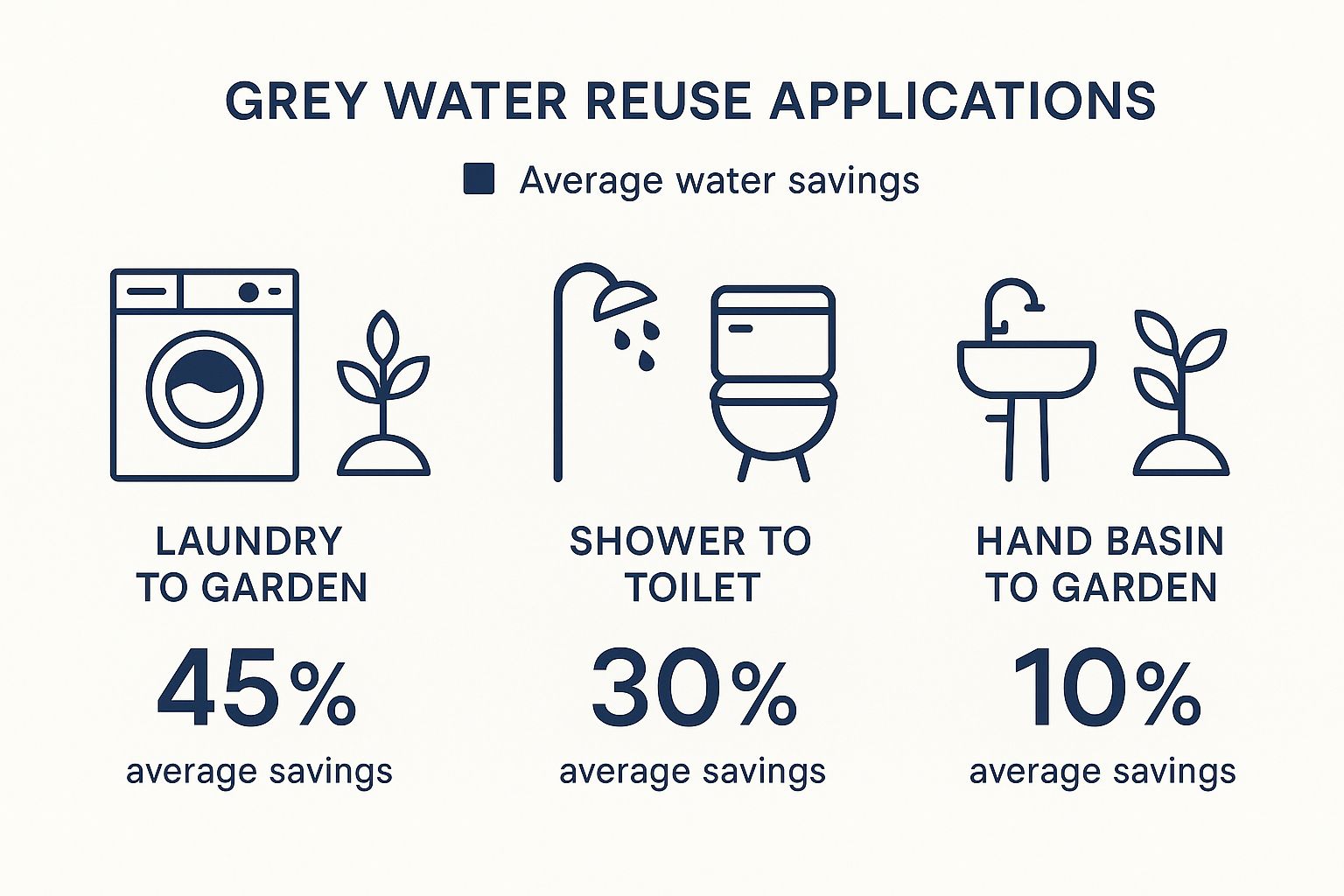
As you can see, even a simple system that sends laundry or shower water to the right place can make a serious dent in a building’s overall water usage.
To help clarify the differences, this table compares the main system types at a glance.
Comparison of Grey Water Recycling Systems
| System Type | Typical Cost | Best For | Filtration Method | Recycled Water Use |
|---|---|---|---|---|
| Diversion | Low | Small-scale residential, garden irrigation | Minimal (often none) | Sub-surface garden watering only |
| Filtration | Moderate | Residential, small commercial | Sand, mesh, or cartridge filters | Toilet flushing, laundry, surface irrigation |
| Advanced Treatment (MBR) | High | Large commercial, healthcare, hotels | Biological treatment + ultrafiltration membranes | Wide non-potable uses, including vehicle washing |
Each system has its place, and the best choice ultimately comes down to balancing your water-saving goals with your budget and the complexity you’re willing to manage.
Advanced Treatment for Maximum Reuse
When you get to large-scale commercial sites and healthcare facilities, the requirements are on another level. In these settings, advanced treatment systems like Membrane Bioreactors (MBRs) are the standard. These are the heavy-duty workhorses of grey water recycling, capable of producing exceptionally high-quality water.
An MBR is a clever combination of biological treatment and ultra-fine membrane filtration. It uses microorganisms to digest organic pollutants in the water, which is then forced through membranes with microscopic pores. This process strips out bacteria and suspended solids, leaving you with clear, odourless water fit for a huge range of non-potable applications.
These systems are certainly more complex and demand a bigger upfront investment, but for any facility with a high water bill, the return is substantial. They create a dependable, on-site water source that boosts sustainability credentials and strengthens operational resilience. Building system efficiency is always critical, a principle that applies equally to sustainable heating; you can learn more about sizing heat pumps in our detailed guide.
Navigating UK Regulations and Installation Rules
Putting a grey water recycling system into a UK property is a brilliant move for sustainability, but it’s a job that needs to be done right. To make sure your system is safe, effective, and totally above board, you have to get to grips with the regulations that govern them. This isn’t about jumping through hoops for the sake of it; it’s all about protecting public health and making sure your investment works perfectly for years to come.
Think of the regulations as a professional recipe. A chef follows precise instructions to guarantee a perfect dish, and in the same way, sticking to UK standards ensures your grey water system performs as it should, without nasty surprises like contamination or system failure. For domestic properties, the main rulebook is British Standard BS 8525-1.
This standard is essentially a blueprint for designing, installing, and looking after grey water systems. It lays out everything from the required quality of the treated water to the specific components you’re allowed to use, giving you a solid foundation for a compliant and efficient setup.
Understanding Permitted Uses
The first rule of grey water recycling in the UK is knowing exactly what you can—and definitely can’t—do with the water you’ve collected and treated. The regulations are incredibly clear on this point to stamp out any risk of it getting mixed up with your drinking water supply.
So, what are the approved uses?
- Toilet Flushing: This is one of the most common and sensible uses, tackling a huge chunk of a building’s water consumption head-on.
- Garden and Landscape Irrigation: A fantastic way to keep your grounds looking green and healthy, especially during dry spells, without turning to the mains.
- Laundry: For systems that feature a more advanced level of filtration and treatment, recycled grey water can be safely used in washing machines.
What you absolutely cannot do is use recycled grey water for anything where it might be consumed, like drinking, cooking, or bathing. The entire system has to be designed to make it impossible for it to mix with your potable (drinking) water.
The Critical Role of Pipe Labelling
To prevent a dangerous mix-up, one of the simplest yet most vital requirements is clear labelling on all pipework. Just imagine a plumber doing maintenance years down the line and accidentally connecting a grey water pipe to a drinking tap—the health risks would be severe.
To avoid this, every pipe carrying recycled grey water must be clearly and correctly marked. This usually means using distinctively coloured green pipes or wrapping them in specific green tape with clear lettering, which instantly signals that the water inside is non-potable. This visual cue is a non-negotiable safety feature for any compliant installation.
This simple step ensures that anyone working on the plumbing in the future can immediately tell the difference between the water circuits, protecting the health of everyone in the building.
Maintenance and Local Authority Checks
A grey water system isn’t a “fit and forget” bit of kit. Regular maintenance is a core part of the regulations, and it’s there to keep the system running safely and efficiently. This involves tasks like cleaning filters, checking pumps are working correctly, and making sure the storage tank is free from any sludge or biofilm.
It’s also always a good idea to have a chat with your local water company and council before you get started. While national standards like BS 8525-1 provide the main framework, some local authorities might have their own specific bylaws or extra requirements. A quick phone call can save you from costly mistakes and make sure the whole project runs smoothly.
While our focus here is on UK rules, it’s interesting to see a global trend towards water conservation. For instance, bodies like the US EPA provide significant grant funding for environmental initiatives. By following the established UK regulations, you’re not just doing your bit for the environment; you’re ensuring your project is fully compliant, safe, and built to last.
Designing Systems for Commercial and Healthcare Properties
For large-scale properties like hotels, hospitals, and office complexes, grey water recycling isn’t just a nice-to-have feature; it’s a powerful operational strategy. These places are incredibly water-intensive, with thousands of litres flowing from showers, laundries, and hand basins every single day. Architecting a system to capture and reuse this resource is a genuine game-changer, both for sustainability and the bottom line.
However, designing for these high-demand settings is a world away from a simple residential setup. The sheer volume and consistency of grey water produced demand solutions that are robust, reliable, and highly efficient. The stakes are higher, but so are the potential rewards.
Analysing Water Use Patterns
The first step in designing any commercial grey water system is to take a deep dive into the property’s unique water usage profile. A hotel’s water signature, for instance, will be dominated by peaks from guest showers and the constant churn of a high-volume laundry operation. A hospital, on the other hand, generates significant output from patient bathrooms and endless handwashing, which brings stringent hygiene standards to the forefront.
By accurately mapping these patterns, engineers can calculate the precise daily water load the system must handle. This isn’t a rough estimate; it’s a critical calculation that dictates the size of every component, from pipes and filters to storage tanks and pumps.
Getting this calculation right is the absolute foundation of an effective system. An undersized system will constantly fail to keep up with demand, while an oversized one is just an unnecessary capital expense. For any serious commercial project, a detailed water audit is non-negotiable.
Choosing Robust and Reliable Technology
With a clear picture of the water load, the next challenge is picking the right technology. For high-volume environments, simple diversion systems or basic filtration just won’t cut it. The tech has to be capable of treating huge quantities of water to a consistently high standard, day in and day out, without fail.
This is where advanced solutions like Membrane Bioreactors (MBRs) really come into their own. An MBR system is pretty much the gold standard for commercial grey water recycling, combining biological treatment with ultra-fine membrane filtration.
Here’s why it adds so much value in a commercial setting:
- Exceptional Water Quality: MBRs produce clear, odourless, and pathogen-free water that is perfectly safe for a wide range of non-potable uses, from flushing toilets to topping up cooling towers.
- Compact Footprint: Despite their power, MBR systems are surprisingly compact. This makes them much easier to retrofit into existing plant rooms or basements where every square metre of space is precious.
- Reliable Performance: They are engineered for continuous, round-the-clock operation, providing a dependable on-site water source that builds resilience against any municipal supply issues or restrictions.
Seamless Integration and ROI
The final piece of the puzzle is integrating the grey water system into the building’s existing plumbing. This needs careful planning to ensure the new network of collection pipes and distribution lines works harmoniously with the current setup, all while meeting strict health and safety codes.
The growing emphasis on water conservation is driving serious investment in this area. The UK’s water reuse market is expanding rapidly, reflecting the increasing demand from commercial and industrial users. A 2025 market forecast valued the UK Water Recycle and Reuse Market at around $14.8 billion, with projections suggesting it could reach $32.7 billion by 2031. For more details on this growing market, you can discover more insights about UK water recycling trends.
For facility managers and property owners, the business case is compelling. While the initial investment is certainly higher than for a domestic system, the return on investment (ROI) is often faster and more substantial. The huge reduction in mains water consumption leads to dramatic savings on utility bills, quickly offsetting the capital cost. This process requires expert guidance, and collaborating with specialist UK building services consultants your project needs is crucial for a successful implementation.
Ultimately, a well-designed commercial grey water system isn’t an expense; it’s a strategic asset that pays dividends in cost savings, operational resilience, and massively enhanced sustainability credentials.
What Does the Future Hold for Water Use in the UK?
Looking ahead, grey water recycling is quickly shifting from a niche interest for eco-enthusiasts to a standard feature in modern, sustainable UK properties. It’s no longer a question of if but when. The simple logic of reusing water is becoming undeniable as the country faces the twin pressures of a changing climate and a growing population drawing from the same finite resources.
This isn’t just some environmental pipe dream; it’s a practical response to very real challenges. The increasing frequency of hotter, drier summers is pushing water reuse into the mainstream for everyone from homeowners to commercial facility managers. What was once seen as a hobby for keen gardeners is now being recognised for what it is: a crucial strategy for keeping landscapes alive and building operational resilience.
Smarter Systems are on the Rise
Technology is, of course, a huge part of this story. Recent innovations are making grey water recycling systems more efficient, more compact, and frankly, more accessible than ever before. We’re now seeing smarter units that can optimise water treatment and distribution on their own, ensuring you get the maximum benefit with minimal fuss. These systems are also getting much easier to retrofit into existing buildings, which massively broadens their appeal.
The core idea is simple: as the technology gets better and cheaper, the barriers to entry fall away. This makes grey water recycling a much more viable and attractive investment for a wider range of properties, from residential blocks to large-scale industrial sites.
A Mainstream Solution by 2035?
Experts predict this trend is only going to pick up speed. Forecasts suggest that reusing water from our baths, sinks, and washing machines will be absolutely essential for maintaining the UK’s roughly 23 million domestic gardens. In fact, many believe grey water recycling will become a mainstream practice for both garden watering and other household uses by 2035, largely driven by climate pressures. You can read more about this prediction in a report on the future of garden watering from the RHS.
As government policies catch up, we could also see new green incentives designed to encourage people to get on board. Things like subsidies or tax credits could make the financial case even more compelling, cementing grey water recycling as a vital, practical tool for building a more water-secure future across the UK.
Got Questions About Grey Water Recycling?
Even after getting your head around the benefits, you might still have a few questions about how grey water recycling works on the ground. Let’s tackle some of the most common queries to clear up any lingering doubts and give you the confidence to move forward.
Grey Water Recycling vs Rainwater Harvesting
While both are fantastic ways to save water, they tap into completely different sources. It helps to think of it like this:
- Rainwater harvesting is like putting a barrel under a drainpipe. It’s simple, direct collection of the rain that falls from the sky onto your roof.
- Grey water recycling, on the other hand, is all about giving water that’s already been used inside a second job. It reclaims the runoff from your showers, sinks, and washing machines.
Although their origins are different, they often end up doing similar work, like watering the garden or flushing toilets. Either way, you’re reducing how much you pull from the mains supply.
Is Recycled Grey Water Actually Safe?
This is a big one. Can you safely use this water in your garden and home? The answer is a firm yes—as long as it’s managed correctly. The key is a properly installed system with the right level of filtration for the job. Get that right, and the water is perfectly safe for all intended non-drinking uses.
The best way to prevent any health risks is to follow established UK regulations and stick to a simple maintenance schedule. This keeps your system running as it should and gives you complete peace of mind.
What Are The Typical Costs in the UK?
The price tag for a grey water recycling system in the UK really depends on how simple or complex you want to get.
A basic DIY diversion kit, perfect for watering the garden, is a great entry point and might only set you back between £50 and £200.
If you’re after a more comprehensive solution, a professionally installed whole-house system with advanced filtration and pumps can range from £2,000 to £5,000, sometimes more. It’s a bigger upfront investment, for sure, but the long-term savings on your water bills can deliver a significant return. It’s also worth checking for financial support; our guide on the Home Energy Scotland Grant provides more information on the kinds of incentives that might be available.


