
Understanding Heat Recovery Ventilation Systems Made Simple
Think of your home as having a set of lungs. With traditional ventilation, like opening a window on a cold day, you get a rush of fresh air, but you also get a blast of chilly air. This forces your heating system to work much harder to warm the place back up. A Heat Recovery Ventilation (HRV) system is much smarter, acting like an efficient respiratory system that breathes continuously without losing that precious, paid-for warmth.
HRV systems are engineered to supply fresh air into a building while extracting stale, damp air at the same time. The real clever part happens inside the system’s core, where heat from the outgoing stale air is transferred to the incoming fresh air. This balanced exchange ensures your home has a constant supply of fresh, filtered air, but without the major heat loss you get with older methods.
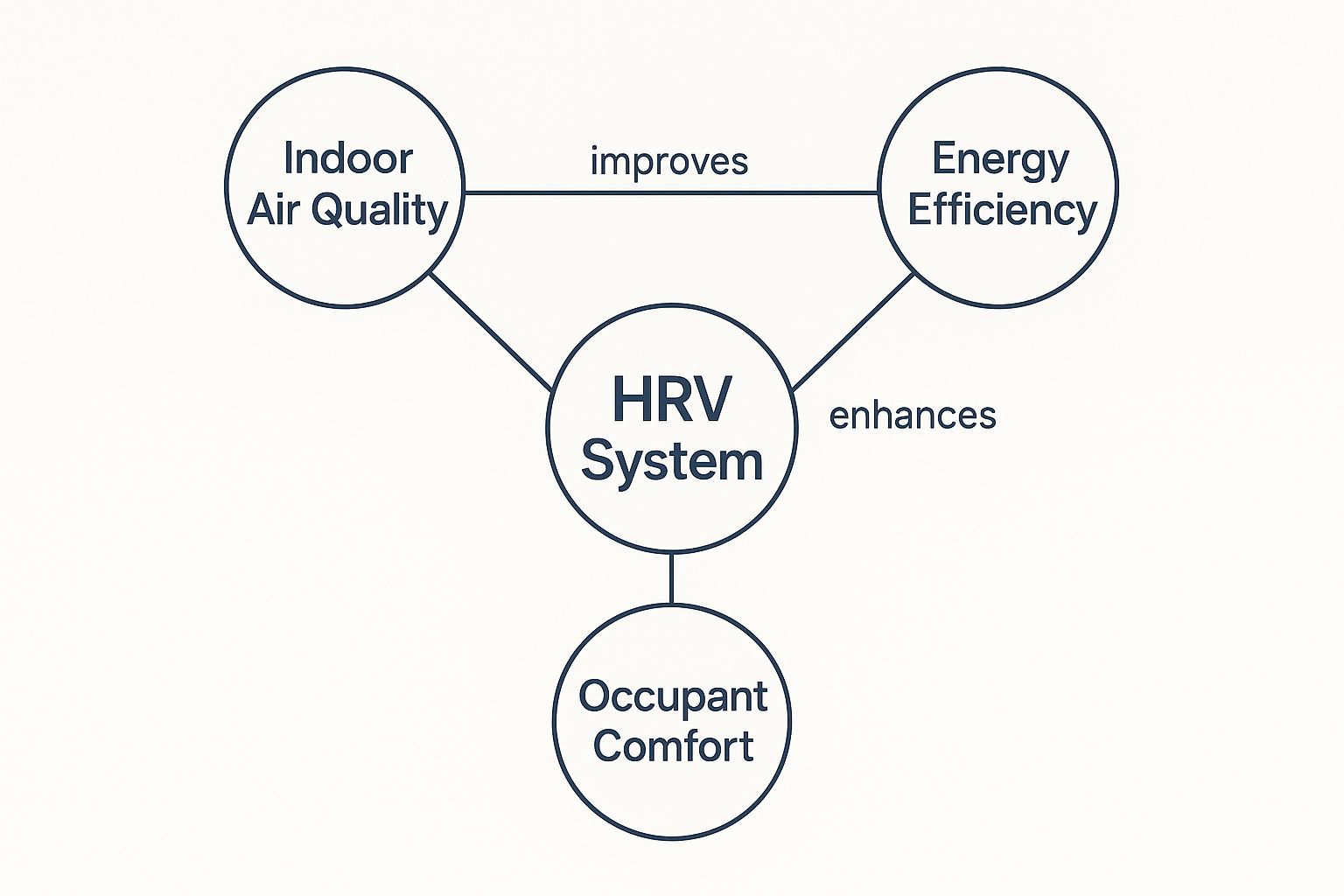
As the above highlights, an HRV system sits at the centre of three key benefits: improved air quality, better energy efficiency, and greater comfort for occupants. These elements work together, making heat recovery ventilation a key component in modern, energy-efficient building design.
The Core Principle: Heat Exchange Explained
At the heart of every HRV unit is a component called a heat exchanger. Picture two separate, sealed tunnels running side-by-side. Warm, stale air from inside your home travels down one tunnel to be vented outside. At the same time, cool, fresh air from outside is pulled into the second tunnel.
The walls separating these tunnels are made from a thermally conductive material. As the warm exhaust air passes through, it heats up these walls. This warmth is then transferred through the walls to the adjacent tunnel, pre-warming the incoming fresh air before it is distributed throughout your home. This means that in winter, the fresh air arriving in your rooms is already partially heated, significantly reducing the strain on your central heating.
Amazingly, these systems can recover up to 95% of the heat that would typically be wasted. It’s important to remember the two air streams never actually mix, so any pollutants, moisture, or odours in the stale air are safely expelled outside without contaminating the fresh, incoming supply.
This diagram shows the basic flow: stale and fresh air follow their own distinct paths, with the heat exchanger acting as the crucial point of energy transfer. This simple but powerful principle is what sets an HRV system apart from just leaving a window ajar.
Why It Outperforms Traditional Ventilation
When you place an HRV system side-by-side with conventional ventilation like extractor fans or trickle vents, the differences in efficiency and performance become clear. The table below offers a straightforward comparison.
| Feature | Heat Recovery Ventilation | Traditional Ventilation | Energy Savings |
|---|---|---|---|
| Energy Efficiency | High. Recovers up to 95% of heat from stale exhaust air, reusing it to warm incoming fresh air. | Low. Expels warm air directly outside, leading to significant heat loss and higher heating demand. | High. Reduces the load on the heating system, leading to lower energy bills. |
| Air Quality | Excellent. Provides a continuous, balanced flow of filtered fresh air throughout the entire property. | Poor. Relies on intermittent extraction or passive vents, which can create draughts and pull in unfiltered outdoor air. | Indirect. Consistent fresh air reduces reliance on opening windows, preventing heat loss. |
| Moisture Control | Superior. Actively extracts moisture from wet rooms (kitchens, bathrooms) preventing damp and mould growth property-wide. | Limited. Localised extraction only tackles moisture at the source, without addressing overall humidity levels. | High. Prevents heat loss through damp walls and reduces the need for energy-intensive dehumidifiers. |
| Running Costs | Lower heating bills significantly offset the minimal electricity cost to run the unit’s fans. | No direct cost for passive vents, but extractor fans consume energy and both lead to much higher heating costs. | Significant long-term savings on heating bills. |
Ultimately, heat recovery ventilation systems deliver a whole-house solution. Instead of just punching holes in your walls for draughty vents or using noisy extractor fans that simply dump your heated air outside, an HRV system manages your home’s air supply intelligently. This organised approach not only saves money on energy bills but also fosters a healthier and more comfortable living environment by tackling issues like high CO2 levels, allergens, and excess humidity at their source.
The Life-Changing Benefits Beyond Lower Energy Bills
While saving money on heating is a fantastic perk, the real story of heat recovery ventilation systems is how they improve the quality of your daily life. These systems don’t just manage energy; they create a healthier, more comfortable, and quieter home you can feel the moment you walk through the door.
A Healthier Home Environment
One of the biggest impacts is the dramatic improvement in your home’s air quality. By constantly swapping stale, polluted indoor air for fresh, filtered outdoor air, these systems make your home a much less friendly place for common household irritants. This has a tangible effect on health and wellbeing.
- Reduced Allergens and Pollutants: The system’s filters are like a bouncer for your home, stopping dust, pollen, and other airborne particles at the door. Many families notice a significant drop in allergy and asthma symptoms.
- Elimination of Condensation and Mould: We’ve all seen it: the persistent condensation on windows that leads to ugly black mould. An HRV system tackles this head-on by drawing damp air from kitchens and bathrooms, getting rid of the moist conditions that mould loves. It’s about fixing the cause, not just masking the symptom.
- Lower CO₂ Levels: Without good ventilation, carbon dioxide builds up inside, making you feel stuffy, tired, and unable to concentrate. An HRV system keeps these levels low, promoting a sense of freshness and alertness throughout the day.
The Psychological and Practical Perks
Living in a home with a constant supply of fresh air brings more than just physical health benefits. It gives you a new level of control over your indoor world, freeing you from old compromises.
Think about it: you no longer have to pick between staying warm and getting fresh air in the winter. The system provides non-stop ventilation without chilly draughts or sending your heating into overdrive. Another often-overlooked advantage is noise reduction. By keeping your windows closed, especially if you live near a busy road, an HRV system helps create a much quieter and more peaceful home. This blend of better air and a tranquil atmosphere is a major reason that properties with a professionally installed system often see an increase in value.
The growing recognition of these advantages is clear in market data. In the United Kingdom, the Mechanical Ventilation Heat Recovery (MVHR) market was valued at around USD 118.14 million in 2024. This figure is expected to grow substantially, showing a definite move towards these advanced ventilation solutions in both new builds and retrofits. You can explore more data on the UK’s MVHR market growth to see this trend for yourself.
Choosing The Perfect System Size For Your Specific Home
Selecting the right size for your heat recovery ventilation system is one of the most critical steps in the whole process. It’s a common misconception that a bigger, more powerful unit is always the best option. In truth, a system that is either too large or too small for your home will be inefficient, cost more to run, and ultimately deliver disappointing results. It isn’t about raw power; it’s about the right power for your space.
Think of it like choosing a boiler for your central heating. A small boiler would constantly struggle to heat a large, draughty house, never quite getting it warm. On the other hand, putting a huge industrial boiler in a two-bedroom flat would be incredibly wasteful, constantly cycling on and off while driving up your energy bills. Sizing a heat recovery ventilation system follows the same principle: matching the system’s capacity to the home’s needs. The goal is to achieve the correct number of air changes per hour (ACH), which is the measure of how often the entire volume of air in a building is replaced.
Centralised vs. Decentralised Systems
The first major decision is whether you need a whole-house centralised system or several smaller, decentralised units.
Centralised Systems: These are the go-to choice for new builds or homes undergoing major renovation. A single unit, usually tucked away in a loft or utility cupboard, is connected to multiple rooms through a network of ducts. It pulls stale, moist air from “wet rooms” like kitchens and bathrooms, and supplies fresh, pre-warmed air to living spaces like bedrooms and lounges. This provides a balanced, whole-house ventilation solution.
Decentralised Systems: Also known as single-room or through-the-wall HRVs, these are individual units fitted directly into an external wall. They are perfect for retrofitting into existing properties where installing extensive ductwork would be impractical or too expensive. You can use them to solve problems in specific areas, such as a damp bedroom or a stuffy home office, without needing to overhaul the entire property.
This choice often boils down to the practicalities of your building. For new and larger homes, the integrated design of a centralised system is usually the better path. In fact, systems with ventilation rates above 200 cubic feet per minute (CFM) represent the largest revenue share in the UK market, showing a strong preference for these comprehensive solutions. You can read more research on the UK heat recovery ventilator market to see how demand is shaping system capacities.
Calculating Your Home’s Ventilation Needs
To find the right size, you need to calculate the required airflow rate for your property, typically measured in cubic feet per minute (CFM) or litres per second (l/s). While a professional installer will carry out precise calculations based on current building regulations, you can make a solid estimate yourself.
A simplified calculation looks like this:
- Calculate the volume of your home: Multiply the total floor area (in square metres) by the average ceiling height (in metres). This gives you the total volume in cubic metres (m³).
- Choose a target air change rate: For a standard UK home, a rate between 0.3 to 0.5 air changes per hour (ACH) is recommended for maintaining good indoor air quality.
- Calculate the required airflow: Multiply the volume of your home (m³) by your target ACH. For instance, a 150m² house with 2.4m ceilings has a volume of 360m³. At 0.5 ACH, you would need an airflow of 180m³ per hour.
To help you visualise what this means for different property types, the table below provides a general guide.
| Home Size | Recommended CFM | Typical System Type | Estimated Coverage Area |
|---|---|---|---|
| 1-2 Bed Flat | 40-70 CFM | Decentralised or Small Centralised | Up to 80m² |
| 2-3 Bed Terrace | 70-120 CFM | Small-to-Mid Centralised | 80-120m² |
| 3-4 Bed Semi-Detached | 120-180 CFM | Mid-Size Centralised | 120-180m² |
| 4+ Bed Detached House | 180-250+ CFM | Large Centralised | 180m²+ |
This table offers a starting point for matching system capacity to your home’s footprint.
This calculation gives you a baseline figure to use when looking at different HRV models. An undersized system will be forced to run on its highest setting all the time, creating excess noise and still failing to properly ventilate your home. Conversely, an oversized unit will run inefficiently and could make the air uncomfortably dry in winter. Getting the size right is the key to an effective and efficient system.
Installation Reality Check: What Actually Happens In Your Home
The promise of consistently fresh, warm air is wonderful, but it’s vital to understand the practical steps to achieve it. Installing a heat recovery ventilation system is a construction project, and like any home improvement, it comes with some temporary disruption. Knowing what to expect beforehand can make the entire process feel much more manageable.
New Build vs. Retrofit: Two Different Worlds
Your experience with installation will be quite different depending on whether the system is for a new home or an existing one.
New Construction: This is the best-case scenario. The ductwork, wiring, and the main HRV unit can be woven into the building’s design right from the blueprint stage. Installers can work in open wall cavities and between floor joists before any plasterboard is fitted, which makes the job quicker, cleaner, and more efficient. It’s all about planning ahead to embed the system into the very fabric of the house.
Retrofit Installation: Putting an HRV system into a finished home is more like performing surgery. It demands meticulous planning to thread ductwork through lofts, inside cupboards, and within service voids while causing the least amount of disturbance. Although it’s perfectly possible, you should anticipate some mess from drilling and cutting. A skilled installer will take care to contain dust and protect your furniture, but it’s a more invasive task.
For retrofits, decentralised, through-the-wall units can be a less disruptive option if you only want to tackle specific problem rooms. However, for a genuine whole-house solution, a centralised system is still the best choice, even with the added complexity of a retrofit project.
Key Installation Steps and Considerations
While no two projects are identical, the fundamental installation process follows a familiar pattern. A professional installation for an average-sized home, once all the components are delivered, typically takes between 2 and 5 days.
The Ductwork Dilemma
Installing the ducts is the most significant part of the job. This network of pipes is the circulatory system for your home’s air. Installers need to run these pipes throughout your property, which might mean cutting small access holes in ceilings or walls. The choice of ducting is crucial; rigid metal or plastic ducts provide the best airflow and are simpler to clean, whereas semi-rigid systems offer greater flexibility for navigating tight spaces.
Electrical and Structural Factors
The main HRV unit needs its own dedicated power source, so an electrician will be required to run wiring to its location, which is usually in a loft or utility room. You also have to consider the unit’s weight and vibration. It must be securely mounted on a solid surface to stop any operational noise from travelling down into your living areas.
Preparing Your Home
You can take a few steps before the installation team arrives to help things go smoothly:
- Clear out the areas where work will take place, especially the loft and any cupboards where ducts are planned to run.
- Cover your furniture and electronics with dust sheets, even if the installers bring their own for protection.
- Talk through the work schedule with your installers so you can organise your daily routines around their activity.
Choosing a reputable and experienced installer is the most important decision you’ll make. Always ask for references, check their credentials, and make sure they give you a clear, detailed plan before any work starts. A well-executed installation is the foundation of an effective heat recovery ventilation system.
Real Performance Stories From Actual UK Homeowners
Theoretical benefits and efficiency ratings are one thing, but how do heat recovery ventilation systems actually perform in the real world of busy UK homes? Let’s move past the marketing claims and look at the genuine experiences of people who have lived with this technology through changing seasons, from draughty Victorian terraces to modern new-builds.
are a welcome and measurable benefit, the most significant impact of these systems is often the clear improvement in the day-to-day quality of life and health inside the home.
Mastering Long-Term Ownership And Maintenance Success
Owning a high-quality heat recovery ventilation system is a fantastic step towards a healthier home, but ensuring its long-term success comes down to understanding its upkeep. The good news is that the required maintenance is often much simpler than homeowners might think. With a little proactive care, you can keep your system running at peak performance for years, protecting your investment and the quality of your indoor air.
Think of it like owning a car: a bit of routine attention prevents major, costly issues down the line. Most essential tasks are straightforward enough for any homeowner to manage, ensuring your system continues to deliver fresh, filtered, and pre-warmed air without a hitch.
Routine Care You Can Handle Yourself
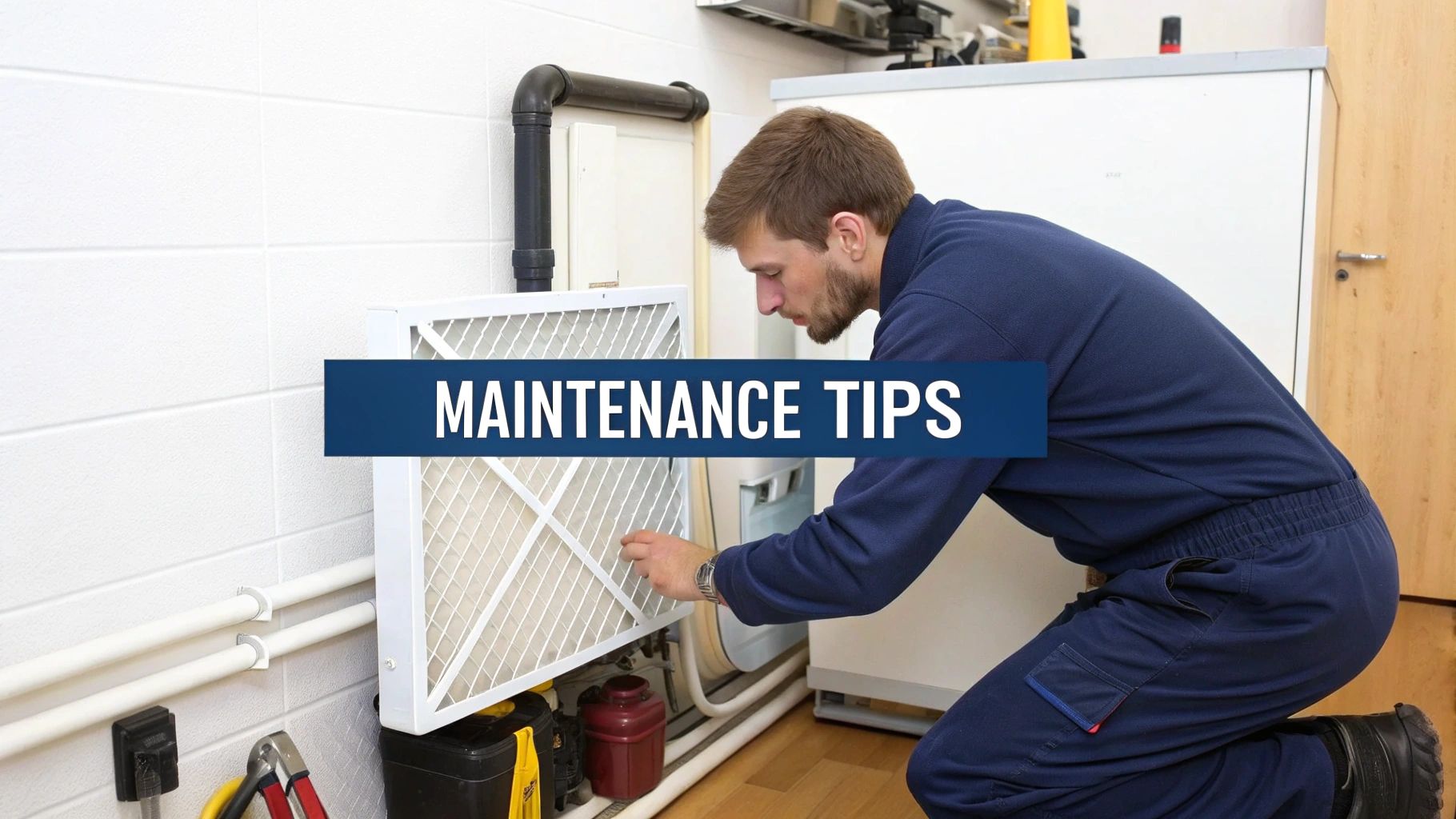
The most important maintenance task is also the easiest: checking and changing the filters. These act as the lungs of your system, capturing dust, pollen, and other airborne particles before they circulate inside your home.
- Filter Checks: You should give your system’s filters a visual inspection every 3 to 6 months. A blocked filter makes the system’s fans work harder, which uses more electricity and reduces the flow of fresh air.
- Replacement Schedule: Most manufacturers suggest replacing filters once or twice a year. This depends on your local air quality and factors like whether you have pets. Replacement filter sets are generally affordable, typically costing between £20 and £50.
Professional Servicing and System Lifespan
While you can handle the basic tasks, scheduling a professional service is vital for the system’s longevity. Just like an annual boiler check, a certified technician will inspect the components you can’t easily see or access.
| Maintenance Task | Frequency | Who Performs It | Key Actions |
|---|---|---|---|
| Filter Inspection | Every 3-6 Months | Homeowner | Visually check for dirt and debris. |
| Filter Replacement | Every 6-12 Months | Homeowner | Swap out old filters for a new set. |
| Valve Cleaning | Every 6 Months | Homeowner | Wipe down interior supply and extract valves. |
| Professional Service | Every 2-5 Years | Certified Technician | Inspect fan motors, clean the heat exchanger core, check ductwork, and rebalance the system. |
A professional service, which is recommended every 2 to 5 years, ensures the internal parts like the heat exchanger core and fan motors are clean and working as they should. This expert check-up is key to maximising the system’s lifespan, which can be 15 to 20 years or even more with proper care. It’s also the perfect time to have the system rebalanced, confirming that the airflow rates are still perfectly matched to your home’s needs. By understanding these straightforward maintenance steps, you can ensure your heat recovery ventilation system remains a reliable and valuable part of your home for many years.
Making The Smart Investment Decision That Fits Your Budget
When looking into a heat recovery ventilation system, it’s natural to focus on the initial price tag. However, the real worth of such an installation isn’t just about the upfront cost. It’s about its lifetime performance, the energy it saves, and the profound improvement it brings to your property. A wise investment means looking beyond the sticker price to see the complete financial picture.
The total cost can differ greatly depending on the system type and how complex the installation is. A single-room, decentralised unit might be fitted for a few hundred pounds, offering a budget-friendly solution for a specific problem like a damp bedroom. In contrast, a fully ducted, centralised system for a four-bedroom house could range from £3,000 to £7,000 or more. This price depends on the property’s layout and whether it’s a new build or a more intricate retrofit.
Calculating Your Return on Investment (ROI)
The key financial question isn’t just “What does it cost?” but rather, “When does it pay for itself?” Your return on investment, or ROI, comes mainly from energy savings. Modern heat recovery ventilation systems can recover over 90% of the heat from the air they extract, leading to a noticeable drop in your heating bills.
To get a rough idea of your potential ROI, consider these points:
- Annual Energy Savings: Look at your current heating costs and apply a cautious saving estimate, perhaps 15-25%. This figure will change based on your home’s airtightness, local energy prices, and your heating habits.
- System and Installation Cost: Always get a clear, itemised quote from a qualified installer.
- Maintenance Costs: Remember to factor in the small annual cost of replacement filters, which is usually between £20 and £50.
By dividing the total installation cost by your estimated yearly savings, you can work out an approximate payback period. For many UK homes, this falls somewhere between 7 and 12 years. Of course, this simple calculation doesn’t put a price on the added benefits of better health and comfort.
Beyond Energy Bills: Property Value and Incentives
An often-missed financial perk is the boost to your property’s value. A professionally installed HRV system is a significant selling point, showing that a home is modern, healthy, and energy-efficient. When weighing up the financial sense of an HRV system, it’s also useful to think about how such an upgrade fits into wider real estate investment considerations, as it directly improves the building’s asset value.
Additionally, UK homeowners and developers should look into available grants and incentives. Schemes like the Boiler Upgrade Scheme or local council initiatives can sometimes offer financial help for energy-efficiency upgrades, which can lower the initial cost considerably. It’s always a good idea to check the latest government and local authority websites for any funding that could make your investment even more appealing.
By taking a full-circle view of the costs, savings, and value-added benefits, you can make a decision with confidence.
At Lùths Services, we specialise in helping you navigate these financial choices. We provide clear, data-driven analysis to find the most cost-effective energy solutions for your property, making sure your investment delivers both immediate comfort and long-term value. Explore how our consultancy can guide your sustainable building project.