
Net zero social housing isn't just a buzzword; it's about creating homes that generate as much energy as they use over a year, effectively wiping out their carbon footprint. This is done through a smart combination of deep energy efficiency retrofits and adding on-site renewable energy generation.
But let's be clear: this is more than a box-ticking exercise. It’s a strategic investment in creating warm, healthy, and affordable homes for the people who live in them.
Charting Your Course to Decarbonisation
Getting started on the journey to net zero can feel like a mammoth task. You're juggling evolving regulations, complicated funding pots, and a huge variety of housing stock. That’s why your first, most critical step is to build a clear, actionable strategy.
A successful roadmap isn't about isolated projects. It’s a fundamental shift in how we approach asset management and upgrades, one that builds a resilient, future-proofed portfolio while putting resident wellbeing front and centre. It's a methodical process that starts with knowing your stock inside-out and ends with happy residents in comfortable, high-performing homes.
The Four Pillars of a Successful Strategy
I've seen many net zero strategies over the years, and the successful ones always stand on four core pillars. If you neglect one, the whole thing can become wobbly, leading to wasted money and poor outcomes for residents.
- Data-Driven Decisions: Everything starts with good data. You need a proper, in-depth assessment of your housing stock—going way beyond a basic EPC rating—to get the baseline right for all future work.
- Fabric-First Principle: Before you even think about installing shiny new tech, you have to sort the building envelope. Prioritising things like insulation, high-performance windows, and airtightness is non-negotiable for cutting energy demand right down.
- Appropriate Technology: Only once you've minimised energy demand should you look at low-carbon systems. This is where you select the right tools for the job, like heat pumps, solar PV, and smart controls that are actually suited to the property type.
- Resident Engagement: Let’s be honest, all the fancy tech and fabric upgrades are useless if residents don't understand how to use them. Continuous, genuine engagement isn't a 'nice-to-have'; it's essential for getting the real-world performance you're aiming for.
This flowchart really brings the process to life, showing how each stage logically builds on the last.
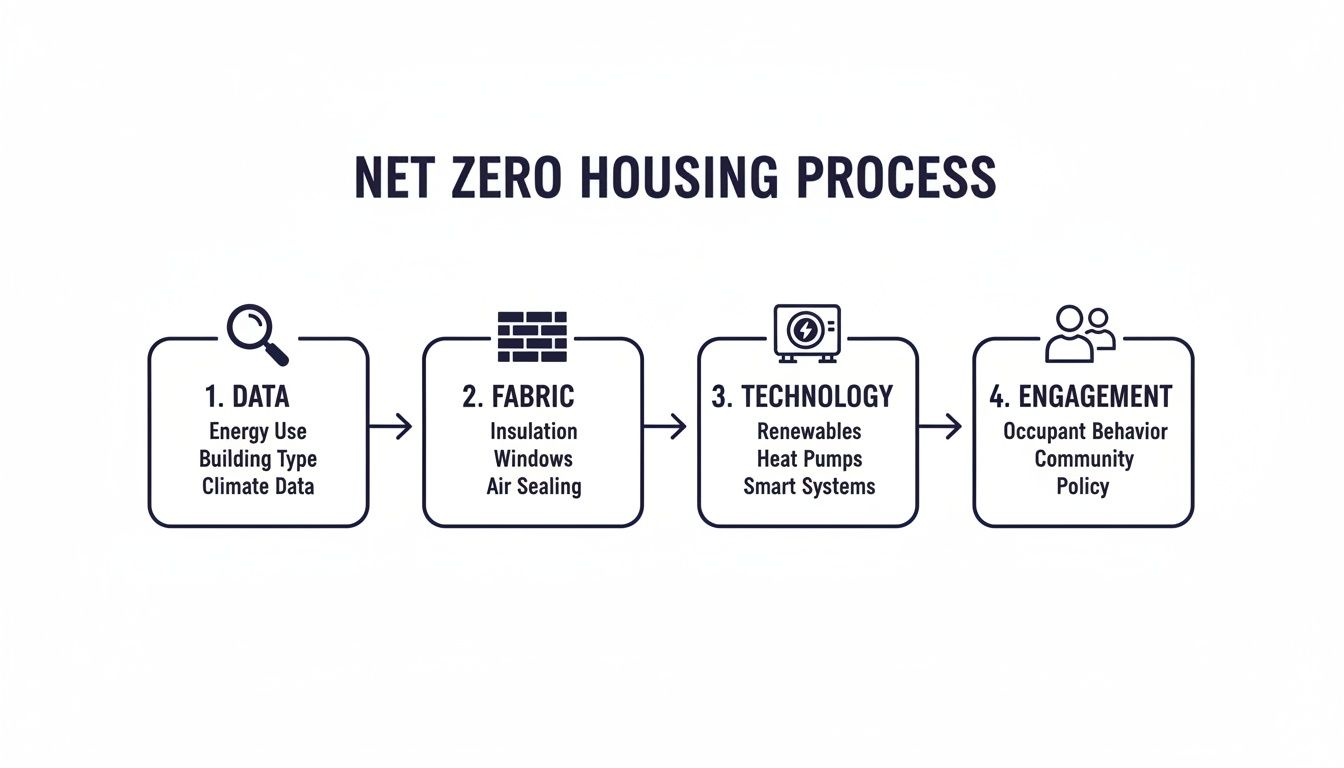
It’s a great reminder that a successful programme is a sequence of deliberate, connected actions, not just a random collection of initiatives.
The journey to net zero is a marathon, not a sprint. A successful strategy acknowledges the entire lifecycle of a building, from the carbon emitted during construction and retrofitting to its operational performance over decades.
To truly understand the full impact of your decisions, you need to zoom out. For a much deeper dive into this, you can learn more about how to assess whole life carbon costs in our detailed guide. Taking this holistic view ensures the investments you make today deliver real, long-term environmental and financial benefits, creating a legacy of high-quality, affordable housing for generations to come.
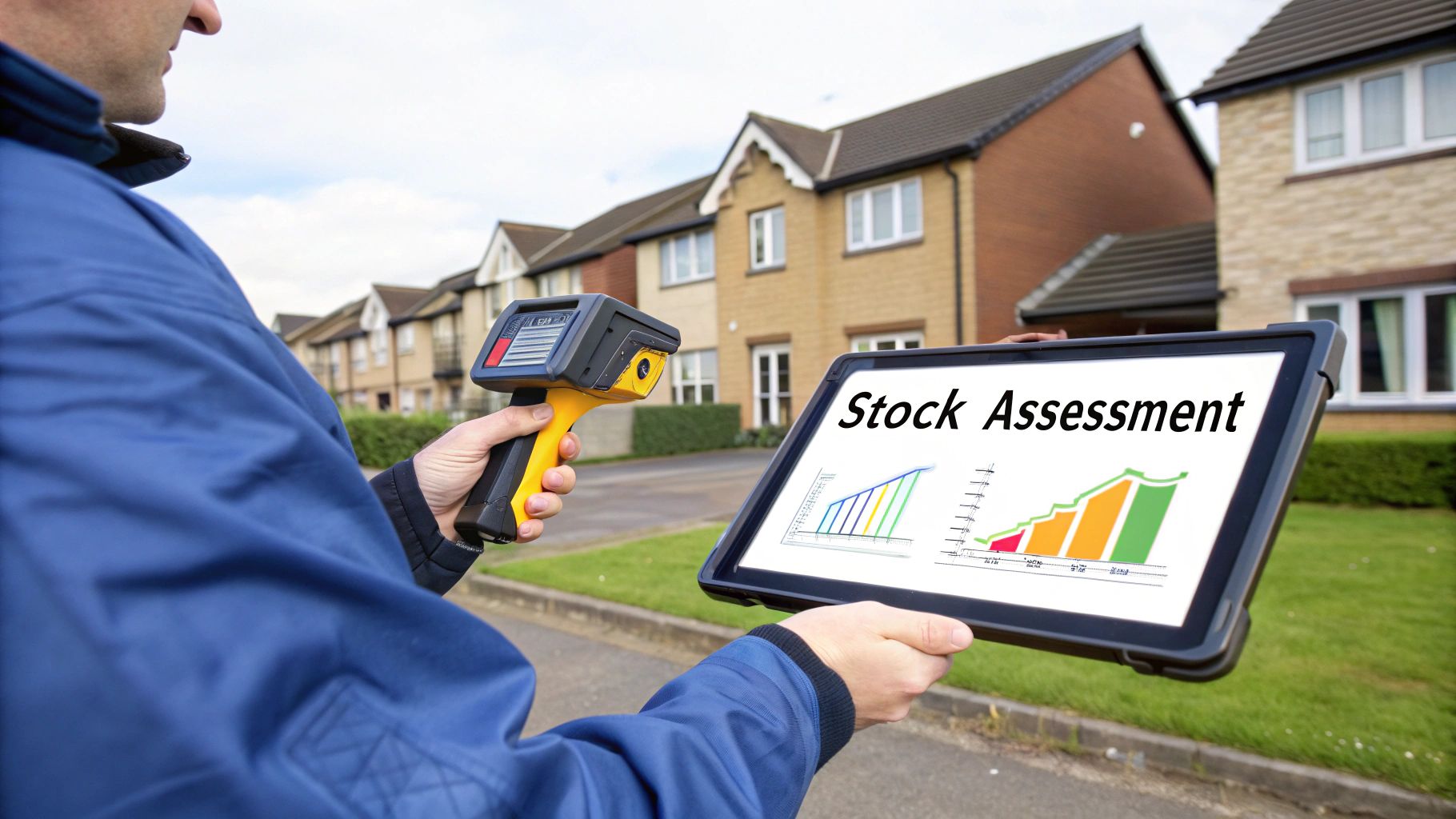
Getting to Grips with Your Housing Stock: A Data-Driven Approach
Embarking on a net-zero journey without first getting under the skin of your housing stock is like setting off across the country without a map. To get beyond guesswork and build a plan that actually works, you have to start with a deep, data-rich understanding of the homes you manage. This isn't just a box-ticking exercise; it's the foundation for every single decision you'll make down the line.
An Energy Performance Certificate (EPC) is a starting point, sure, but it’s only one piece of the puzzle. A proper assessment goes much, much further. It creates a detailed baseline of how your properties perform in the real world, giving you actionable intelligence to shape your entire retrofit strategy, from the quick wins to the deep, long-term overhauls.
Moving Beyond Basic EPCs
Relying only on EPC ratings can be seriously misleading. They’re often based on assumptions and rarely reflect how a home is actually performing or how residents live in it. To get the real picture, you need to layer multiple data sources.
Modern asset management software is a great place to start, as it lets you pull together existing info on property age, construction type, and maintenance history. But to get the granular detail needed for smart planning, you have to supplement this with on-the-ground surveys. Our comprehensive guide on what to expect from building assessment reports shows just how a detailed physical analysis can uncover hidden problems and opportunities you'd otherwise miss.
Physical surveys should be your next port of call. We're talking about:
- Thermal Imaging: Using infrared cameras to literally see where heat is escaping. It’s brilliant for spotting thermal bridges, gaps in insulation, and draughty windows.
- Airtightness Testing: A blower door test is the only way to properly measure air leakage, which is a massive factor in both heat loss and resident comfort.
- Condition Surveys: A thorough look at the state of the building fabric—roofs, walls, windows—to figure out what needs fixing before you even think about upgrades.
Finding Your Property Archetypes
Your housing stock is probably a real mix, from post-war terraces to modern low-rise flats. Trying to apply a one-size-fits-all solution is a recipe for wasted money. The smart move is to group your properties into archetypes based on their shared characteristics.
Common archetypes you might find include:
- Pre-1919 solid brick terraces
- 1950s-1970s semi-detached houses with cavity walls
- 1980s timber-frame homes
- Low-rise or high-rise blocks of flats
Grouping properties this way is a game-changer. It allows you to develop scalable retrofit solutions that can be rolled out efficiently. A fabric-first approach that works for a solid-walled Victorian terrace will be totally different from what’s needed for a 1960s concrete-panel flat. This segmentation makes the whole process of planning, procurement, and delivery far more manageable.
By identifying these archetypes, you can strategically pinpoint the 'low-hanging fruit'—those properties where relatively simple measures can deliver significant improvements. This approach allows for quick, impactful wins that build momentum for your broader net zero social housing programme.
This process also forces you to identify your "hardest-to-treat" homes early on. These are the ones that will need more complex, bespoke solutions and, frankly, a bigger budget. Knowing where they are is crucial for realistic long-term financial planning.
Setting Realistic, Phased Targets
Once you have a crystal-clear picture of your stock, you can start setting achievable targets in phases. The scale of the challenge is massive; social housing makes up 17% of the UK's housing, meaning millions of homes need upgrading. Add to that the government mandate for an EPC C rating by 2030 in England, and the pressure is on to make real progress that also tackles fuel poverty—an issue hitting 17.3% of social housing tenants.
A phased approach breaks this enormous task into manageable chunks. Your roadmap might look something like this:
- Phase 1 (Years 1-3): Go for the 'low-hanging fruit'. This could mean bringing all your EPC D properties up to a C with straightforward measures like cavity wall and loft insulation.
- Phase 2 (Years 4-7): Tackle the moderately difficult homes. This phase might involve external wall insulation and window replacements for specific archetypes you’ve identified.
- Phase 3 (Years 8-10+): Now it’s time for the hardest-to-treat properties. Think deep retrofits, integrating low-carbon heating systems and renewables.
Of course, this plan shouldn't be set in stone. Treat it as a living document that can adapt to new funding opportunities, emerging technologies, and the lessons you learn from the earlier phases. This methodical, data-led approach ensures every pound is spent effectively, moving your portfolio systematically towards a net-zero future.
Prioritising Fabric-First Upgrades and Low-Carbon Systems
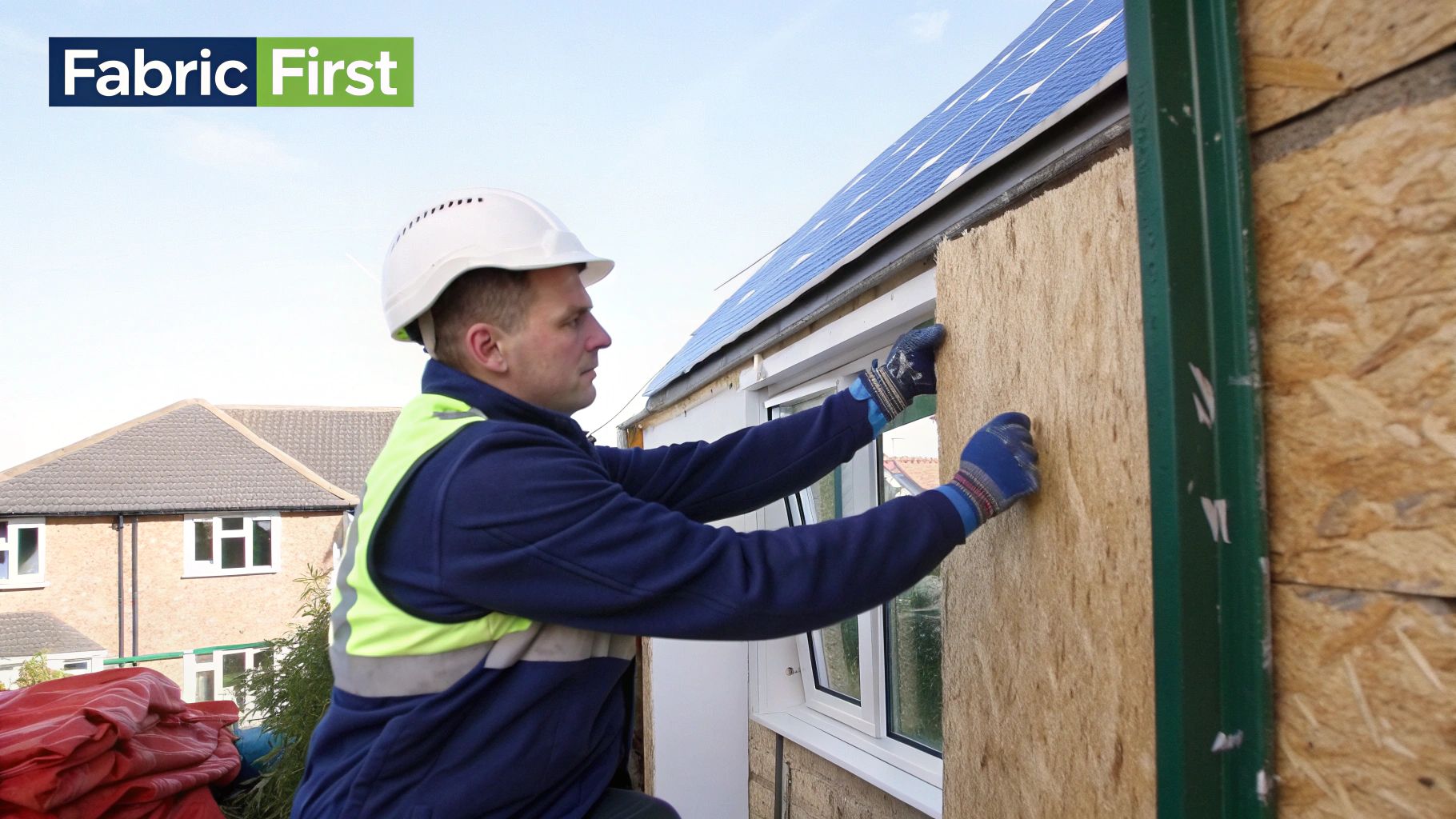
Once you’ve got a clear picture of your housing stock, the real technical work can get underway. The journey to genuine net-zero social housing is built on a simple but critical principle: ‘fabric-first’. This isn't just industry jargon; it's a non-negotiable philosophy that should dictate the entire sequence of your retrofit works.
The idea is straightforward but powerful. You have to reduce a home's energy demand as much as possible before even thinking about how to supply it with low-carbon heat. It’s like trying to fill a leaky bucket—installing a state-of-the-art heat pump in a draughty, poorly insulated property is inefficient, expensive for residents to run, and ultimately frustrating for everyone. The only logical approach is to address the building envelope first.
Strengthening the Building Envelope
When we talk about the 'fabric' of a building, we mean its core structure—the walls, roof, floors, windows, and doors. These elements are the thermal barrier between a resident’s warm home and the outside world. Improving this barrier is the single most impactful and cost-effective step you can take.
Key fabric upgrades to focus on include:
-
High-Performance Insulation: This is the absolute cornerstone of any fabric improvement project. For properties with cavity walls, high-quality blown-in insulation is often a quick win. For solid-walled homes, which are common in older social housing stock, External Wall Insulation (EWI) is usually the best bet. EWI doesn't just boost thermal performance; it also gives the building’s exterior a fresh look and protects the underlying brickwork.
-
Upgraded Glazing: Swapping old single or even early-generation double-glazed windows for modern, high-performance double or triple-glazed units can dramatically cut heat loss. It's important to look at the frames as well as the glass, as thermally broken frames are essential to stop heat from escaping through the structure.
-
Airtightness Measures: You'd be amazed how much heat is lost through uncontrolled draughts. A systematic approach to sealing gaps around windows, doors, loft hatches, and where pipes and cables enter the building is vital. I always recommend an airtightness test before and after the works to quantify the improvement and ensure the quality control is up to scratch.
As part of your fabric-first strategy, exploring various timber cladding solutions can offer a fantastic combination of improved thermal performance and aesthetic appeal. It’s a sustainable material that integrates beautifully with modern EWI systems.
A common and costly mistake is overlooking thermal bridges—areas like window reveals, floor-to-wall junctions, and steel lintels where heat can bypass the insulation. These weak spots can seriously undermine an otherwise well-insulated wall, leading to cold spots and a real risk of condensation and mould.
Properly identifying and dealing with these areas is crucial for a successful retrofit. It's a smart move to bring in specialists for detailed thermal bridge assessments. This is a worthwhile investment that ensures your fabric upgrades perform exactly as designed.
Choosing the Right Low-Carbon Heating System
With the building's energy demand slashed, you can now turn your attention to selecting a low-carbon heating system. A huge benefit of the fabric-first approach is that these systems can be sized to meet the reduced heat load of the property. This makes them smaller, cheaper to install, and more efficient to run than if you'd skipped the fabric work.
The low-carbon heating market is constantly evolving, but a few key technologies have proven themselves as the most viable options for social housing retrofits.
Comparing Heat Decarbonisation Technologies
Here’s a quick rundown of the main contenders. The best choice always depends on the specific property type, location, and the scale of your project. There's no one-size-fits-all answer here.
| Technology | Best Suited For | Typical Upfront Cost | Key Benefits | Main Challenges |
|---|---|---|---|---|
| Air Source Heat Pump (ASHP) | Individual houses and low-rise flats with some external space. | Moderate | High efficiency (300-400%), can provide cooling, eligible for government grants. | Requires space for an outdoor unit, operates at lower flow temperatures needing larger radiators. |
| Ground Source Heat Pump (GSHP) | Developments with available land (for horizontal loops) or space for boreholes (for vertical loops). | High | Extremely high efficiency, very low running costs, long lifespan. | Significant groundworks required, highest capital cost, disruptive installation. |
| District Heat Network | High-density housing like blocks of flats or estates, particularly in urban areas. | Very High (for new networks) | Highly efficient at scale, can use various heat sources (waste heat, biomass), simplifies maintenance for landlords. | High initial infrastructure investment, requires significant resident buy-in and coordination. |
The decision isn't purely technical; it's also strategic. For a portfolio of terraced houses, individual ASHPs are often the most practical choice. For a tower block, connecting to or creating a new district heat network is probably the most efficient long-term solution. You’ll also need to factor in things like local grid capacity and any planning constraints.
Integrating Renewables and Smart Technology
The final layer in achieving net-zero social housing is adding on-site renewable energy generation and smart control systems.
Solar photovoltaic (PV) panels are an obvious choice, allowing homes to generate their own clean electricity. When you pair them with a battery storage system, you can drastically reduce a home's reliance on the grid, slash resident bills, and even provide a backup during power outages.
Beyond generation, smart technologies are key to empowering both providers and residents. Smart thermostats and building management systems can optimise heating schedules based on occupancy and weather forecasts, ensuring energy is only ever used when it's actually needed. This not only boosts efficiency but also gives residents simple, intuitive control over their environment—something that is absolutely vital for the long-term success of any retrofit project.
Securing Funding and Delivering Projects on Budget
A robust technical plan is vital, but let's be honest: the transition to net-zero social housing really hinges on one critical factor. Funding. Without a solid financial strategy, even the most brilliantly designed retrofit programmes can stall before they even begin.
Navigating the complex world of grants, subsidies, and private finance requires a proactive, almost creative approach. The good news is that significant capital is out there. The key is knowing where to look, how to build a compelling business case, and how to blend different funding streams to get the most scale and impact from your project.
This isn't just about securing the initial investment. It’s about delivering the project on time and, crucially, on budget. Every pound spent has to deliver tangible value for both your organisation and your residents.
Navigating the Social Housing Decarbonisation Fund
For UK housing providers, the Social Housing Decarbonisation Fund (SHDF) is the main game in town for financing large-scale retrofits. It’s a substantial, multi-year commitment from the government, specifically designed to kick-start the decarbonisation of the nation's social housing stock.
This fund is already making a real difference on the ground. The SHDF has backed the installation of approximately 104,700 energy efficiency measures, set to improve over 50,800 households by late 2025. With a £3.8 billion government commitment over a decade, it's a genuine cornerstone of the UK's 2050 net-zero ambition. You can explore the latest statistics on the SHDF's progress to see the scale of deployment for yourself.
Successfully bidding for SHDF funding takes more than just a list of properties, though. You need a meticulously prepared application that screams value for money, backed by a robust delivery plan and a strong partnership approach.
A few things I've seen in winning SHDF bids:
- A strong consortium: Partnering with local authorities, experienced contractors, and other housing associations strengthens your bid. It shows scalability and a real depth of shared expertise.
- A data-driven approach: Use that detailed stock assessment data we talked about earlier. It justifies your choice of properties and interventions, proving you're targeting the right homes with the right solutions.
- Clear value for money: Bids are heavily scrutinised for cost-effectiveness. You need to clearly articulate the expected carbon savings, bill reductions for residents, and improvements to health and comfort per pound of public money invested.
- A credible delivery team: You have to demonstrate that you have the project management chops and the supply chain relationships in place to actually deliver the project as promised.
Blending Finance for Maximum Impact
While the SHDF is a powerful tool, it often requires match funding. Relying on a single source of capital can really limit the scope of your ambitions. A much more resilient financial strategy involves blending different pots of money to create a comprehensive funding package.
Think of it as creating a financial mosaic. Each piece contributes to the bigger picture, allowing you to undertake deeper, more impactful retrofits across a much larger number of homes.
The most successful net-zero social housing programmes are those that get creative with their funding. By combining public grants with internal capital and private finance, you can de-risk your projects and achieve a scale that would be impossible with one stream alone.
Consider these potential sources to complement your SHDF grant:
- Internal Budgets: Earmark funds from your planned maintenance and capital works programmes. Retrofits often align perfectly with existing asset management cycles, like roof or window replacements.
- Energy Company Obligation (ECO): This scheme obligates larger energy suppliers to fund energy efficiency measures for low-income households, which can often be layered right on top of SHDF projects.
- Private Finance: Lenders are increasingly offering 'green loans' and other financial products specifically for decarbonisation projects, often with more favourable terms.
- Local Authority Grants: Many councils have their own climate or fuel poverty funds that can contribute to projects happening within their patch.
Avoiding the Pitfalls of Descoping
One of the biggest heartbreaks in project delivery is 'descoping'—that painful process of scaling back a project's ambition because of budget overruns or unforeseen problems. All too often, it means deep retrofit plans get watered down to lighter-touch measures, completely compromising the long-term net-zero goal.
Avoiding this comes down to rigorous planning from the very beginning. The main culprits behind descoping are usually an underestimation of costs and a fragile supply chain. To combat this, you need to build resilience directly into your project plan.
Start by conducting thorough, intrusive surveys on a representative sample of your properties. This moves you beyond a simple desktop analysis and uncovers the hidden complexities that can send costs spiralling later on.
At the same time, engage with your supply chain partners early. Securing commitments from installers and material suppliers with clear, fixed pricing helps protect your budget from market volatility. By anticipating challenges and managing risks from day one, you stand the best chance of ensuring your project delivers on its original promise, creating the truly high-performing, net-zero social housing you set out to build.
Mastering Resident Engagement and Project Delivery
You can have the most technically perfect retrofit in the world, but if the people living in the home aren't on board, it can still fall flat. Getting to genuine net zero social housing performance isn't just about high-spec insulation and fancy low-carbon tech; it's fundamentally about people. A successful project hinges on putting residents right at the centre of your strategy, turning what could be a massive disruption into something collaborative and even positive.
Engagement isn't a one-off briefing or a letter stuffed through the door. Think of it as an ongoing, two-way conversation that has to start long before any tools appear on site. This is how you build the trust needed to navigate the upheaval of major works and make sure residents feel like partners, not just obstacles.
Building a Resident-Centric Engagement Framework
A properly structured engagement strategy is your roadmap for managing expectations and getting that all-important buy-in. It’s what turns residents from passive recipients into active partners in the project's success. Your framework needs to inform, listen, and support them every step of the way.
This kind of proactive communication is absolutely vital for a smooth delivery. Social landlords are often looked to as the leaders in the national retrofit effort, but progress can be painfully slow. Take the SHDF Wave 2.1, for instance—by July 2024, measures had only been completed in 6,519 properties, a tiny 7% of the target.
And here's the kicker: research shows that resident behaviour change can unlock up to 22% of a building’s potential energy efficiency gains. That proves a well-run engagement plan is every bit as critical as the physical work itself. You can dig into the details on these challenges in the full government evaluation report on the SHDF programme.
Your engagement plan should map out a few key touchpoints:
- Initial Consultations: Get people together in community meetings and one-to-one chats. Explain the 'why' behind the project—lower bills, warmer homes, better health—and, most importantly, listen to their worries.
- Managing Disruption: Be brutally honest about the timeline, the noise, and when you'll need access. Give them a dedicated Resident Liaison Officer (RLO) as a single point of contact for any problems that crop up.
- Clear and Simple Training: After the new kit is installed, provide hands-on, jargon-free training for systems like heat pumps or smart thermostats. And don't just talk—leave behind simple, visual guides they can actually use.
A fantastic outcome of getting resident engagement right is a real, measurable jump in overall satisfaction. When people feel heard, respected, and supported, they become champions for the project. That kind of advocacy is priceless for future phases of your programme.
A positive experience reinforces the value of your investment in ways that go far beyond carbon savings. For more ideas, you can explore different strategies for how to improve customer satisfaction and adapt them for your residents.
Ensuring Quality and Operational Excellence
While resident engagement is absolutely crucial, it has to be backed up by flawless project execution. Shoddy work doesn't just destroy resident trust; it can completely undermine the performance of the very expensive measures you’re putting in. Operational excellence is simply about getting it right the first time.
This means keeping a tight rein on your supply chain and having zero tolerance for poor quality. Every single aspect of the installation has to meet the highest standards to deliver the energy savings you've promised and save you from a future of maintenance nightmares.
Here’s where to focus for solid delivery assurance:
-
Supply Chain Coordination: Only work with contractors who have real, proven experience in retrofit projects and get the sensitivities of working in occupied homes. Bringing them in early helps you plan realistic schedules and get a handle on material procurement before it becomes a problem.
-
Quality Assurance Checks: You need a robust QA process with regular site inspections. This should include checking for common failure points, like sloppy insulation around junctions, leaky airtightness seals, and heat pumps that haven't been commissioned correctly.
-
Post-Occupancy Evaluation: The job isn't done when the vans drive away. You must follow up with residents after a few months to see how they’re getting on with their new systems. This feedback is absolute gold dust for making your next project even better.
By marrying a deeply human, resident-focused strategy with meticulous project management, you create a powerful formula for success. This dual focus ensures your investment doesn't just hit its technical and environmental targets but also strengthens your relationship with the very community you serve.
Your Net Zero Social Housing Questions Answered

The journey to net zero always brings up a host of practical, on-the-ground questions. Drawing from our hands-on project experience, this section tackles some of the most common queries we hear from housing providers. We’re aiming to give you direct, actionable answers to help you move forward with confidence.
These are the real-world challenges that come up time and again. Addressing them head-on is the key to a successful decarbonisation programme.
What Is the Biggest Mistake to Avoid in a Retrofit Project?
The most common and costly pitfall we see is installing new technology, like heat pumps, without first dealing with the building's fabric. This "tech-first" approach simply doesn't work.
There's a reason a ‘fabric-first’ strategy is non-negotiable. Putting an advanced heating system into a poorly insulated, draughty home is deeply inefficient. It leads to high running costs, poor performance, and unhappy residents. You have to reduce the home's energy demand first through proper insulation, better glazing, and improved airtightness.
Getting this crucial first step right makes any low-carbon heating system more effective. It can even mean you can install a smaller system, saving significant capital costs and ensuring residents are comfortable from day one.
How Do We Ensure Residents Use New Systems Correctly?
The only way to guarantee new systems deliver their intended benefits is through continuous and early resident engagement. It absolutely cannot be an afterthought tacked on at the end of a project.
The conversation has to start long before any work begins. Focus on explaining the ‘why’ behind the changes—lower bills, better comfort, and improved health for their families.
Once the installation is complete, it’s vital to provide practical, ongoing support:
- Simple Guides: Create clear, visual instructions that avoid technical jargon.
- Hands-on Demos: Offer one-to-one sessions to show residents exactly how to operate new controls and thermostats.
- Dedicated Support: Set up a direct support line for the first few months to answer questions and troubleshoot any teething issues.
When residents feel involved and supported, they become partners in the project. A technically perfect installation that residents don't understand or trust will ultimately fail to deliver its promised energy savings.
A deep retrofit is a significant intervention in someone's home. Building trust and a sense of co-ownership with residents isn't just good practice—it's the foundation of a successful net zero social housing project that performs well for years to come.
Deep Retrofit on Fewer Homes or a Lighter Touch on More?
This is a classic dilemma, and the right answer really depends on your long-term strategy and current funding streams. A 'lighter touch' approach, like getting all properties to a minimum EPC C, delivers widespread benefits quickly and helps meet immediate regulatory goals. It’s a great way to tackle fuel poverty across a broader swathe of your stock.
However, a deep retrofit on a smaller number of homes provides far more profound carbon savings and much greater bill reductions for those residents. Crucially, these projects also act as invaluable pilots, teaching you vital lessons for future, larger-scale work.
Many providers are now using a blended strategy, and it’s often the most effective path. They use broad funding (like ECO) for widespread upgrades while targeting specific funds (like the Social Housing Decarbonisation Fund) for deep retrofits on the harder-to-treat homes. The key is to have a data-led plan that maps a clear pathway to net zero for every single property, even if that journey is phased over several years.
At Luths Services, we specialise in creating practical, data-driven roadmaps for decarbonisation. We help social housing providers navigate every stage of their net-zero journey, from initial stock assessment to project delivery and performance monitoring. Explore our services to see how we can support your project.