
Electric underfloor heating is an appealing modern option, but whether it’s good value comes down to a classic trade-off. It offers the luxury of warm floors with lower upfront installation costs and easy retrofitting, which makes it a fantastic choice for renovations. The catch? This is often balanced by higher long-term running costs compared to traditional wet systems, making its real worth entirely dependent on your specific situation.
Analysing the Value of Electric Underfloor Heating
Deciding if electric underfloor heating is the right move for your UK home requires a clear-eyed look at where and how you’ll be using it. Its appeal is undeniable, especially in projects where you can’t face major disruption. Unlike water-based systems that demand extensive pipework and often a new boiler, electric mats or cables can be laid quickly with minimal impact on floor height.
This makes it a go-to choice for adding comfort in specific zones. Think of a bathroom or kitchen renovation where you want that touch of luxury without having to overhaul your entire central heating system. It’s a perfect fit for that scenario.
However, the main stumbling block is the running costs. With UK electricity prices being significantly higher per unit than gas, using an electric system to heat a large, poorly insulated living space can get expensive fast. Its efficiency really shines when it’s used smartly in well-insulated areas for short, targeted periods.
The core decision isn’t just about initial cost versus running cost; it’s about application. For a small, well-used room like a bathroom, the speed, comfort, and control often justify the expense. For whole-house heating, the financial case becomes much harder to make.
To help you weigh this up, let’s break down the key differences.
Electric vs Wet Systems: A Quick Comparison
| Feature | Electric Underfloor Heating | Wet (Hydronic) Underfloor Heating |
|---|---|---|
| Installation Cost | Lower initial outlay (£40 – £70 per m²) | Higher initial outlay (£70 – £120+ per m²) |
| Running Cost | Higher, tied to electricity prices | Lower, often uses a more efficient gas boiler |
| Installation Speed | Fast (1-2 days for a typical room) | Slower, requires plumbing and screeding |
| Best Use Case | Single rooms, renovations, bathrooms | New builds, whole-house heating systems |
| Heat-Up Time | Quick (30-60 minutes) | Slower (several hours) |
| Maintenance | Virtually maintenance-free | Requires annual boiler/pump servicing |
How Electric Radiant Floor Heating Works

To really get a feel for the pros and cons of electric underfloor heating, you first need to understand how it actually works. Unlike a traditional radiator that heats the air (known as convection), these systems work through radiant heat.
Put simply, they warm up the objects and people in the room directly. This creates a far more consistent and comfortable warmth that rises evenly from the floor up, eliminating the cold spots and draughts that convection systems often leave behind.
It all starts with thin electrical heating elements installed just underneath your floor covering. When you turn the system on, these elements resist the flow of electricity, which generates heat in a very controlled way. It’s this direct heating that gives you that lovely, gentle warmth under your feet.
Choosing Your System Type
Here in the UK, you’ll generally come across two main ways to install electric underfloor heating. Which one you pick really comes down to the shape of your room and the specifics of your project.
- Heating Mats: Think of these as a bit like a rug. They are essentially pre-spaced heating wires fixed onto a mesh mat. You simply roll them out, which makes for an incredibly quick installation in regularly shaped rooms like kitchens or lounges.
- Loose-Wire Systems: If you’re working with a bathroom full of fixtures or a room with awkward angles and pillars, loose wires give you total flexibility. The cable is laid out by hand and secured, letting you customise the layout perfectly around any obstacle.
The core difference isn’t about performance, but practicality. Mats are all about speed and simplicity for standard spaces. Loose wires, on the other hand, offer the precision you need for more complex room designs. Both deliver the same high-quality radiant heat.
The Role of The Thermostat
An electric underfloor heating system is only as good as its controller. The thermostat is the brain of the whole operation, and its job is to regulate temperature and, crucially, stop you from wasting energy.
Modern smart thermostats have become an absolutely critical part of managing running costs. These advanced controllers let you schedule everything with precision, making sure the system only draws power when it’s genuinely needed.
For instance, you could program the bathroom floor to warm up just before your morning alarm and then switch off automatically once you’ve left for work. This level of room-by-room, targeted control is key to maximising comfort while keeping your electricity bills in check—something a centralised heating system just can’t replicate.
Comparing Installation and Running Costs
Let’s get straight to the point: the numbers. When you’re weighing up the pros and cons of electric underfloor heating, a transparent financial breakdown is essential. For most UK homeowners I speak to, the initial investment and the long-term running costs are the biggest factors in their decision.
One of the most compelling arguments for electric systems is the relatively low upfront installation cost. The materials are simply less expensive, and the labour involved is far less disruptive compared to fitting a wet (hydronic) system, which often involves significant plumbing work and laying a new screed floor.
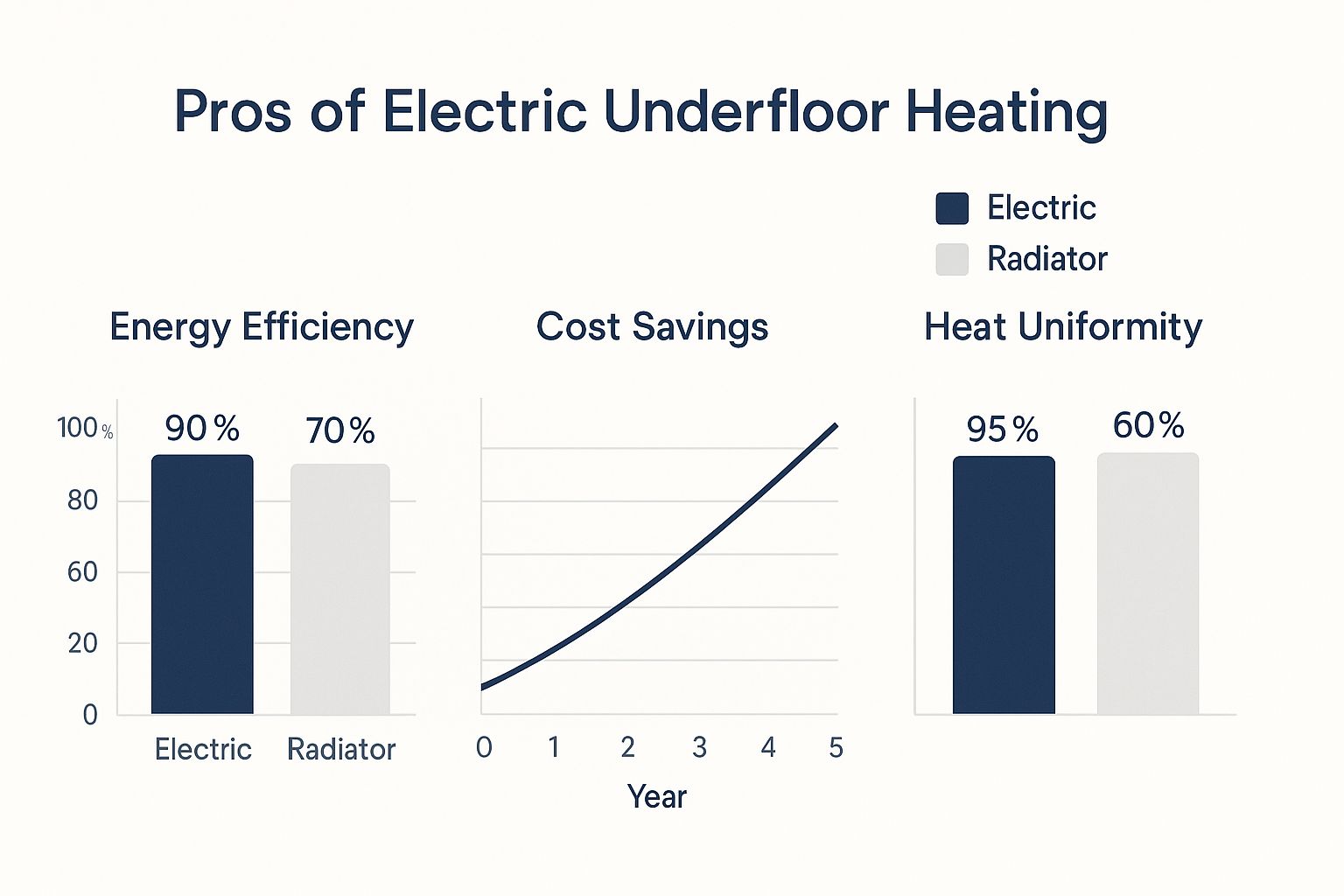
As you can see, the efficiency and even heat distribution can create a much more comfortable environment. Over time, this can lead to a more cost-effective home, despite the higher unit cost of electricity compared to gas.
The Initial Outlay Explained
So, what are we talking about in real terms? The installation cost for electric underfloor heating typically comes in at around £40-£60 per square metre in northern regions like the North West. This figure tends to climb to about £70 per square metre in London and the South East.
To give you a practical example, fitting out a standard 10m² bathroom would likely cost somewhere between £400 and £700. It’s a manageable figure for a single room.
The lower installation expense makes electric systems a fantastic choice for renovations or single-room projects, like a bathroom or kitchen, where connecting to the central heating would be impractical and much more expensive.
Cost Comparison Electric vs Wet Underfloor Heating (Per m²)
To give you a clearer picture, I’ve put together a table breaking down the typical upfront and running costs for both electric and wet systems across the UK.
| Cost Aspect | Electric Underfloor Heating | Wet (Hydronic) Underfloor Heating |
|---|---|---|
| Upfront Installation Cost (Materials & Labour) | £40 – £70 per m² | £100 – £150+ per m² |
| Estimated Annual Running Cost | £9 – £14 per m² | £4 – £7 per m² (Gas Boiler) |
As the table shows, the initial savings with an electric system are significant, but the running costs for a wet system, particularly one powered by a gas boiler, are lower year-on-year.
Understanding Long-Term Running Costs
While the installation is cheaper, the day-to-day running cost is where the equation flips. There’s no getting around it: electricity costs more per unit (kWh) than gas in the UK. This means that heating a large, poorly insulated space with only an electric system can get pricey.
However, that’s not the full story. Several key factors can dramatically reduce these running costs and make the system much more economical:
- Insulation: This is non-negotiable. High-quality insulation boards must be installed underneath the heating system. They act as a barrier, preventing heat from escaping downwards and instead directing it up into the room. This simple step can cut wasted energy by up to 50%.
- Smart Thermostats: Modern smart controls are a game-changer. They give you precise control over scheduling and zoning, meaning you only heat the rooms you’re actually using, when you’re using them. This simple change drastically reduces unnecessary electricity consumption.
- Flooring Choice: The right floor finish makes a huge difference. Hard surfaces like tile and stone are excellent heat conductors, warming up quickly and efficiently. On the other hand, thick carpets with high tog ratings act as an insulator, forcing the system to work harder and longer to heat the room.
By getting these elements right, you can manage the running costs far more effectively. For those aiming to make their properties even more energy-efficient, it’s worth looking into schemes like the Home Energy Scotland Grant which can help fund wider home improvements.
When managed correctly, an electric system’s efficiency and targeted control can deliver that luxurious underfloor heating experience without breaking the bank.
Evaluating Comfort and Energy Efficiency
One of the biggest draws of electric underfloor heating is, without a doubt, the quality of comfort it provides. It’s a world away from traditional radiators, which work by heating the air through convection. This often leads to stuffy rooms with noticeable hot and cold spots. Electric systems, on the other hand, use radiant heat.
This approach warms the room from the floor upwards, heating objects and people directly for a consistent, gentle warmth that feels completely natural. The result is a luxurious feeling that conventional heating just can’t match. You get none of the draughts caused by circulating air, and the system is totally silent, creating a much more peaceful living space.
A Closer Look at Energy Efficiency
When we start talking about energy efficiency, the pros and cons of electric underfloor heating become a bit more complex. The high unit cost of electricity in the UK is a genuine concern for many. While it’s true that electricity is more expensive per kilowatt-hour than gas, that single fact doesn’t paint the full picture of the system’s real-world performance.
Electric systems are incredibly good at turning electricity into heat—virtually nothing is lost in the process. Their real strength, though, is in their rapid response times and precise zonal control. You can heat a single room, like a bathroom, in just 30-60 minutes. There’s no need to fire up your entire central heating system for one small space.
The efficiency of electric underfloor heating is unlocked through smart, on-demand usage. It’s not about whole-house heating; it’s about delivering targeted warmth exactly where and when it’s needed, preventing wasted energy in unoccupied spaces.
This targeted approach means you end up using energy far more intelligently. When paired with smart controls and good insulation, these systems really shine. Data from the Energy Saving Trust in 2025 has already highlighted that combining them with smart thermostats can significantly cut energy use compared to older, less responsive heating methods.
Real-World Efficiency Scenarios
To see how this works in practice, let’s look at a couple of common situations:
- Renovations and Extensions: Installing an electric system in a new extension is much less disruptive than running new pipework from your existing boiler. It’s a self-contained, efficient solution for a new space.
- Supplementary Heating: Imagine a large living room heated by something slower, like an air source heat pump. Electric underfloor heating can give a quick burst of comfort while you wait for the main system to get up to temperature. If you want to know more about those, you can read our guide on the pros and cons of heat pumps.
Ultimately, the long-term running cost of electric underfloor heating has to be viewed as part of broader home energy efficiency strategies. In a well-insulated home, the ability to deliver fast, localised heat often balances out the higher unit cost of electricity, giving you a great mix of comfort and control.
When to Choose Electric Underfloor Heating
Knowing the pros and cons of electric underfloor heating is one thing, but knowing exactly when it’s the superior choice is another. The system really comes into its own in specific, practical situations where the benefits just make more sense than the alternatives.
Electric systems are a perfect fit for renovations and retrofits, especially in bathrooms and kitchens. In these projects, minimalism and practicality are king. The heating mats are so thin they have a negligible impact on floor height, which means you can avoid the headache and cost of altering doorways or skirting boards.
Ideal for Renovations and Extensions
Installation is quick and far less disruptive than trying to extend an existing central heating system. You don’t need plumbers to run new pipework, which simplifies the whole project and keeps labour costs down. For a home extension or a single-room conversion like a conservatory, putting in a self-contained electric system is often the most logical and cost-effective route.
For projects where disruption, installation speed, and preserving existing floor levels are paramount, the practicality of electric underfloor heating is unmatched. It delivers targeted luxury without the complexity of a full plumbing overhaul.
Perfect as a Supplementary Heat Source
Electric underfloor heating also shines when it’s used as a secondary, comfort-focused heat source. Think of a large, open-plan living area that’s mainly heated by radiators or a slower-response system—the floor can still feel quite chilly. Flicking on the electric system gives you a quick burst of warmth right under your feet, making the space feel cosy much faster.
This targeted approach means you don’t have to fire up the entire central heating system just to take the chill off one area. It’s an intelligent way to manage comfort and energy, particularly during those in-between seasons like spring and autumn. This smart application is a key reason the market is growing, with single-family homes expected to hold a 64.2% share of the residential segment by 2025. You can find more data on UK underfloor heating market trends.
Situational Recommendations
To put it plainly, you should be considering electric underfloor heating when:
- You are renovating a single room, particularly a bathroom, kitchen, or conservatory.
- Connecting to the central heating is too disruptive or expensive, like in a new extension.
- You want to add a layer of comfort to a room that already has a primary heat source.
- Quick heat-up times are a priority for spaces you only use intermittently.
Pairing this technology with renewable energy sources makes its appeal even stronger. For anyone looking to maximise sustainability, understanding how a solar power heating system can integrate with your home’s electrical demands is a logical next step. In these specific situations, electric underfloor heating isn’t just a luxury; it’s a practical, efficient choice.
Common Questions About Electric Floor Heating

Even after weighing up the pros and cons, practical questions often linger. Getting these final doubts sorted is key to making a confident decision for your project in the UK. We’ll tackle some of the most frequent queries we hear about installation, flooring compatibility, and what you can expect long-term.
Let’s get straight to the point with clear answers on what you can realistically do yourself, which floor coverings give the best results, and how reliable these systems really are, years down the line.
Can I Install Electric Underfloor Heating Myself?
This comes up a lot—can you save on labour costs by making it a DIY job? While laying the mats or wires is often straightforward for a competent DIYer, the electrical side of things is a different story with strict rules here in the UK.
UK building regulations (Part P) are crystal clear: the final connection to the mains and the thermostat must be handled and certified by a qualified electrician. Trying to do this yourself isn’t just unsafe; it’s illegal and will likely void your home insurance.
So, what parts can you tackle?
- Preparation: You can get the subfloor ready and lay the insulation boards.
- Mat/Wire Laying: You can carefully position the heating mats or secure the loose wires following the manufacturer’s layout plan.
- Resistance Testing: This is a crucial step. You need to test the system’s resistance with a multimeter before, during, and after laying the floor to make sure the cable hasn’t been damaged in the process.
While a partial DIY install can trim the labour bill, getting a professional in for the whole job is often the smart move. They ensure everything is installed correctly, the warranty stays intact, and all legal electrical standards are met, saving you from potentially expensive headaches later on.
What Flooring Works Best with Electric Underfloor Heating?
The performance of your system hinges massively on your choice of floor covering. You want materials with excellent thermal conductivity, as they let heat transfer into the room quickly and efficiently. The wrong choice can trap that heat, leading to poor performance and higher running costs.
Ceramic, porcelain, and natural stone tiles are the gold standard. They heat up fast and hold that warmth brilliantly, making them a perfect match for underfloor heating. Other great options include Luxury Vinyl Tile (LVT), which is also an excellent heat conductor.
Engineered wood is another solid choice, but always check the manufacturer’s maximum floor surface temperature—it’s typically around 27°C. Solid wood can be tricky, as it’s prone to warping with the constant temperature changes.
If you’re set on having carpet, it’s doable, but you have to be careful. The combined tog rating of the carpet and its underlay must be low, ideally under 2.5 tog. Anything thicker acts as an insulator, blocking the heat from reaching the room and forcing your system to work overtime.
How Long Does Electric Underfloor Heating Last?
One of the biggest selling points for electric underfloor heating is its incredible durability and almost non-existent maintenance. Once it’s installed correctly, the heating cables are sealed away under the flooring, safe from any wear and tear.
High-quality systems are genuinely built to last. Top manufacturers are so confident in their products that they often back them with extensive warranties, anywhere from 20 years to the lifetime of the floor covering itself. That offers some serious peace of mind.
Unlike wet systems with their pumps and annual boiler services, an electric system is a true ‘fit and forget’ solution. There are no pipes that can leak or components needing regular check-ups. The only part that might need attention after many, many years is the thermostat, but that’s a simple and affordable swap for an electrician if it ever fails. This reliability is a huge plus when you’re thinking about long-term value.
At Luths Services, we specialise in creating energy-efficient building strategies that balance comfort, cost, and sustainability. If you are considering how to integrate low-carbon heating solutions into your next project, explore our sustainable building consultancy services.


