
Ever left a garden hose lying in the sun? You’ll know the water inside can get surprisingly hot. That simple, everyday effect is the very heart of solar thermal technology. It’s all about using the sun’s raw energy to heat your water directly, a completely different beast to solar PV panels, which are designed to generate electricity.
So, Is Solar Heating a Smart Move for UK Homes?
With energy bills being a constant headache for most of us, it’s no wonder people are hunting for smarter, more sustainable ways to cut costs and lighten their environmental load. This is where looking into solar heating systems in the UK stops being a niche idea and becomes a genuinely practical, forward-thinking choice.
Unlike the often complex world of electricity generation, solar thermal is refreshingly straightforward. It has one job and one job only: heating the water you use every day.
Think of it as giving your boiler a well-deserved holiday. On a good sunny day, a properly installed system can handle almost all your hot water needs, from the morning shower to the evening washing up. This slashes your reliance on gas or electricity, and you’ll see the difference in your monthly bills.
The Real-World Advantages for Homeowners
For anyone weighing up this technology, the benefits go well beyond just saving a few quid. Opting for solar heating is a tangible step towards greener living, directly lowering your home’s carbon footprint. It’s a reliable, mature technology that just quietly gets on with the job in the background.
- Slash Your Energy Bills: By capturing free energy from the sun, you can dramatically reduce the gas or electricity you pay for to heat water. Most systems will provide 50-70% of a typical home’s yearly hot water.
- Lower Your Carbon Footprint: Switching to a renewable heat source is one of the most powerful things a household can do to help the planet.
- Greater Energy Independence: While you’ll still need a conventional boiler or immersion heater as a backup, solar thermal makes you far less vulnerable to the whims of the energy market and its unpredictable price hikes.
A classic myth is that solar heating is useless during the UK’s famously grey weather. The reality is that modern systems are incredibly efficient at absorbing diffuse sunlight. This means they’re still pre-heating your water even on overcast days, ensuring your boiler has much less work to do.
This guide is here to cut through the jargon and demystify the entire process for you. We’ll break down exactly how the technology works, what it’s likely to cost, and the practical steps involved in getting a system installed. Our goal is to give you the clear, honest information you need to decide if solar heating is the right long-term investment for your home.
How Solar Thermal Systems Actually Work
Understanding solar heating systems in the UK is a lot simpler than you might think. Forget complex physics for a moment; the core principle is the same one that warms up a garden hose left out on a sunny day. We’re just capturing that natural heat in a highly efficient way and moving it where you need it most: your hot water tank.
So, let’s follow the energy’s journey from the sun all the way to your shower. It’s a four-stage process, with a few key components all working together seamlessly.
Step 1: Capturing the Sun’s Energy
It all begins up on your roof with the solar collectors (you might hear them called panels). Crucially, these aren’t the same as solar PV panels that generate electricity. Their one and only job is to absorb as much heat as possible from sunlight – even the diffuse light that gets through on a classic overcast British day.
Inside these collectors runs a network of pipes filled with a special transfer fluid, which is usually a mix of water and antifreeze (glycol). As this fluid circulates through the sun-drenched panels, it gets seriously hot.
Step 2: Transporting the Heat
Once the transfer fluid hits the right temperature, a small, low-energy pump automatically kicks in. This pump pushes the hot fluid down from the rooftop collectors through a set of super-insulated pipes. These pipes run discreetly to your hot water cylinder, losing barely any heat on the way down.
You can think of this part of the system as the central nervous system, constantly checking the temperature and moving that captured solar energy efficiently to where it needs to go.
Step 3: Transferring Heat to Your Water
This is where the real magic happens. The hot fluid from the panels flows into a clever device called a heat exchanger, which is basically a coiled pipe sitting inside your hot water cylinder.
Imagine stirring a cold cup of tea with a piping hot spoon. The spoon doesn’t actually mix with the tea, but it efficiently transfers its heat into the liquid, warming it up. A heat exchanger works in exactly the same way, passing the sun’s heat into your water supply without the two fluids ever touching.
The now-cooler transfer fluid is then simply pumped back up to the roof to collect more heat, and this cycle repeats all day long.
Step 4: Storing and Backing Up Hot Water
All that lovely solar-heated water is stored in a well-insulated hot water cylinder, ready for you to use for showers, baths, or washing up. A good quality cylinder can keep water hot for days.
Of course, this is Britain, so solar energy alone isn’t always going to be enough, especially in the depths of winter. That’s why every single solar thermal system works in tandem with your existing boiler or immersion heater.
Your conventional heating system acts as a reliable backup. It senses the water temperature in the cylinder and only fires up if the sun hasn’t quite managed to get it up to your desired temperature. On many days, it will only need to top up the heat a little bit. In summer, it might not need to switch on for water heating at all – and that’s where the big savings are made. This integrated setup ensures you have dependable hot water 365 days a year, whatever the weather is doing outside.
Choosing The Right Solar Heating System
Picking the right solar heating system for your UK home isn’t like buying an appliance off the shelf. The best setup really hinges on your property, our notoriously changeable climate, and of course, your budget. Get it right, and you’re not just investing in some panels; you’re turning sunlight into real, tangible savings on your energy bills for years to come.
The first big decision you’ll face is the type of solar collector to go for. These are the engines of your system, and in the UK, there are two main technologies battling it out, each with its own pros and cons.
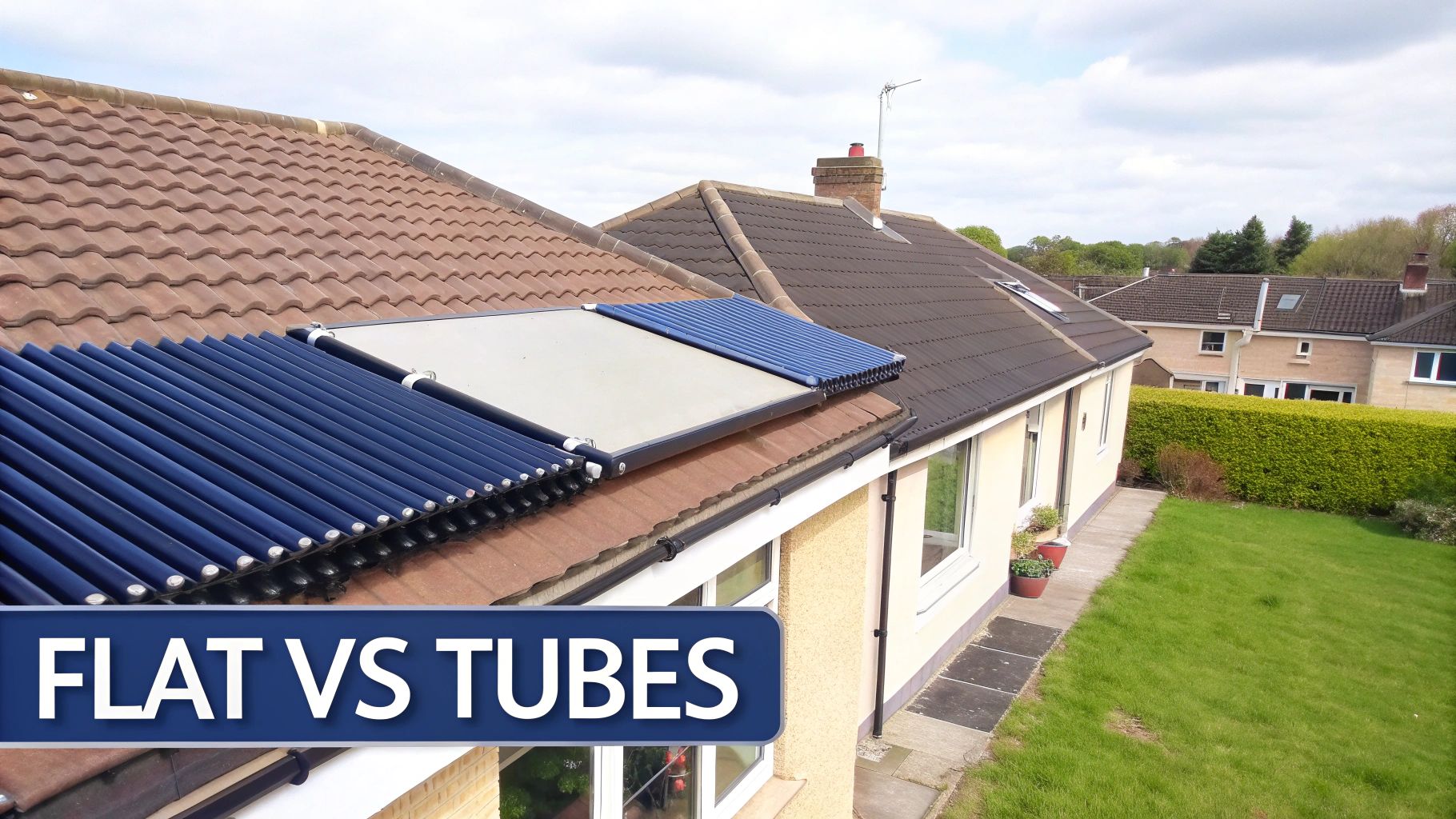
Flat Plate Collectors vs Evacuated Tubes
Think of flat-plate collectors as the dependable workhorse of the solar world. They’re essentially a large, dark plate in a shallow, insulated box with a glass lid. They are sturdy, straightforward, and generally easier on the wallet, which makes them a hugely popular choice for homeowners who want a cost-effective, no-fuss solution.
Evacuated tube collectors, on the other hand, are the high-performance specialists. They’re made up of a row of glass tubes, and inside each tube is an absorber plate. The clever bit is that the air between the inner and outer glass layers is sucked out to create a vacuum—just like in a thermos flask.
This vacuum is a fantastic insulator, dramatically cutting down on heat loss to the outside air. Because of this, evacuated tubes are incredibly efficient, especially on the colder, windier, or overcast days we get so often in the UK.
They do tend to have a higher price tag upfront, but their superior performance can mean bigger long-term savings. This is particularly true for families with a high demand for hot water or for homes in the less sunny corners of the country.
Comparing Solar Collector Types for UK Homes
To help you weigh up the options, here’s a quick side-by-side comparison. It breaks down the key differences to help you decide which collector type might be a better fit for your home and priorities.
| Feature | Flat-Plate Collectors | Evacuated Tube Collectors |
|---|---|---|
| Performance | Good efficiency, especially in direct sunlight. | Excellent efficiency, particularly in cold or cloudy weather. |
| Cost | Generally lower initial purchase and installation cost. | Typically more expensive upfront. |
| Durability | Very robust and durable due to their simple construction. | The glass tubes can be more fragile, but individual tubes can be replaced. |
| Best For | Budget-conscious buyers in sunnier parts of the UK. | Homeowners prioritising maximum year-round performance. |
Ultimately, the choice comes down to balancing your budget against your performance expectations. Both are great technologies, but one will likely suit your specific circumstances better.
Sizing Your System for Your Home
Once you’ve settled on the collector type, the next vital step is getting the size right. A system that’s too small will leave you frustrated and wanting more. Go too big, and you’ve simply paid for capacity you’ll never use. Understanding how to size your solar system for your home’s energy needs is absolutely crucial.
There are two main components to get right: the solar collectors themselves and the hot water cylinder where the energy is stored.
Sizing the Collectors
A good rule of thumb for UK homes is to allow about 1 square metre of solar collector area for each person living in the house.
- 1-2 people: A system of around 2-3 m² is usually a good starting point.
- 3-4 people: You’d probably be looking at a system size of 3-4 m².
- 5+ people: For a larger family, a system of 5 m² or more might be needed.
Following this guideline helps ensure the system can provide a decent chunk (typically 50-70%) of your yearly hot water needs without taking up unnecessary roof space.
Sizing the Hot Water Cylinder
All that lovely solar-heated water needs a place to go. The system works with a dedicated hot water cylinder that has two coils: one for the fluid from the solar panels and a second for your backup boiler. If you don’t have a twin-coil cylinder already, you’ll need one installed.
The tank has to be big enough to store the heat you generate on a sunny day for when you need it later—at night or on a cloudy day. As a baseline, allow 30-50 litres of hot water storage per person.
- 1-2 people: A cylinder of 120-150 litres is generally a good fit.
- 3-4 people: A 180-250 litre cylinder would be more appropriate.
- 5+ people: Look towards a larger cylinder of 300 litres or more.
These numbers are a solid starting point for a conversation with a qualified installer. They’ll do a proper survey, looking at your family’s actual water use, your roof’s orientation, and any potential shading to recommend the perfect setup. Often, this is part of a bigger picture; you can see how it fits with other technologies by comparing options like air source vs ground source heat pumps in our detailed guide.
Costs, Benefits, and Financial Incentives
When you’re thinking about any big home improvement, the conversation always comes around to the numbers. Investing in one of the many solar heating systems in the UK is a significant decision, of course, but it’s one that stops looking like a simple expense and starts looking like a smart, long-term investment once you see the full picture.
So, let’s break down the costs, look at the real-world benefits, and walk through the financial incentives that can make this technology more affordable than you might think.
The Upfront Cost of a Solar Thermal System
The initial outlay for a solar thermal system is usually the biggest hurdle for most homeowners. The final price tag depends on a few things: the size of the system, the type of collectors you go for (evacuated tubes tend to cost more than flat-plate ones), and how complex the installation job is.
For a typical three-bedroom house, you can generally expect a professionally installed system to cost somewhere between £4,000 and £7,000. That figure should cover everything you need to get up and running:
- The solar collectors that sit on your roof.
- A new, compatible hot water cylinder, if your current one isn’t up to the job.
- The pump, controller, and all the insulated pipework.
- Professional installation and commissioning by a qualified engineer.
- VAT on all the parts and the labour.
It might seem like a hefty sum, but it’s vital to weigh it against the backdrop of ever-rising energy prices and the savings the system will deliver for years to come.
Calculating Your Return on Investment
The real magic of a solar thermal system is in the savings it racks up, year after year. By generating up to 70% of your home’s annual hot water for free, you seriously cut down how much you rely on your gas or electricity supply. The payback period—how long it takes for the system to pay for itself through savings—really hinges on how much hot water your family uses and what you’re currently paying for energy.
For a typical family, a solar thermal system can knock between £80 and £120 off your annual energy bills. When you look at the bigger picture, including the latest energy price cap developments, you can see how renewables offer a bit of financial stability, shielding you from future price hikes. This makes for a compelling case that only gets stronger as traditional energy costs climb. For a deeper dive into the numbers, our guide explores if solar thermal is cost-effective in the UK in more detail.
Unlocking Government Financial Support
To help nudge the UK towards renewable heat, the government is offering some pretty significant financial help. The main incentive for homeowners looking at solar thermal is the Boiler Upgrade Scheme (BUS).
The Boiler Upgrade Scheme isn’t just a discount; it’s a government grant designed to make green technology a realistic choice for more households. It cuts the upfront cost directly, making the decision to switch a whole lot easier.
The scheme provides a one-off grant to help with the cost and installation of low-carbon heating systems. To qualify, your property needs to be in England or Wales and have a valid Energy Performance Certificate (EPC) without any outstanding recommendations for loft or cavity wall insulation.
The grant process is refreshingly simple because your installer handles it for you. Here’s how it works:
- Find an MCS-certified installer: Only installers certified under the Microgeneration Certification Scheme can get the grant for you.
- Get a quote: The installer will price up the job, with the grant amount already factored in.
- Installer applies for the grant: Once you give the go-ahead, your installer takes care of the BUS application.
- Grant is deducted from your bill: The grant value comes straight off the total amount you pay. Simple as that.
This scheme is a massive help in making solar heating systems in the UK a more attainable and financially sound choice. The UK’s commitment to renewables is clear; in a recent year, renewables made up 37% of our energy supply, overtaking fossil fuels for the first time. The appetite at home is growing too, with solar installations now topping 1.7 million nationwide.
Planning Your Solar Thermal Installation
Right, so you’ve decided a solar thermal system is the way forward. That’s a brilliant step, but now for the practical bit: making it happen. Think of this section as your roadmap, guiding you through the essential property checks, the legal bits and bobs, and the crucial task of finding a top-notch professional to put it all together.
A successful installation doesn’t start with a panel being hoisted onto your roof. It begins much earlier, with a realistic look at your property to make sure it’s actually a good fit for harnessing the sun’s power.
Assessing Your Property’s Suitability
Before you even think about getting quotes, a few quick checks can tell you if solar thermal is a genuine option for your home. These are the very first things any installer will look at during a proper survey.
First up, your roof’s orientation. For the best performance here in the UK, you’re looking for a roof that faces anywhere from east to west through south. A perfectly south-facing roof is the ideal, but you can still capture a surprising amount of energy on roofs facing south-east or south-west.
Next, you’ll need the space. The collectors need a clear, shadow-free spot of about 2 to 5 square metres. It’s vital that this area isn’t shaded by trees, chimneys, or the neighbour’s new extension, especially during the middle of the day when the sun is at its most powerful.
Finally, your roof structure has to be sound enough to hold the weight of the panels. Any decent installer will confirm this, but if you know your roof is getting on a bit or isn’t in the best shape, it might need some strengthening work first.
Understanding Planning Permission
Here’s some good news. For most homeowners, putting up solar thermal panels is considered ‘permitted development’, which is a fancy way of saying you probably won’t need planning permission.
Permitted development rights let homeowners make certain changes to their property without a formal application, as long as the work meets specific rules. For solar panels, this usually just means they can’t stick out too much from the roofline.
But, there are always exceptions. If you live in a listed building, a conservation area, or a World Heritage Site, you’ll almost certainly need to get consent before you start. If you’re in any doubt at all, the best thing to do is have a quick chat with your local planning authority.
Finding a Certified Installer
This is, without a doubt, the most important part of the whole process. The quality of the installation directly affects how well your system works, how safe it is, and how long it lasts. In the UK, the gold standard for renewable energy installers is the Microgeneration Certification Scheme (MCS).
Choosing an MCS-certified installer isn’t just a good idea; it’s non-negotiable. It’s a must-have if you want to access government grants like the Boiler Upgrade Scheme (BUS). More importantly, it’s your guarantee that both the installer and the kit they’re using meet strict quality standards. Solar has grown massively, with UK capacity shooting up by over 18,000% since 2010. You can find out more about this incredible growth and how around 1.6 million homes now use solar by looking into the latest UK solar statistics.
A certified pro will give you a proper quote, carry out a detailed survey, and make sure your system is set up perfectly for maximum efficiency.
Key Questions to Ask Potential Installers
Once you’ve got a shortlist of MCS-certified installers, it’s time to dig a little deeper to find the right one for you. Don’t be shy about asking plenty of questions—a good installer will be happy to answer them.
Here’s a handy checklist of things to ask:
- Experience: “How many solar thermal systems have you installed around here?” Local experience is a huge plus, as they’ll know the regional conditions.
- Warranties: “What warranties do you provide for the installation work itself, and for the parts like the panels and the pump?”
- Equipment: “Which brands of collectors and hot water cylinders do you suggest, and why?” This helps you figure out if they’re recommending what’s best for you or just what they like to sell.
- Performance Estimate: “Can you give me a detailed estimate of how the system should perform and what I might save on my energy bills?”
- Timeline: “What’s the rough timeline from signing the contract to having the system up and running?”
- Aftercare: “What sort of aftercare or maintenance packages do you offer once the job is done?”
Taking the time to plan carefully and pick the right partner will make sure your investment in a solar heating system in the UK gives you reliable, free hot water for many years to come.
Right then, your new solar heating system is installed and the sun’s decided to make an appearance. So, how do you squeeze every last drop of value from your investment? Maximising the performance of solar heating systems in the UK doesn’t mean you need a degree in engineering; it’s mostly about smart habits and a little bit of upkeep.
A small tweak to your daily routine can make a world of difference. Try timing jobs that use a lot of hot water, like running the dishwasher or the washing machine, for sunny afternoons. When you do this, you’re using the solar-heated water directly from the cylinder. This simple change means your backup boiler doesn’t have to fire up as often, saving you money.
It’s also about having realistic expectations. Your system’s output will naturally change with the seasons. In summer, you can expect it to cover most, if not all, of your hot water needs. But during the shorter, cloudier days of winter, it’ll act more like an efficient pre-heater, taking the chill off the water so your boiler only has to do the final bit of work.
Smart Habits for Solar Efficiency
To really get the most from your system, a few energy-conscious behaviours will go a long way:
- Time Your Chores: As we mentioned, try to run appliances that need hot water when the sun is at its peak, usually between 11 am and 3 pm.
- Spread Out Usage: It’s best to avoid using all your hot water in one go. Spacing out showers gives the system a chance to recover and reheat the water in the cylinder using that free energy from the sun.
- Insulate Your Home: It sounds obvious, but a well-insulated house holds onto its heat for much longer. Our guide on thermal bridge assessments explains how finding and fixing these hidden heat-loss spots can cut your overall energy demand even further.
Essential Low-Effort Maintenance
Looking after your investment is pretty straightforward. A few simple checks now and then will keep your system running smoothly for its entire 20+ year lifespan. Keep an eye out for any obvious leaks and glance at the system’s pressure gauge occasionally to make sure it’s stable. It’s also a good idea to have a professional check the antifreeze fluid in the panels every few years to make sure it’s still doing its job.
The potential for solar in the UK is growing faster than you might think. In the first five months of one recent year, solar power generation hit a record high, accounting for an incredible 11.6% of the country’s electricity in May. This just goes to show how effectively we can capture the sun’s energy, even with our famously variable climate. You can dig into the data behind the UK’s solar surge on Carbon Brief.
Your Solar Heating Questions Answered
When you’re thinking about a big home improvement like solar thermal, it’s completely normal to have a list of questions. Getting clear, straightforward answers is what turns uncertainty into a confident decision. So, let’s get into some of the most common queries we hear from UK homeowners about the practicalities of solar water heating.
This section tackles the big questions, from how much hot water you’ll actually get to whether your property is a good fit.
How Much Hot Water Will a Solar System Give Me?
This is usually the first question on everyone’s lips, and for good reason. A well-designed, professionally installed solar thermal system in the UK will typically cover between 50% and 70% of your home’s total hot water needs over a year.
Of course, this figure ebbs and flows with the seasons. During the long, sunny days of summer, your system could easily meet close to 100% of your hot water demand. That means your boiler might barely kick in at all for weeks on end. Come winter, its role changes to pre-heating the water, giving your boiler a massive head start and still cutting down the energy needed to get it up to temperature.
Think of your solar thermal system less as a replacement for your boiler and more as its new, hardworking partner. It does the heavy lifting whenever the sun is out, letting your conventional system step in only when absolutely necessary. That’s the secret to unlocking real energy savings.
What Happens on a Cloudy Day?
It’s a common myth that solar panels need blazing sunshine to do their job. While they are at their best in direct sun, modern solar heating systems in the UK are incredibly good at capturing diffuse light—the light that still gets through on an overcast day.
They won’t generate as much heat as they would on a clear, bright day, but they are still working away, warming the fluid in the collectors. This pre-warmed water still makes a big difference, so even on the greyest of British days, your system is still chipping away at your energy bills.
How Long Will the System Last?
Solar thermal systems are built to be tough and have a very long lifespan. The panels themselves are incredibly robust, designed to withstand whatever the British weather throws at them for decades.
With just a little bit of basic maintenance, you can expect a high-quality solar thermal system to last for 20 to 25 years, and often even longer. This longevity is a massive plus when you’re looking at the overall return on your investment, promising many years of free hot water.
Is My Home Suitable for Solar Water Heating?
The good news is that most homes in the UK are suitable. However, a few key factors will determine just how well a system will perform on your property. Here’s a quick checklist to get you started:
- Roof Direction: You need a roof that faces anywhere from east to west, through south. A directly south-facing roof is the gold standard.
- Shade-Free Space: You’ll need a clear patch of roof, free from shadows cast by trees or other buildings, of about 2–5 square metres to mount the panels.
- A Hot Water Cylinder: You must have space for a dedicated solar hot water cylinder. This is usually located in an airing cupboard.
An MCS-certified installer can carry out a proper survey to confirm everything and give you a solid estimate of how the system would perform on your home.
Ready to see how solar heating could cut your property’s energy costs and carbon footprint? Luths Services offers expert, independent guidance on sustainable building solutions, from the first feasibility checks to the final installation. Contact us today to discuss your project.


