
At its heart, a solar heating system is a very simple idea. It captures the sun’s energy to heat your water, taking a massive load off your traditional boiler. Think of it like a garden hose left out on a sunny day – the water inside gets warm. Solar thermal technology just refines and supercharges that basic principle to heat the water for your taps, showers, and even to give your central heating a bit of a boost.
It’s a straightforward way to slash your energy bills and shrink your carbon footprint.
How Solar Heating Systems Turn Sunlight into Hot Water
First things first, let’s clear up a common mix-up. We’re talking about solar thermal systems, which are specialists dedicated to one job: heating water. They’re often confused with solar photovoltaic (PV) panels, which generate electricity.
Imagine the solar collectors on your roof as a powerful sponge soaking up sunlight. Inside these panels is a network of pipes filled with a special heat-transfer fluid, usually a mixture of water and antifreeze. As the sun beats down on the collector’s dark, absorbent surface, this fluid gets incredibly hot.
The Journey from Rooftop to Tap
Once the fluid reaches the right temperature, a small, efficient pump kicks in automatically. It circulates the hot fluid down from the roof through a sealed loop of pipework and into your hot water cylinder. But this isn’t just any old cylinder; it’s a specially designed twin-coil model that makes the magic happen.
- The Solar Coil: The super-hot fluid from the collectors flows through a coil at the bottom of the cylinder. It works just like the element in a kettle, transferring its heat to the water stored in the tank without ever actually mixing with it.
- The Conventional Coil: A second coil sits higher up in the tank, connected to your regular boiler or heat pump. This is your backup, making sure the water is always piping hot, even on the greyest winter days.
After giving up its heat, the now cooler fluid is pumped back up to the roof to start the cycle all over again. This loop runs continuously whenever there’s enough sun to make it worthwhile, providing a huge chunk of your home’s hot water completely free of charge. If you want to dive deeper into the nuts and bolts, there’s a wealth of information available on solar water heating systems.
Supplementing Your Existing System
It’s important to be realistic about the UK climate. A solar heating system is designed to work with your main heating source, not replace it entirely. It acts as a powerful teammate to your boiler or heat pump, dramatically cutting down how often it needs to fire up.
On average, a well-designed solar thermal system can provide up to 60-70% of a household’s entire yearly hot water needs. That means your boiler runs less, saving you money on fuel and reducing wear and tear on the appliance itself.
Through the summer, the system can often cover 100% of your hot water demand – think free hot showers for months on end. In spring and autumn, it does the heavy lifting by pre-heating the water significantly, so your boiler only needs a short burst to get it to the final temperature. Even on a bright winter’s day, it’ll still take the icy chill off the incoming mains water, delivering valuable energy savings when you need them most.
Choosing the Right Solar Heating Technology
Getting your solar heating system right starts with picking the right components. This isn’t a one-size-fits-all situation; the best choice for you will come down to your home’s location, your budget, and what you expect the system to deliver. At the heart of it all are the solar collectors, and you’ll mainly come across two types.
Think of it like choosing a car. You could go for a sturdy, reliable estate that gets the job done without any fuss, or a sleek, high-performance model that costs more but delivers exceptional results in all conditions. That’s pretty much the difference between flat-plate and evacuated tube collectors.
Flat-Plate Collectors: The Dependable Workhorse
The most common sight on UK rooftops, and for good reason, are flat-plate collectors. These are the industry’s workhorses, known for being tough, reliable, and straightforward. At its core, a flat-plate collector is a simple, weatherproofed box with a dark absorber plate sitting under a sheet of toughened glass.
This simple design makes them incredibly robust and generally cheaper than their more sophisticated cousins. They work brilliantly in direct sunlight, making them a fantastic, cost-effective option for many homes, especially if you’re in a sunnier part of the country. Their only real downside is that they can lose a bit more heat to the atmosphere, particularly on very cold or windy days, which can dip their efficiency during the winter months.
Evacuated Tube Collectors: The High-Performance Option
If you’re after maximum efficiency, particularly through the UK’s often grey and chilly seasons, then evacuated tube collectors are the premium choice. Instead of one large panel, these systems use a row of glass tubes. Inside each tube is an absorber plate, but the crucial part is that the air has been pumped out to create a vacuum.
That vacuum is the secret to their success. It works just like a thermos flask, acting as a perfect insulator and drastically cutting down heat loss to the outside air.
Because of this, evacuated tube collectors really shine:
- They excel in diffuse light, meaning they still capture energy effectively even on overcast days.
- They perform much better in cold weather, as the vacuum stops the cold air from chilling the absorber plate.
- They can achieve higher temperatures, making them suitable not just for hot water but also for contributing to your central heating.
All this extra performance does come with a higher price tag. However, the extra energy they generate all year round often means the initial investment pays for itself with bigger savings over the system’s lifetime.
To help you visualise the difference, we’ve put together a simple comparison.
Comparing Solar Thermal Collector Technologies
This table breaks down the key differences between the two main collector types, helping you weigh up the pros and cons for your specific needs.
| Feature | Flat-Plate Collectors | Evacuated Tube Collectors |
|---|---|---|
| Best For | General domestic hot water in sunnier climates. | Maximum year-round performance, especially in the UK. |
| Efficiency | Good, especially in direct sunlight. | Excellent, particularly in cold or overcast weather. |
| Cost | Lower initial investment. | Higher initial investment. |
| Durability | Very robust and durable due to simple construction. | Generally durable, but individual tubes can be fragile. |
| Appearance | A single, solid panel on the roof. | A series of tubes, which some find more modern. |
| Cold Weather Performance | Can lose efficiency on very cold or windy days. | Superior performance due to vacuum insulation. |
Ultimately, both are excellent technologies. The choice really boils down to balancing your upfront budget against your long-term efficiency goals.
The infographic below shows the average efficiency you can expect from different solar collector types.
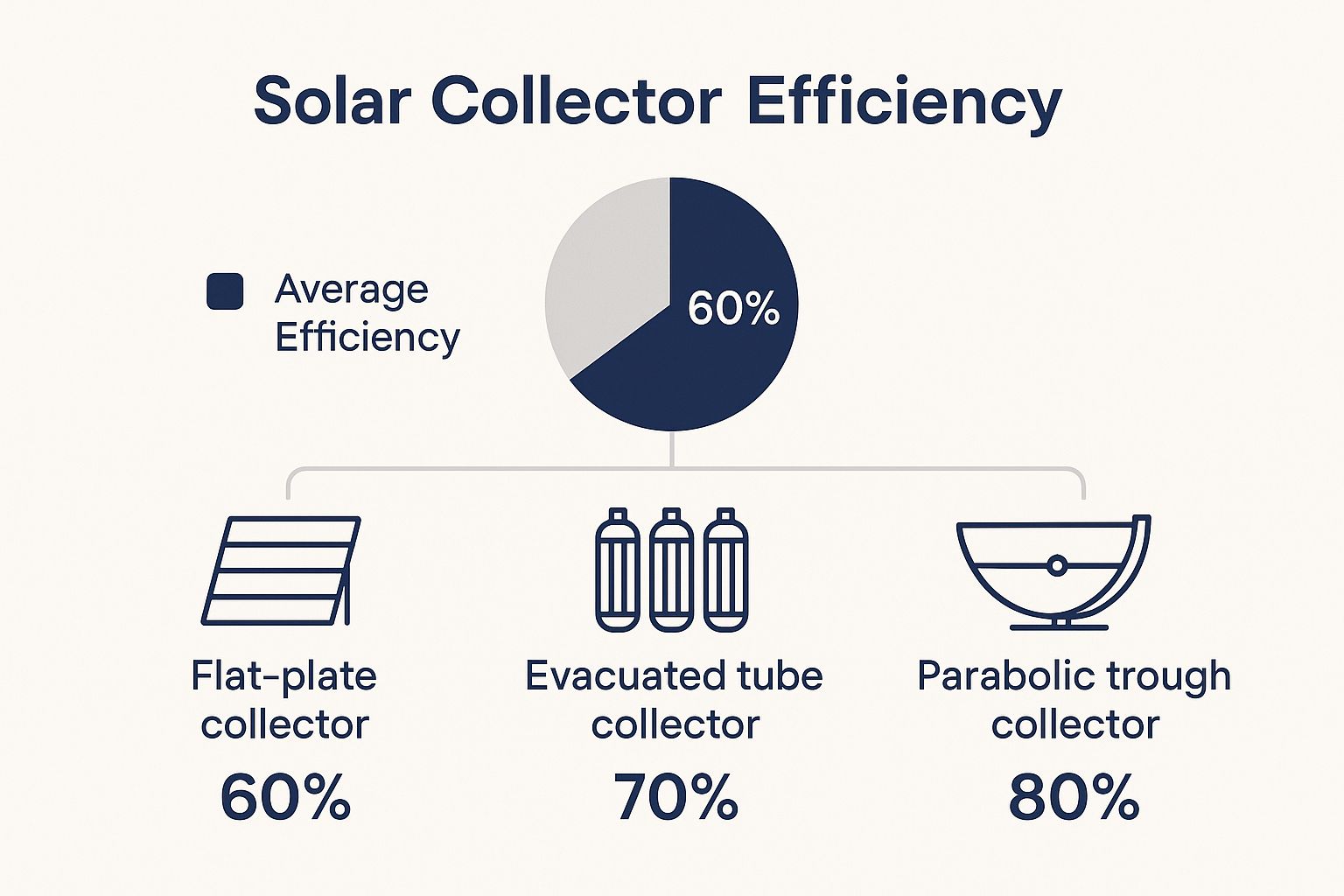
As you can see, there’s a clear performance difference, with evacuated tubes offering a significant efficiency boost for the kind of solar heating systems we typically install in homes.
Active vs Passive Solar Heating Systems
Beyond the collectors, you’ll also hear people talk about ‘active’ and ‘passive’ systems. In the UK, the overwhelming majority of installations are active systems. These use a small, efficient electric pump to circulate the special fluid that transfers heat from the collectors on your roof down to your hot water cylinder. This gives you precise control and ensures you capture as much heat as possible.
Passive systems, on the other hand, don’t use a pump. They rely on the natural process of convection—the simple fact that hot water rises—to move the fluid around. While they are simpler, with no moving parts to worry about, they have a major drawback for UK homes: the storage tank must be positioned higher than the collectors. That’s just not practical for most houses.
For this reason, active systems are the standard, offering far more flexibility and reliability. These systems are often paired with other modern heating technologies; you can read more about this in our guide on air source vs ground source heat pumps.
Key Takeaway: The choice between flat-plate and evacuated tube collectors is a classic trade-off between budget and performance. Flat-plate is a solid, reliable choice, while evacuated tubes give you superior efficiency all year round—a massive plus in the unpredictable UK climate.
Why Solar Is a Mainstream UK Energy Solution
Thinking about solar heating? You’re not alone. What was once seen as an experiment for the eco-conscious has firmly planted itself as a smart, practical choice for UK homeowners. Over the last decade, solar power has quietly shifted from the fringes to become a cornerstone of our national energy strategy. It’s a proven and reliable choice.
This wasn’t an accident. It’s a direct response to some very real pressures we’re all feeling. Rising bills for traditional fuels have made everyone more conscious of their energy spending, while a collective desire to be a bit more self-sufficient has pushed renewable solutions right to the front of the queue.
The Sheer Scale of Solar Growth in Britain
The growth of solar across the UK has been nothing short of explosive, cementing its status as a proper mainstream technology. We’re not talking about a few scattered installations here and there; this is a fundamental change in how the country gets its power, driven by millions of individual homes and businesses.
The numbers really tell the story. The UK’s installed solar capacity has skyrocketed, hitting 19 gigawatts (GW) as of July 2025. To put that in perspective, that’s the equivalent of around 4.2 million typical home solar setups.
To really grasp how quickly things have changed, back in 2010, the UK had just 0.0937 GW of solar capacity. That’s a jump of over 18,000% in just 15 years. You can dig into the specifics by exploring the latest UK solar energy statistics.
What this rapid expansion means for you is that a robust, professional industry is now well-established. From certified installers to equipment suppliers, the whole ecosystem is mature. That means quality, reliability, and competitive pricing are the norm.
Key Drivers Behind the Solar Boom
So, what’s behind this surge in popularity? It’s a mix of good old-fashioned financial sense, helpful government oversight, and a genuine public desire to do things a bit better.
Three big drivers stand out:
- Volatile Energy Prices: The unpredictable and often soaring cost of gas and electricity has made the stability of solar incredibly appealing. A solar heating system essentially lets you lock in a chunk of your energy costs for decades, shielding your household from those wild market swings.
- Government Support and Frameworks: Schemes like the Microgeneration Certification Scheme (MCS) have been crucial. They provide a quality assurance framework that gives homeowners confidence. You know the tech is sound and the installers are competent, ensuring your system is safe, reliable, and does what it says on the tin.
- Growing Environmental Awareness: Let’s face it, more of us are thinking about our carbon footprint. Installing a solar heating system is one of the most direct and powerful ways to cut your household’s emissions, helping the UK meet its wider climate goals.
Opting for a solar heating system today doesn’t make you an early adopter testing out new tech. It means you’re joining millions of others who have embraced a proven, financially sound solution that delivers real, long-term savings and energy security.
This powerful combination of economic reality, solid regulation, and environmental common sense has cemented the place of solar heating systems in the UK. The technology isn’t a “one day” concept anymore; it’s a practical, mainstream solution delivering real benefits to homes up and down the country, right now.
Crunching the Numbers: Solar Heating Costs and Savings
When you’re thinking about a big home improvement like a solar heating system, the conversation inevitably lands on the numbers. You need a solid grasp of what it’ll cost upfront and, just as importantly, what you’ll get back over the long run. Let’s break down the investment and the savings you can realistically expect on your energy bills.
For a professionally installed solar thermal system here in the UK, you’re typically looking at an initial cost somewhere between £4,000 and £6,000. Of course, that’s not a one-size-fits-all figure. A few key things will move that price tag up or down.
The biggest factor is the size of the system you need, which is all down to your family’s hot water habits. Then there’s the type of collector you go for – the more budget-friendly flat-plate panels or the higher-performance evacuated tubes. Finally, the job itself can throw up variables; the condition of your roof or the layout of your existing plumbing can make the installation more complex. My advice? Always get a few quotes from different MCS-certified installers to make sure you’re getting a fair price for a quality job.
Seeing a Return on Your Investment
While the initial outlay is what most people focus on, the real story of solar heating is told over years of lower energy bills. A properly designed system can genuinely slash your water heating costs by up to 70% each year. For a typical family, that can easily add up to hundreds of pounds in savings annually, especially if you’re moving away from a more expensive fuel source.
This is where we get to the return on investment (ROI) – the point where the system has officially paid for itself through savings. The time it takes to hit this milestone is called the payback period, and it’s influenced by a few things:
- Your Current Fuel: The savings really stack up if you’re replacing expensive fuels like electricity or oil. Switching from mains gas will still save you money, but the payback will be longer.
- Rising Energy Prices: This one works in your favour. As the cost of conventional energy creeps up, the free energy from your roof becomes more valuable, shortening that payback time.
- System Performance: A well-sized, properly installed system simply works better. It generates more hot water, which means bigger savings and a faster ROI.
Many of the principles for working this out are the same as for solar PV panels. If you want to dive deeper into the calculations, you can learn more about figuring out the solar panel payback period.
Government Grants and Financial Help
To give homeowners a nudge towards renewable tech, the UK government often offers financial support that can take a serious chunk out of the initial cost. The main one to know about right now is the Boiler Upgrade Scheme (BUS).
Under the Boiler Upgrade Scheme, homeowners in England and Wales can sometimes get grants to help cover the installation of low-carbon heating. While its main focus is often on heat pumps, it’s always worth checking the latest government guidelines, as the rules and eligible technologies can change.
Getting a grant like this can dramatically lower your upfront investment and makes the financial case for solar heating look even stronger. It’s another reason why using an MCS-certified installer is a must—their certification is usually a requirement for applying for these schemes. Just be sure to check what’s currently on offer, as these programmes do get updated.
Your Installation and Maintenance Checklist
Getting a solar heating project right starts long before anyone sets foot on your roof. It’s all about smart planning. This is what ensures your system not only works brilliantly from day one but keeps delivering those savings for decades to come. Let’s walk through the whole process, from checking out your property to the simple, long-term care it’ll need.
First things first: a proper look at your property’s suitability. Your roof is the engine of the entire system, so getting its details right is absolutely crucial for success.
Finding the Sweet Spot for Your Collectors
To catch the most energy here in the UK, the perfect orientation for solar collectors is south-facing. That said, roofs facing anywhere from south-east to south-west will still perform exceptionally well. You also need a clear, unhindered view of the sun, especially during the middle of the day when its rays are at their most powerful.
Things like nearby trees, chimneys, or even a neighbour’s new extension can cast shadows that really hit performance. A good installer will carry out a detailed shading analysis to make sure your panels are getting all the sunlight they need. The ideal roof pitch is usually somewhere between 30 and 40 degrees, which helps the collectors track the sun’s path across the sky all year round.
The Importance of Certified Installation
When it comes to the actual fitting, there’s one credential that matters more than any other: MCS certification. Using a Microgeneration Certification Scheme (MCS) certified installer isn’t just a good idea—it’s non-negotiable for a few key reasons:
- Quality Assurance: It’s your guarantee that the installer knows what they’re doing, uses approved kit, and sticks to strict industry standards.
- Incentive Eligibility: If you want to access government grants like the Boiler Upgrade Scheme, using an MCS-certified professional is almost always a requirement.
- Consumer Protection: It gives you a safety net, providing access to robust consumer protection schemes if anything goes wrong.
This kind of standardisation has been a massive factor in the technology taking off. In the first half of 2025 alone, domestic solar installations jumped by 22%, with over 99,500 new systems fitted as homeowners got on board with renewable solutions.
Sizing Your System Correctly
With solar heating, bigger isn’t always better. An oversized system will just generate more hot water than you can possibly use, especially in summer. On the flip side, an undersized one will leave your boiler picking up the slack far too often. A professional will calculate the perfect size based on how much hot water your household gets through each day. For anyone thinking about wider energy solutions, looking into solar panel installations can offer some extra context.
As a rough rule of thumb, it’s a good idea to allow about one square metre of collector area per person in the household. This usually ensures the system is powerful enough to make a real dent in your bills without being over the top.
Long-Term Care and Maintenance
One of the best things about solar thermal technology is just how reliable and low-maintenance it is. Unlike a complex boiler, there are very few moving parts to worry about. Still, a little bit of routine care will keep your system running at peak efficiency for its entire 20+ year lifespan.
A simple annual check is often all it takes:
- Visual Inspection: Just glance up at the collectors. Are they clean and clear of debris like leaves or bird droppings? A good downpour usually takes care of this for you.
- Pressure Check: The system is a sealed loop. Your installer will show you the pressure gauge and how to check that it’s sitting in the correct range.
- Professional Service: It’s wise to get a professional service every 3-5 years. An engineer will check the pump, controls, and the quality of the heat transfer fluid, topping it up if needed. Think of it as preventative medicine to ensure a long, efficient life for your system.
Getting the installation right and keeping up with this minimal maintenance, like in projects such as the Silverburn Care Home installation, is the key to getting the best possible return on your investment.
Right, let’s get down to the brass tacks. You’ve seen the diagrams and heard the technical spiel, but what does fitting a solar heating system actually mean for your home? The real impact hits you in two places you’ll definitely notice: your bank account and your environmental conscience.
What It Means for Your Bills
For a typical home in the UK, a properly designed solar thermal system can knock 50-70% off your annual hot water bill. That’s not a typo. Of course, this varies with the seasons, but the end result is always a welcome saving.
Come summer, with its long, bright days, it’s not unusual for the system to cover virtually all your hot water needs. This is when you really feel the benefit – your boiler might not even have to fire up for hot water for weeks on end. It’s a great feeling, getting those ‘free’ hot showers straight from the sun.
Even in spring and autumn, the system is still doing the heavy lifting. It pre-heats the water to a significant degree, meaning your boiler only needs a short, low-energy boost to get it up to the final temperature.
Shrinking Your Carbon Footprint
The eco-friendly side of things is just as compelling. By swapping fossil fuels for clean solar energy, the average domestic system saves around 400kg of carbon dioxide every single year. To put that into perspective, that’s about the same as the emissions from driving a standard car for 1,500 miles.
This isn’t just a small personal win; it contributes to a much bigger picture. The more homes that adopt solar, the stronger the UK’s energy security becomes, reducing our dependence on the unpredictable world of imported gas. In fact, it’s estimated that solar power helped the UK avoid a whopping £600 million in gas imports back in 2025. It’s becoming a real cornerstone of our national energy strategy.
Key Takeaway: Think of a solar heating system as more than just an eco-gadget. It’s a smart financial move that locks in a big chunk of your energy costs for the next couple of decades, shielding you from price hikes while making a real, measurable dent in the UK’s carbon reduction targets.
While a solar heating system is a fantastic step, if you’re keen to see the whole picture, it’s worth understanding your carbon footprint in more detail. It gives you some great context on how all the different bits of your lifestyle add up.
Common Questions About Solar Heating Systems
Thinking about solar thermal technology for your home? It’s a big decision, and it’s only natural to have a few questions. Making a significant investment means you need clear, straightforward answers to feel confident you’re making the right move.
Here, we’ll tackle some of the most common queries we hear from homeowners, cutting through the jargon to address any doubts about performance, longevity, and how these systems fit with what you already have.

This is the practical stuff you need to know about what to expect from solar heating systems in the real world.
Do Solar Heating Systems Work in Winter?
Yes, they absolutely do. It’s a common misconception that they need blazing sunshine to be effective.
While their output obviously peaks during long, sunny summer days, solar thermal collectors are designed to absorb energy from daylight, not just direct, intense sunlight. They still pre-heat your water very effectively during the winter and on cloudy days.
What this really means is your boiler or heat pump has significantly less work to do to get the water up to temperature. That translates into lower energy bills all year round.
How Long Do These Systems Last?
A professionally installed solar heating system is a proper long-term investment. These things are built to be incredibly durable.
The solar collectors themselves typically have a lifespan of over 20 years, and it’s not uncommon to see systems continuing to operate efficiently for much longer.
A well-maintained solar thermal system is a reliable and robust addition to your home. While components like pumps might need servicing after about a decade, the core technology is designed to last for decades, providing a steady return on your investment.
It’s a dependable and surprisingly low-maintenance technology for any homeowner.
Can It Replace My Boiler Completely?
This is a crucial point to get your head around: a solar heating system is designed to work with your main heating source, not replace it entirely. Think of it as a powerful assistant that takes a massive workload off your existing system.
It’s brilliant at providing a huge chunk of your hot water needs, often covering between 50-70% of your annual usage.
However, you’ll still need a conventional boiler or heat pump for your central heating and to top up the hot water on days with very little light. This partnership ensures you always have a reliable supply of hot water, no matter what the weather is doing. It’s a supplementary system, but an incredibly effective one.
At Luths Services, we specialise in designing and implementing low-carbon solutions that deliver real savings and environmental benefits. If you’re ready to explore how a solar heating system could work for your property, visit us at https://www.luths-services.com to start the conversation.


