
At its core, a solar heating system operates on a simple principle: it captures sunlight and converts it directly into heat for your water or air. It’s completely different from the solar PV panels you see everywhere, which generate electricity. Think of it more like a garden hose left out in the sun – it’s a brilliant, low-tech way to capture the sun’s warmth and put it to work right where you need it.
Unlocking the Power of the Sun for Heat

A solar thermal system is remarkably straightforward. It’s not about volts or watts; it’s all about collecting raw heat. The whole process kicks off with the solar collectors – those dark, heat-absorbing panels you see on roofs. You can think of them as supercharged black surfaces, engineered to get as hot as physically possible when the sun hits them.
This focus on pure heat is what sets it apart from the more familiar solar photovoltaic (PV) technology. While PV panels are busy converting sunlight into an electrical current, a solar power heating system zeroes in on thermal energy alone. This makes it an incredibly direct and efficient way to tackle one of the biggest energy hogs in any building: heating water.
The Thermal Transfer Process
Tucked away inside the solar collectors is a network of pipes filled with a special fluid, usually a mix of water and antifreeze to handle those chilly winter mornings. As the sun beats down, this fluid heats up, sometimes to very high temperatures. A small, efficient pump then gets to work, circulating this hot fluid away from the roof.
It travels down through a well-insulated circuit to a heat exchanger, which is typically a coil inside your hot water storage tank. This is where the magic happens. The heat is transferred from the collector fluid into the water in your tank, gradually bumping up its temperature. The now-cooler fluid then heads back up to the roof to soak up more heat, and the cycle repeats all day long.
This continuous loop essentially turns the sun into a free boiler. The system is designed to store this solar-heated water in a heavily insulated tank, making sure you’ve got hot water ready to go long after the sun has set.
Once you grasp how these systems harness the sun’s raw energy, it’s easy to see why they’re a fantastic example of modern energy-efficient technology. They directly meet a specific energy demand with minimal loss, offering a practical way to slash your reliance on gas or electricity for heating water.
This direct approach to heating brings some major wins:
- High Efficiency: Turning sunlight directly into heat is far more efficient than converting it to electricity and then using that electricity to create heat. There’s no middleman.
- Reduced Energy Bills: When you don’t have to fire up your traditional boiler or immersion heater nearly as often, you’ll see a real drop in your gas and electricity bills.
- Lower Carbon Footprint: For most properties, heating water is a massive part of their carbon emissions. Switching to solar dramatically reduces that environmental impact.
Ultimately, a solar thermal system is a robust and dependable way to tap into a free, limitless energy source, giving you a sustainable solution for your daily hot water needs.
The Key Components of Your Solar Heating System
A solar thermal system is a surprisingly elegant collection of parts, each with a specific job to do in turning sunlight into usable heat. Think of it as a well-drilled team; every player is crucial for getting the job done efficiently. Understanding how these core bits of kit work together is the key to appreciating just how effective this technology can be.
At the very heart of the operation, you’ll find the solar collectors. These are the most obvious parts of the system, usually sitting up on a roof, and they have one critical task: absorb as much heat from the sun as they possibly can. They are the engine of your setup, and how well they perform dictates the efficiency of everything else down the line.
Here in the UK, you’ll mainly come across two types of collectors: flat-plate and evacuated-tube models. Each has its own strengths and is suited to different conditions, so choosing the right one is an important first step.
Capturing the Sun: Collectors Explained
Flat-plate collectors are the traditional workhorses of the solar thermal world. They’re built around a large, dark absorber plate housed inside an insulated, weatherproof box, all protected by a sheet of toughened glass. A special fluid flows through pipes attached to the plate, soaking up the heat and carrying it away. Their simple, robust design makes them a durable and cost-effective choice, particularly for domestic hot water systems.
Evacuated-tube collectors, on the other hand, are a more advanced design. They’re made up of a series of glass tubes, and each one contains an absorber plate sitting in a near-vacuum. This vacuum is a superb insulator—it works just like a thermos flask—and dramatically cuts down on heat loss to the outside air. This design makes them especially good in the UK’s cooler, cloudier, and windier climate, as they can reach higher temperatures even when the sun isn’t at its peak.
This diagram shows the main categories of solar collectors available.
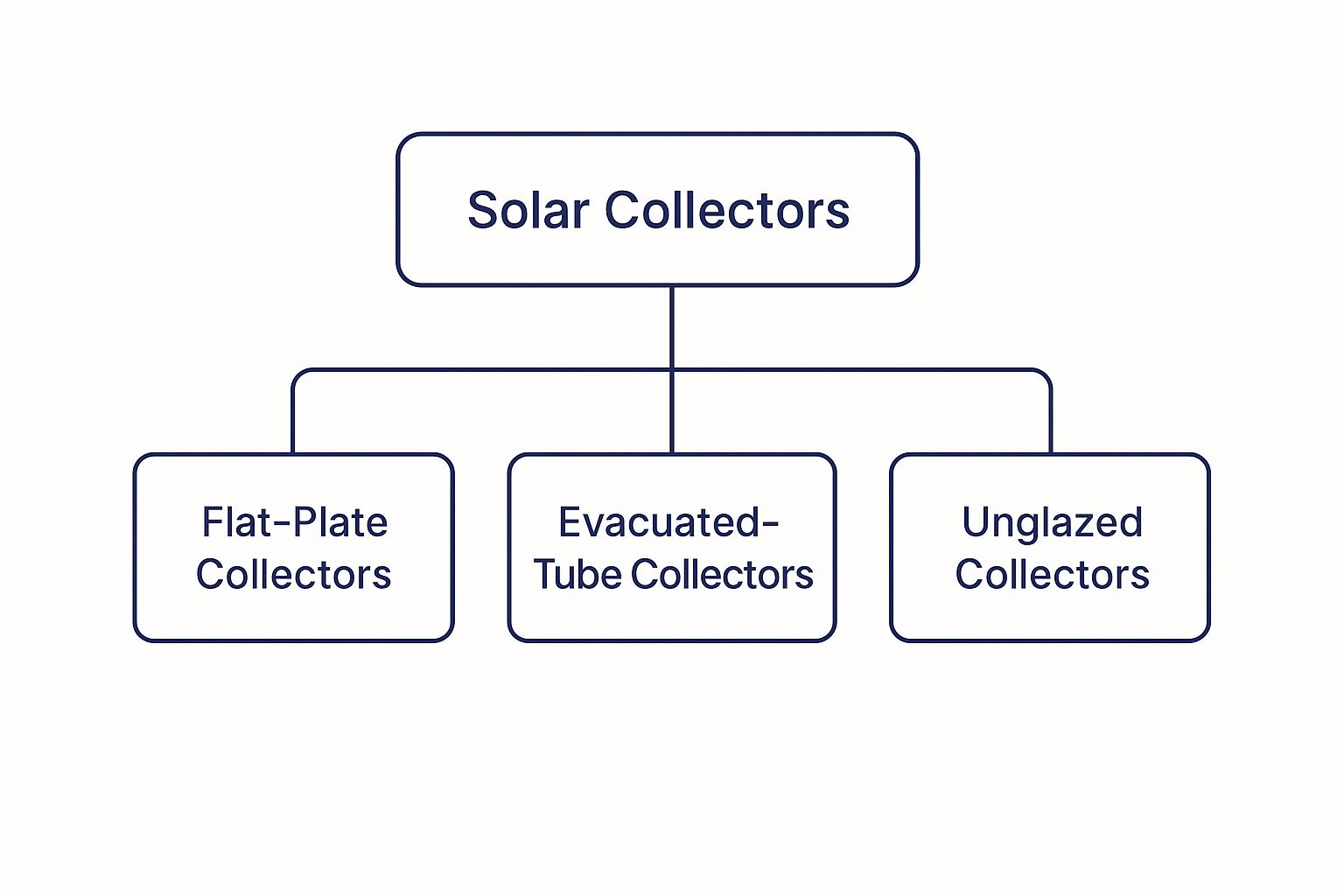
As you can see, flat-plate and evacuated-tube collectors are the most common technologies used for domestic and commercial hot water systems.
The Support System: Pump, Controller, and Storage
Once the collectors have done their job of capturing the sun’s energy, a support team of components takes over to manage and store it. These parts work together in a seamless loop to make sure hot water is ready whenever you need it.
The system relies on a heat transfer fluid—usually a mix of water and glycol (antifreeze)—which circulates through the collectors, absorbing warmth without the risk of freezing in winter. This heated fluid is then pushed around the system by a small but vital circulation pump. Think of this pump as the heart of the system, tirelessly moving the fluid from the collectors on the roof down to your storage tank and back up again.
Guiding this whole operation is the controller, which is essentially the system’s brain. This clever bit of kit uses temperature sensors to keep an eye on both the collectors and the water in the storage tank.
The controller’s logic is simple yet brilliant: it only switches the pump on when the fluid in the collectors is significantly hotter than the water in the tank. This makes sure the system only runs when it can actually add heat, maximising efficiency and stopping it from wasting energy by circulating cool fluid on a cloudy day.
Finally, all that captured heat needs a home. The insulated storage tank, or cylinder, acts as the system’s thermal battery. This is where the heat collected during the day is passed into your domestic water supply, usually via a heat exchanger coil inside the tank. These cylinders are heavily insulated to keep the water hot for hours, even overnight, so you have a ready supply long after the sun has gone down. Together, these components form a complete and effective solar power heating system.
Sizing Your System for Maximum Efficiency

A solar power heating system isn’t an off-the-shelf purchase; its real value comes from being perfectly tailored to your property. Getting the size right is probably the single most important factor for cutting your bills and ensuring you’ve always got hot water.
Go too small, and you’ll find your backup boiler is constantly kicking in. Go too big, and you’ve simply paid for collectors and a cylinder you can’t possibly use. It’s a waste.
This is exactly why a professional assessment is essential. A good installer will dig into the details of your home and how you live to design a system that hits that sweet spot between cost and performance. It’s a balancing act, and several key variables need careful consideration.
Calculating Your Hot Water Demand
First things first, we need to get a handle on how much hot water you actually use each day. This figure becomes the foundation for everything else, telling us how much heat the system needs to generate and, crucially, how much it needs to store.
An installer will look at:
- Household Size: The number of people in your home is the most straightforward indicator of water demand.
- Lifestyle Habits: Think about your daily routines. Are there multiple bathrooms in use at the same time? Are long showers or deep baths a regular thing?
- Appliance Use: Don’t forget dishwashers and washing machines. If they’re plumbed into the hot water supply, they add to the daily total.
On average, a person in the UK gets through about 50 litres of hot water a day. So, for a family of four, the target is a system that can heat and store at least 200 litres every day to keep everyone happy. This calculation is what sets the size for the hot water cylinder.
Assessing Your Property and Location
Once your demand is clear, the focus shifts to your property’s potential to actually capture the sun’s energy. Let’s be honest, not all roofs are created equal. A proper site survey is non-negotiable to figure out the real-world performance you can expect.
Here’s what matters:
- Roof Orientation: In the UK, a south-facing roof is the gold standard, as it gets the most sun from morning till evening. Don’t worry if you’re not perfectly south-facing; south-east or south-west orientations still work brilliantly.
- Roof Pitch: An angle somewhere between 30 and 45 degrees is the sweet spot for capturing solar energy effectively all year round.
- Available Space: We need to know how much clear, usable roof space you have. Things like chimneys, vents, or skylights all need to be worked around.
- Shading: This is a big one. Nearby trees, neighbouring buildings, or even your own chimney can cast shadows that will seriously dent your system’s output, especially during those peak sun hours.
You only need to look at the huge growth in solar across the UK to see how many properties are suitable. The country’s installed solar power capacity has exploded, hitting an incredible 19 gigawatts (GW) by July 2025. To put that in perspective, that’s roughly equivalent to 4.2 million home solar setups. It’s a mind-boggling 18,000% increase from just 0.0937 GW back in 2010, proving just how viable this technology is here. You can find more UK solar statistics over on Sunsave.energy.
By combining your hot water needs with the specifics of your roof and local climate, an installer can accurately calculate the required collector area and match it with the correctly sized storage tank, ensuring your system performs efficiently.
Integrating with Your Existing Boiler
A solar thermal system is brilliant, but for year-round reliability, especially during those grey British winters, it needs to play nicely with your existing boiler or immersion heater. This integration isn’t an afterthought; it’s a core part of the design.
The most common way to do this is with a twin-coil cylinder. It’s a clever bit of kit. One coil connects to the solar collectors, and the other connects to your boiler. The sun does the heavy lifting, pre-heating the water for free. If solar can’t quite get the water up to the temperature you’ve set, the boiler automatically fires up to provide that final boost. It’s a seamless process that guarantees you always have hot water without burning fuel unnecessarily.
This principle of proper sizing is vital for all renewable heating. If you’re exploring other options, our guide on the proper sizing of heat pumps is well worth a read.
Costs Savings and Financial Incentives in the UK
While the environmental case for solar heating is compelling, for most people, the decision really boils down to the numbers. It’s easy to focus on the initial outlay, but that’s a mistake. A solar heating system isn’t just a cost; it’s an investment that starts paying you back from day one.
The upfront expense for a professionally installed system in the UK can land anywhere between £4,000 and £7,000 for a standard home. This figure can shift based on the size of your property, the type of collectors you choose, and how complex the installation is. Naturally, costs are higher for commercial buildings, but the potential savings scale up right alongside them.
But that initial figure is only chapter one of the financial story. The real value is written over the long term, mainly through a dramatic drop in your energy bills.
Understanding Your Return on Investment
A well-designed solar heating system can genuinely cover up to 60% of your property’s annual hot water needs, completely free. That’s a direct hit to your gas or electricity consumption, and the savings pile up faster than you might think.
Take a typical family home, for example. They could easily see their energy bills fall by £300 to £500 every year. This means the payback period—the time it takes for the system to pay for itself through savings—is often somewhere between eight and fifteen years. Given that these systems have a lifespan of over 20 years, you’re looking at a decade or more of essentially free hot water.
The economic case for solar is becoming stronger every year. As conventional energy prices continue to be volatile, generating your own heat provides a valuable buffer against future price hikes, giving you greater financial stability and predictability.
The UK’s expanding solar capacity is already making a huge difference economically. In the first five months of 2025, solar power generation skyrocketed, producing 7.6 terawatt hours (TWh) of electricity—a massive 42% leap from the same period in 2024. This isn’t just a win for the environment; it’s a financial victory, saving the UK an estimated £600 million in natural gas imports we didn’t have to buy.
Let’s look at what this might mean for different types of properties. The table below gives a rough idea of installation costs versus the long-term gains.
Solar Heating System Cost vs. Long-Term Savings
| System Size (Property Type) | Estimated Installation Cost | Estimated Annual Energy Bill Savings | Approximate Payback Period |
|---|---|---|---|
| Small Home (2-3 bedrooms) | £4,000 – £5,500 | £300 – £400 | 10 – 14 years |
| Large Home (4-5 bedrooms) | £5,500 – £7,000 | £400 – £550 | 9 – 13 years |
| Small Commercial (e.g., B&B) | £8,000 – £15,000 | £800 – £1,500 | 7 – 10 years |
| Medium Commercial (e.g., Care Home) | £15,000+ | £1,500+ | 6 – 9 years |
As you can see, while the initial investment is significant, the payback is steady and predictable, protecting you from future energy price shocks.
Tapping into UK Government Grants and Schemes
To help homeowners and businesses make the switch, the UK government has put some valuable financial support in place. These incentives are designed to lower that initial hurdle and make a solar heating system a much easier decision.
Here are the key schemes to look into:
- The Boiler Upgrade Scheme (BUS): This scheme offers grants to help cover the cost of replacing a fossil fuel heating system with a low-carbon one, and that includes solar thermal. For eligible properties, it can take a serious chunk out of the upfront installation price.
- VAT Reduction: In a major boost for green energy, the government has slashed VAT on the installation of energy-saving materials, including solar thermal systems, right down to 0%. This is an immediate saving that makes the whole project more affordable.
These incentives make the financial argument pretty compelling. For businesses, exploring all the available funding is a no-brainer. You can find out more in our detailed guide on energy efficiency grants for businesses.
When you combine the long-term bill savings with these government grants, the return on investment for a solar heating system shifts from a possibility to a smart, predictable financial move.
Real-World Applications and Success Stories
It’s one thing to talk about the technical ins and outs, but where a solar power heating system really proves its worth is out in the real world. This isn’t just a technology for niche eco-homes; it’s a solid, cost-saving solution that’s being put to work right now across a huge range of UK properties, from suburban streets to busy commercial sites.
Seeing how others are already benefiting from solar thermal is often the best way to understand what it could do for you. The impact is usually clearest in buildings with a constant, high demand for hot water – places where the energy bills can be eye-watering.
Success in Commercial and Public Buildings
Think about commercial properties like hotels, gyms, and care homes. Their daily routines – laundry, showers, kitchens – rely on huge volumes of hot water, making energy a massive operational cost. By bringing free solar energy into the mix, these businesses can make a serious dent in their overheads.
A leisure centre, for example, can use solar to pre-heat water for its swimming pool and showers, meaning its big gas boilers don’t have to work nearly as hard. In the same way, a care home can guarantee a steady, reliable supply of hot water for its residents while cutting running costs. That’s a saving that can be put straight back into patient care.
These examples really bring home the key benefits for organisations:
- Reduced Operational Costs: Lower energy bills go directly to the bottom line.
- Stronger Green Credentials: Showing a real commitment to sustainability is a powerful message for customers and stakeholders.
- Budgetary Stability: You’re less exposed to the whims of volatile fossil fuel prices, making financial planning much more predictable.
The sheer versatility of a solar power heating system means it can be adapted for almost any scenario where hot water is a major energy expense. From industrial process heat to ensuring comfort in social housing, the applications are broad and genuinely impactful.
The bigger picture for solar energy in the UK just reinforces its growing importance. As a nation, we’re on track to generate around 14.43 billion kWh of solar electricity in 2025. That’s enough juice to power between 4.8 and 5.3 million typical UK homes for a whole year, a massive step in decarbonising our energy supply. You can dig into more UK solar statistics from GreenMatch.
Transforming Residential Energy Use
For homeowners, putting a solar heating system on the roof is a direct route to more energy independence and smaller monthly bills. A properly designed system can deliver up to 60% of a household’s annual hot water needs, which you’ll definitely notice from the very first bill.
Take a typical family of four. Their daily routine of showers, washing up, and laundry creates a constant demand for hot water. A solar thermal system meets a huge chunk of that demand for free. This means their backup boiler fires up far less often, especially during the sunnier stretch from April to September.
This translates into real, long-term benefits for homeowners:
- Immediate Bill Reduction: You’ll see the savings on the first energy bill after the system is switched on.
- Increased Property Value: Homes equipped with renewable energy systems are becoming more and more attractive to potential buyers.
- Future-Proofing Your Home: Gaining a bit of independence from the grid helps protect against the energy price hikes that are bound to come.
All these success stories, from bustling commercial hubs to quiet family homes, share a common thread. They show that a solar power heating system is a mature, reliable technology that delivers real, measurable financial and environmental returns.
Installation, Maintenance, and Lifespan
So, you’re considering a solar heating system. It’s a fantastic step towards generating your own energy, but what’s actually involved in getting one up and running? The good news is that the whole process is surprisingly straightforward and designed to cause as little disruption as possible.
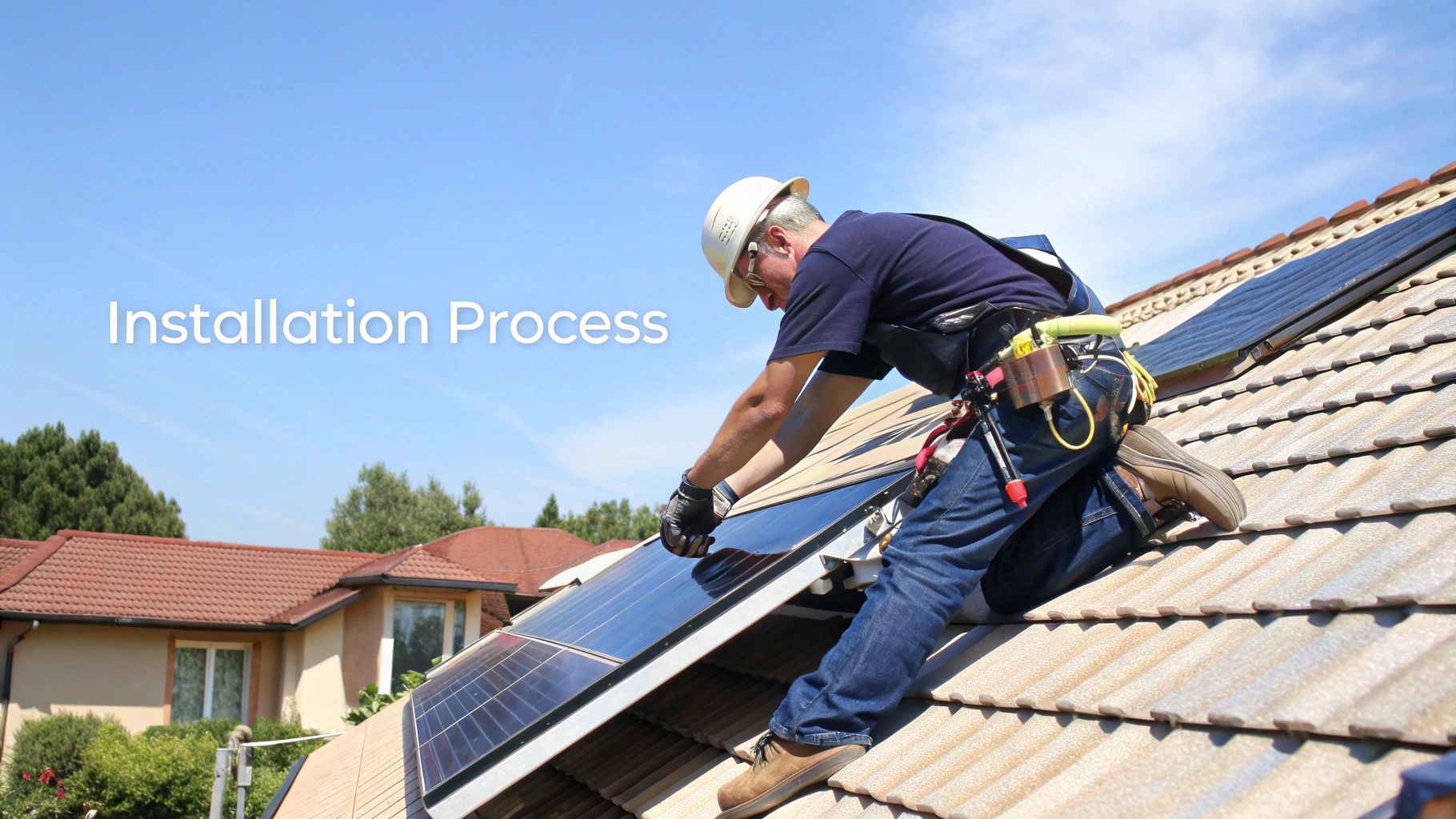
It all kicks off with a detailed site survey. Before any equipment shows up, an expert needs to take a good look at your roof’s condition. It’s vital to sort out any necessary roof repairs first to make sure you have a solid foundation for the panels. Once your roof gets the all-clear, the installation team can get cracking. Typically, they’ll have the whole system installed and ready to go in just one to three days.
Keeping It Running: The Beauty of “Fit and Forget”
One of the best things about a solar heating system is just how little you have to think about it. Unlike a temperamental old boiler, there are very few moving parts to break down. It’s truly a “fit and forget” technology, but a few simple checks will ensure you’re getting the absolute best performance for decades to come.
The routine upkeep is minimal and infrequent. Here’s what’s typically involved:
- An annual once-over: A quick visual check of the collectors for any obvious debris or damage is usually enough. Here in the UK, a decent downpour is often all that’s needed to keep them clean.
- A quick pressure check: The system’s sealed fluid circuit needs to maintain a stable pressure. A glance at the pressure gauge every few months is all it takes to see if everything’s as it should be.
- An antifreeze check-up: The heat transfer fluid contains antifreeze to protect the system during cold snaps. It’s a good idea to have a professional check this fluid every 3-5 years to make sure it’s still doing its job, and replace it if needed.
That’s pretty much it. The system just quietly gets on with its job in the background, turning sunlight into free hot water without demanding your constant attention.
A well-maintained solar power heating system is built like a tank. With its robust components and simple design, you can confidently expect it to last for 20 to 25 years—sometimes even longer—delivering reliable service and energy savings year after year.
Built to Last: Long-Term Durability
The impressive lifespan of these systems comes down to their simple, effective design. The collectors themselves are made from tough, weather-resistant materials built to handle everything the British weather can throw at them.
The other key components, like the pump and the controller, are usually installed indoors, safe from the elements and easy to get to if they ever need a bit of attention. This robust build quality is what ensures your investment pays for itself many times over, well into the future.
This principle of proper setup and maintenance for long-term savings isn’t unique to solar. It’s just as crucial for other renewable technologies like heat pumps. You can read more about making ASHPs work efficiently in our guide on that topic.
Common Questions About Solar Heating Systems
Thinking about investing in a solar heating system is a big step, so it’s completely normal to have a few questions before you take the plunge. We’ve pulled together some of the most common queries we get from UK homeowners and businesses to give you clear, straightforward answers. Hopefully, this will clear up any lingering doubts.
One of the first things on everyone’s mind in the UK is, of course, the weather. How can a solar thermal system possibly work on a typical overcast British day? You might be surprised.
These systems aren’t just looking for bright, direct sunshine. They are designed to capture thermal energy from the entire light spectrum, including the diffuse radiation that gets through cloud cover. While a clear, sunny day will always give you peak performance, your system will still be ticking over, steadily heating water even on grey, cloudy days, especially from spring through to autumn.
Can Solar Heat My Entire House?
A solar thermal system is a specialist, designed specifically for heating your water—for taps, showers, and baths. It’s brilliant at that, but it doesn’t generate the high-grade heat needed to run a central heating system like radiators or underfloor heating.
For whole-house heating, you’d be looking at different technologies. The ideal setup is to use a solar power heating system for your hot water and pair it with an efficient primary heating source, like a modern boiler or a heat pump, to handle your central heating.
Solar Thermal vs Solar PV Panels
It’s easy to get these two confused, but they do fundamentally different jobs. The simplest way to think about it is:
- Solar Thermal: This is plumbing technology. Its only job is to grab heat from the sun and use it to heat water directly. It’s all about thermal energy.
- Solar PV (Photovoltaic): This is electrical technology. These panels turn sunlight into electricity, which can then power anything in your home, from your lights to your telly.
The key takeaway here is specialisation. Solar thermal is incredibly efficient at one specific task—heating water. It will typically outperform a PV system that has to use its electricity to power an immersion heater to do the same job.
What Maintenance Does the System Need?
Happily, very little. Solar thermal systems are built to be robust and low-maintenance, with a design life of over 20 years. There are no complex moving parts exposed to the wind and rain.
We’d recommend a professional check-up every three to five years, just to inspect the heat transfer fluid and make sure the system pressure is where it should be. Otherwise, a quick visual check once a year is usually all that’s needed, and you can let the rain take care of keeping the panels clean.
Ready to cut your energy bills and move towards a more sustainable future? At Luths Services, we specialise in designing and implementing cost-effective renewable energy solutions for commercial, industrial, and residential properties. Discover how we can help you harness the power of the sun by visiting us today.


