
Imagine your home is wearing a high-performance technical jacket. That jacket is what we call the building fabric – it’s the physical shell that separates your comfortable indoor space from the wild and unpredictable world outside. It’s a complete system, meticulously designed to keep you warm, dry, and safe.
What Do We Actually Mean by Building Fabric?
When we talk about a building’s fabric, we’re not just listing off a random collection of materials. Think of it as an integrated system where every single piece has a job to do, and they all have to work together. This “building envelope,” as it’s often called, includes the roof, external walls, ground floor, windows, and doors. Its most basic job? To provide shelter and hold the building up.
But a modern building fabric does so much more than just keep the rain out. It’s a high-performance barrier that actively manages the flow of heat, air, and moisture. Just like a good Gore-Tex jacket shields you from wind and rain while letting your body breathe, a well-designed building fabric maintains a steady, comfortable indoor climate, no matter what the weather is doing.
It’s More Than Just Bricks and Mortar
It’s crucial to see the building fabric as a complete, functioning system, not just a pile of individual parts. The performance of your loft insulation, for example, is directly tied to how airtight your windows and doors are. A brand-new, perfectly insulated roof won’t do you much good if cold draughts are constantly whistling in through poorly sealed floorboards. It all has to work in harmony.
A “fabric first” approach prioritises getting the performance of the building envelope right before even thinking about the heating system or other mechanical services. This strategy is now widely seen as the smartest and most effective way to create low-energy, comfortable, and durable buildings.
By focusing on the fabric first, you’re tackling the root causes of energy loss and discomfort right at the source. This is the bedrock of creating a building that isn’t just cheap to run, but is also a healthier and more pleasant place to live. A high-performing fabric delivers on three key fronts:
- Improved Energy Efficiency: Less heat escapes in winter and less unwanted heat gets in during summer. This dramatically cuts down your reliance on central heating and any cooling systems you might have.
- Better Comfort: Getting rid of draughts and cold spots means the indoor temperature stays much more stable and comfortable all year round. No more huddling by the radiator.
- Greater Durability: Properly managing moisture stops problems like damp, condensation, and mould before they can start. This protects the building’s structure and ensures it stands the test of time.
Exploring the Core Components of Building Fabric
If you think of a building as having a ‘jacket’, then the building fabric is that jacket. It’s made up of several essential layers, each with a very specific job to do. For this jacket to work properly, keeping the building warm, dry, and comfortable, all its parts must work together as a single, integrated system.
From the roof that shields you from the rain to the ground floor connecting you to the earth, every single part plays a crucial role. The main players are the roof, external walls, ground floor, and the openings like windows and doors. Each one acts as a barrier, controlling the flow of heat, air, and moisture. Let’s take a look at how these fundamental parts come together.
Walls: The Vertical Shield
External walls make up the largest part of the building’s envelope and are its main vertical barrier against the outside world. Here in the UK, you’ll generally come across two main types: solid walls, which you’ll find in older properties built before the 1920s, and cavity walls, which became the standard way to build later on.
- Solid Walls: These are exactly what they sound like – a single, solid layer of brick or stone. They’re incredibly strong, but they also transfer heat very easily, making them a major source of energy loss in older buildings.
- Cavity Walls: Modern construction uses two layers (or ‘leaves’) of masonry with a gap—the cavity—in between. This cavity is often filled with insulation, which creates a much more effective thermal barrier than a solid wall ever could.
The materials used for these walls have a massive impact on performance. The infographic below gives a quick snapshot of the sheer variety of materials used in construction today.
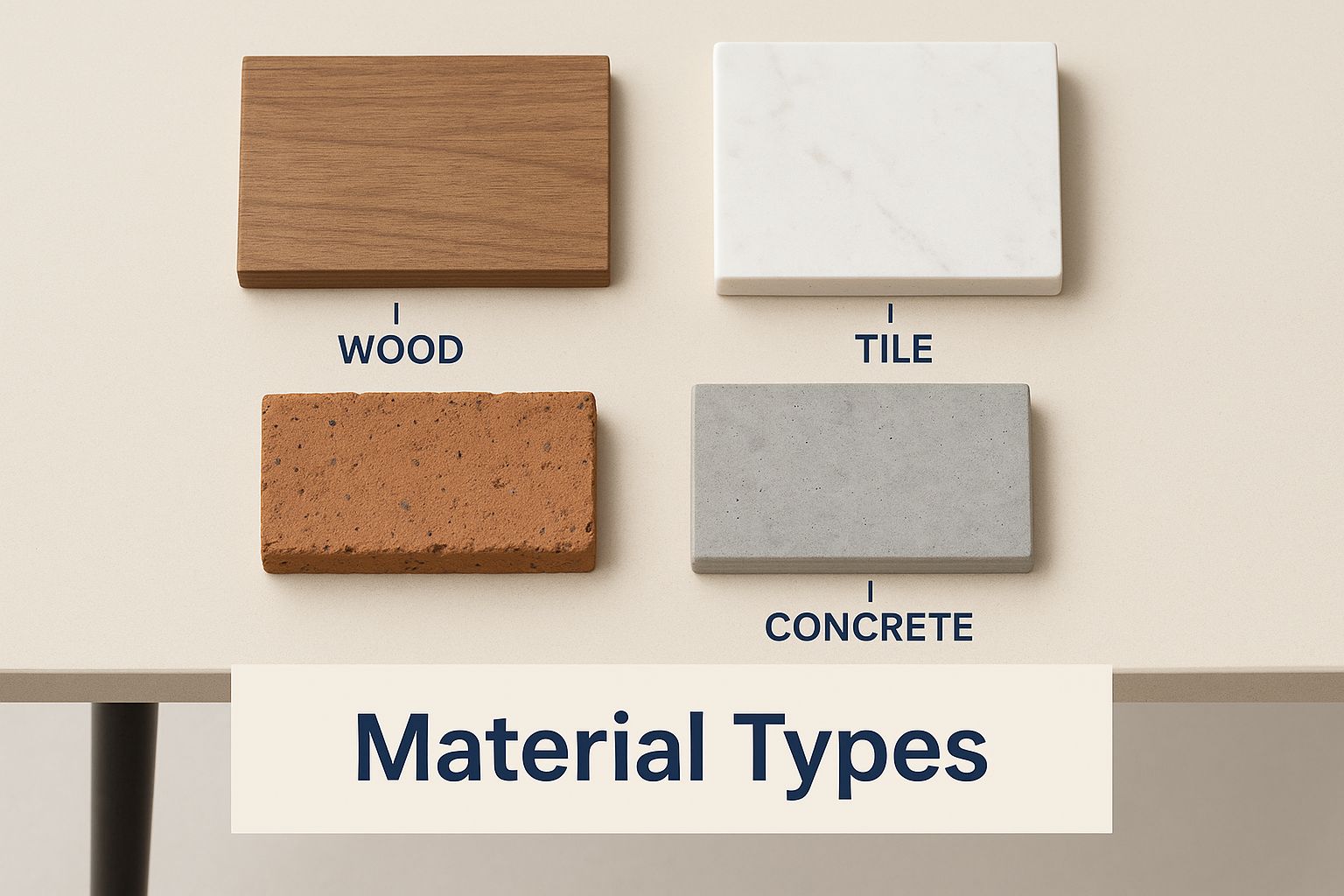
This just goes to show the diversity of materials, from traditional brick and block to more modern composites, that make up the building fabric. The choice of these materials is foundational to the construction sector. For example, historical data shows that while overall UK construction material imports have grown, certain items have fluctuated. Bricks saw a 4.3% decrease in deliveries in October 2020 compared to the previous year, while concrete blocks actually increased by 2.5%. This reflects the shifting trends and practices in the building industry. You can dig deeper into these construction material trends and their supply chain dynamics.
To get a clearer picture of how these components fit together, let’s break them down in a table.
Key Building Fabric Components and Their Functions
Here’s a simple summary of the main parts of the building fabric, what they do, and what they’re typically made of in UK properties.
| Component | Primary Function | Common UK Materials |
|---|---|---|
| External Walls | Provide vertical structural support and act as a thermal and weather barrier. | Brick, blockwork, stone, timber frame, render. |
| Roof | Protect the building from precipitation, sun, and wind. Key for preventing heat loss. | Clay or concrete tiles, slate, metal sheeting, felt. |
| Ground Floor | Provide a stable base and prevent heat loss to the ground and moisture ingress. | Concrete slab, suspended timber joists. |
| Windows & Doors | Allow light, access, and ventilation while minimising heat loss and draughts. | uPVC, timber, aluminium frames with double or triple glazing. |
Each element has a distinct role, but they all need to work in concert for the building to perform well as a whole.
Roofs and Floors: The Horizontal Protectors
The roof is the building’s first line of defence against rain, snow, and sun. At the other end, the ground floor is what manages the connection with the earth beneath. A well-insulated roof is absolutely critical, as a huge amount of a building’s heat—often up to 25%—is lost straight up and out.
Similarly, the ground floor has to stop heat from seeping into the ground and prevent damp from rising up into the building. In most UK homes, you’ll find either suspended timber floors or solid concrete floors, and each one needs a different approach when it comes to insulation and damp proofing.
A building’s fabric is only as strong as its weakest link. A perfectly insulated roof and walls will have their performance undermined by a poorly insulated ground floor or inefficient windows. Every component must be considered.
Windows and Doors: The Controlled Openings
Windows and doors are often the most complex parts of the building fabric. They have a tough job: they need to provide light, views, and access, all while acting as a robust thermal barrier. Historically, they were the weak points for heat loss, but modern high-performance glazing and well-insulated frames have completely changed the game.
The key things to look for with windows and doors are:
- U-value: This is a measure of how easily heat can pass through. The lower the U-value, the better the insulation. Simple as that.
- Airtightness: Well-sealed frames and junctions are essential to prevent draughts, which are a massive cause of both heat loss and general discomfort.
- Glazing: Modern windows use double or even triple glazing. They’re often filled with an inert gas and have special low-emissivity coatings to dramatically improve their thermal performance.
By understanding how these core components function and interact, we can start to see the building fabric not just as a static structure, but as a dynamic system that’s crucial for energy efficiency, comfort, and durability.
Why the Thermal Performance of Your Home Matters
A high-performance building fabric is your single best defence against wasted energy and uncomfortable living conditions. Getting your head around how heat moves through your home isn’t just an academic exercise—it has a real, tangible impact on your wallet, your comfort, and your carbon footprint. It’s the difference between a home that works with you and one you’re constantly fighting against.
Think of your home’s thermal performance like its ability to wear a winter coat effectively. A well-designed coat keeps your body heat in and the cold out, with no gaps or thin patches. In the same way, the building fabric aims to keep valuable heat inside during winter and prevent unwanted heat from getting in during the summer.
Understanding Heat Loss and U-Values
Heat has a natural tendency to flow from warmer areas to cooler ones. In a heated building, this means heat is always trying to escape to the colder air outside. The speed at which it escapes through a particular material—whether it’s a wall, window, or roof—is measured by its U-value.
A U-value simply tells you how good a material is at stopping heat from passing through it. The lower the U-value, the better the insulator. A modern, well-insulated wall will have a very low U-value, while an old, single-glazed window will have a very high one.
This concept is absolutely central to understanding your building’s energy efficiency. Every single component has a U-value, and driving those numbers down is the key to reducing your heating bills and creating a much cosier space.
The Problem of Thermal Bridging
But great insulation is only part of the story. Imagine your high-tech winter coat has a broken zip or a tear in the sleeve. Cold air will get in through these weak spots, completely bypassing the thick insulation everywhere else. In a building, we call these weak spots thermal bridges.

A thermal bridge is basically an area of the building fabric where heat can find an easy escape route, travelling much more quickly than through the insulated parts around it. Common culprits include:
- Steel or concrete beams that run from the inside to the outside of a wall.
- Gaps around poorly fitted windows and doors.
- The junctions where walls meet the floor or the roof.
These “cold spots” can be responsible for a staggering 30% of a building’s total heat loss. They don’t just waste a huge amount of energy; they also create cold interior surfaces where condensation and mould love to grow. To really get to grips with these critical weak points, you can learn more about professional thermal bridge assessments and how they pinpoint problem areas.
Improving your building’s thermal performance means tackling both sides of the coin: specifying excellent insulation (low U-values) and ruthlessly minimising these thermal bridges. This “fabric first” approach is the smartest investment you can make for long-term efficiency, comfort, and sustainability.

How Building Fabric Manages Moisture and Durability
Beyond just keeping a building warm, the fabric of a building has another critical job: managing moisture. Think of it like a high-quality GORE-TEX jacket. It has to keep the rain out while letting your sweat escape. A healthy building fabric works in the same way, controlling water from two key sources—the weather outside and the condensation we create inside.
Moisture really does come from everywhere. Rain hammers against the walls, while everyday life—cooking, showering, even just breathing—releases huge amounts of water vapour into the air. A family of four can easily produce up to 10 litres of water vapour in a single day. If that moisture has nowhere to go, it’s going to find the coldest surface it can and condense, kicking off a whole host of problems.
Breathability and Vapour Control
This is where the idea of “breathability” becomes so important. A breathable wall construction is one that allows water vapour to pass right through it and escape outside, preventing it from getting trapped deep within the structure. This is usually achieved by picking the right combination of materials and layering them correctly.
In modern, highly insulated buildings, though, the game changes slightly. The main priority is to stop the warm, moist indoor air from ever reaching the cold outer layers of the construction. This is where specific, cleverly designed layers come into play:
- A Vapour Control Layer (VCL) is fitted on the warm side of the insulation. Its job is simple: stop moisture from getting into the wall structure in the first place.
- A Breather Membrane is placed on the cold side of the insulation. This layer stops rainwater from driving in from the outside but is designed to let any vapour that did get trapped inside escape outwards.
Think of it as a one-way valve system for moisture. It’s designed to stop water getting in from either side, but always provides an escape route for any vapour that does find its way into the building’s structure.
Getting this balance wrong can be disastrous. When moisture gets trapped, it leads directly to damp patches, peeling paint, and the growth of harmful mould, which can pose serious health risks. Over time, this persistent damp can cause the slow, silent decay of timber frames, mortar, and other structural components, seriously undermining the building’s long-term durability.
Understanding and predicting these moisture risks is a specialist field. It often takes a professional assessment to make sure the building fabric can cope with moisture properly, something we cover in our guide to a condensation risk assessment. Ultimately, a well-designed fabric doesn’t just protect the property’s value; it protects the health and wellbeing of the people inside.
Practical Strategies to Improve Your Building Fabric
Knowing the theory is one thing, but putting it into practice is where you see the real difference in your energy bills and comfort levels. When it comes to improving your building fabric, there’s a simple but powerful guiding principle: ‘fabric first’.
This approach is all about prioritising upgrades to the building’s envelope—its insulation and airtightness—before you even think about spending money on a new heating system.
Why? Because it’s far more effective to reduce the demand for heat in the first place than it is to simply generate more of it, even if it’s done efficiently. Think of it like trying to keep a cup of tea warm. You wouldn’t keep topping it up with hot water while it sits in a flimsy paper cup; you’d put it in a proper insulated flask. Sealing the ‘leaks’ in your building’s thermal jacket does the same thing, ensuring any energy you pay for is kept inside.
Prioritising High-Impact Upgrades
When you’re deciding where to start, you want to focus on the areas that give you the biggest bang for your buck. Some upgrades have a much bigger impact than others, and a targeted approach will get you the best results without breaking the bank.
Here are the heavy hitters to consider:
- Loft and Roof Insulation: Heat rises, so an uninsulated loft is like leaving a massive thermal window wide open. Topping up your loft insulation to the recommended depth of 270mm is one of the quickest and most cost-effective ways to boost your home’s performance.
- Wall Insulation: For homes with cavity walls, getting them filled with insulation is a relatively straightforward job that slashes heat loss. If you’ve got an older property with solid walls, you can add either external or internal wall insulation to create that crucial continuous thermal barrier.
- High-Performance Windows and Doors: Old, single-glazed windows are a major source of heat loss. Modern double or triple-glazed units are worlds apart in performance. Look for low U-values and make sure the frames are expertly sealed to kill draughts and tighten up the whole building fabric.
Of course, the cost of materials is a huge factor in any project. Construction material prices can shift based on wider economic trends, which is something you have to factor into your planning. For example, the UK material price index for ‘All Work’ jumped by a significant 15.5% in October 2022 compared to the year before, which really shows how important careful budgeting is.
The Importance of Airtightness
Beyond insulation, airtightness is the other side of the high-performance coin. Uncontrolled air leakage through all the little gaps, cracks, and poorly sealed joints can be responsible for a huge chunk of a building’s heat loss. It’s what creates those uncomfortable draughts and keeps your heating system working overtime.

A key aspect of improving your building fabric involves ensuring its air tightness. Learning about identifying and sealing air leaks can significantly enhance your home’s thermal performance.
Common culprits for air leakage are the gaps around window and door frames, holes drilled for pipes and cables, and the junctions between floors and walls. A systematic approach to hunting down these gaps and sealing them with the right sealants, tapes, and draught-proofing strips is a simple but incredibly effective measure.
By making your home more airtight, you take back control of its ventilation. You stop wasting heat and ensure the entire building fabric system works exactly as it’s supposed to.
Looking ahead, it’s clear that the fabric of a building is only going to become more critical. As we push towards a properly sustainable future, advanced building standards are putting the performance of the building envelope front and centre. It’s no longer an afterthought but the absolute foundation of low-carbon design.
Pioneering approaches like Passivhaus, for instance, are built around a super-insulated and virtually airtight building fabric to achieve near-zero energy use. This isn’t some niche concept anymore; it’s a glimpse into the mainstream future. Upcoming UK building regulations are increasingly focusing on fabric performance to meet our climate goals. The whole game is shifting from generating energy more efficiently to drastically cutting the need for it in the first place.
For anyone looking to build with this in mind, exploring innovative eco-friendly house plans is a brilliant place to start.
The Critical Role of Craftsmanship
Of course, even the most advanced designs can fall flat without proper installation. This is where skilled craftsmanship becomes the final, crucial piece of the puzzle. The best materials and plans don’t mean much if junctions are poorly sealed or insulation is crammed in incorrectly.
This is where the real value of skilled labour shines through. In the UK, labour expenses are a huge part of any construction budget, with recent data showing they accounted for roughly 58% of the sector’s earnings in 2023.
Investing in your home’s fabric is more than just a personal benefit; it is a vital contribution to creating resilient, healthy, and future-proof buildings for generations to come.
Ultimately, a high-performance building fabric is all about minimising energy use over the building’s entire life. To truly get a grip on the impact of these choices, you need to look at the big picture, which is why understanding whole-life carbon costs is so essential. It gives you the complete story of a building’s environmental footprint.
Common Questions About a Building’s Fabric
Let’s clear up some of the common queries that come up around the fabric of a building. Getting these concepts straight is the first step to applying them correctly.
Is the Building Fabric Just the Structure?
Not quite, though it’s an easy mistake to make. While the structural bits like walls and floors are definitely part of the fabric, the term is much broader. It really means the entire outer shell or “envelope” that separates the cosy inside from the unpredictable outside.
Think of it this way: the structure is the skeleton, but the fabric is the high-performance skin wrapped all around it. That skin includes everything from your insulation and windows to the protective membranes that keep out wind and rain.
Why Do People Always Talk About a ‘Fabric First’ Approach?
‘Fabric first’ is a simple but powerful idea. It means you should always prioritise improving your building’s insulation and airtightness before you even think about upgrading the heating system.
It’s just common sense when you break it down. It’s far more effective to reduce the amount of heat you need in the first place, rather than just installing a bigger boiler to pump more heat into a leaky building. A high-performing fabric allows you to get away with a much smaller, cheaper-to-run heating system, which saves a huge amount of money over the long haul.
A well-sealed and insulated building fabric can slash heating requirements by over 75%. It’s the bedrock of a genuinely low-energy home and the single most impactful long-term investment you can make for both comfort and running costs.
Can I Actually Improve the Fabric of an Old Building?
Absolutely, and it’s one of the most rewarding things you can do. Older buildings certainly come with their own quirks and challenges, but their fabric can nearly always be upgraded significantly.

Some of the most common and effective strategies include:
- Loft Insulation: This is often the easiest win. Simply topping up the insulation in your roof space is incredibly cost-effective and a great first step.
- Wall Insulation: If you have solid walls, they can be insulated either on the outside or the inside. For homes with cavity walls, getting the cavity filled is a straightforward option.
- Window Upgrades: Swapping out old, draughty single-glazed windows for modern double or triple-glazed units makes a massive difference to both heat loss and comfort.
Ready to get your building’s performance up to scratch? Luths Services offers expert, independent guidance on low-carbon design and practical fabric improvements. Discover our sustainable building consultancy services.


