
Put simply, Demand Side Response (DSR) is a smart way of balancing the UK's electricity grid by rewarding energy users for being flexible. Rather than just building more power stations to cope with high demand, DSR encourages businesses to change when they use electricity, helping keep the lights on for everyone.
Understanding Demand Side Response
Think of the National Grid like a motorway at rush hour. When too many cars pile on at once, you get a traffic jam. The old-school solution? Build more lanes (or in this case, more power plants). But that’s expensive, slow, and often means firing up fossil fuel generators.
DSR offers a much smarter alternative. It’s like paying some drivers to travel at quieter times. The result? Congestion eases, and traffic flows smoothly without needing to pour more concrete.
This is the core idea of Demand Side Response. It’s a programme that financially rewards large energy consumers—from factories and data centres to big commercial buildings—for temporarily cutting back or shifting their electricity use when the grid is under strain.
How DSR Eases Grid Pressure
Instead of firing up a costly, carbon-heavy "peaker plant" to meet a short spike in demand, the grid operator sends a signal to DSR participants. They might respond by:
- Pausing non-essential industrial machinery for a short while.
- Tweaking heating, ventilation, and air conditioning (HVAC) settings.
- Switching over to on-site power, like backup generators.
- Postponing an energy-hungry task, like charging a fleet of electric vehicles.
By taking these small actions together, they lower the "peak" demand across the country, which keeps the grid stable without needing to generate extra power.
Demand Side Response turns energy consumption from a fixed overhead into a potential revenue stream. It allows organisations to play an active role in building a more resilient, cost-effective, and greener energy system.
This proactive approach is becoming essential for the UK's energy security. Not only does it help prevent blackouts and cut grid operational costs, but it's also crucial for integrating more renewable energy. When it’s windy and sunny, DSR can help soak up that clean power. When the renewables aren't available, it can reduce demand to fill the gap.
This flexibility makes DSR a cornerstone of a modern, decarbonised energy network.
To break it down even further, here's a quick look at the moving parts.
Demand Side Response At a Glance
The table below summarises the core components of Demand Side Response, clarifying what it is, who it involves, and its primary purpose.
| Component | Description |
|---|---|
| What It Is | A programme that pays energy users to reduce or shift their electricity consumption. |
| Who Participates | Primarily large energy consumers like industrial sites, data centres, and commercial buildings. |
| When It Happens | During periods of high national electricity demand or when the grid is under stress. |
| Why It's Needed | To balance electricity supply and demand, prevent blackouts, and support renewable energy integration. |
| The Reward | Participants receive payments for their flexibility, creating a new revenue stream. |
In essence, DSR is a collaborative effort between the grid operator and businesses to create a more efficient and stable power system for everyone.
How Demand Side Response Actually Works
It might sound complicated, but understanding the nuts and bolts of Demand Side Response is actually quite straightforward. At its heart, it’s a simple communication loop between the grid operator, your business, and the tech that manages your energy use. This conversation keeps the grid stable and opens up a new way for you to earn revenue by being flexible.
The whole system boils down to two main actions: either "turning down" or "turning up" your energy consumption when the grid sends out a call. Both are vital for creating a balanced and efficient national energy system.
Turning Down During Peak Demand
The most common flavour of DSR is when you’re asked to reduce your electricity usage when the national grid is feeling the strain. This usually happens during peak demand—think of a freezing cold winter evening when everyone across the country cranks up the heating and switches on the lights at the same time.
Instead of firing up a costly and dirty fossil-fuel power plant to meet that short-term spike, the grid operator sends out a DSR signal. Businesses like yours respond by temporarily dialling back their consumption. This isn't about shutting down your operations; it's about making small, pre-agreed tweaks.
The infographic below paints a clear picture of this process, showing the simple flow from a high-demand signal to a compensated drop in energy use.
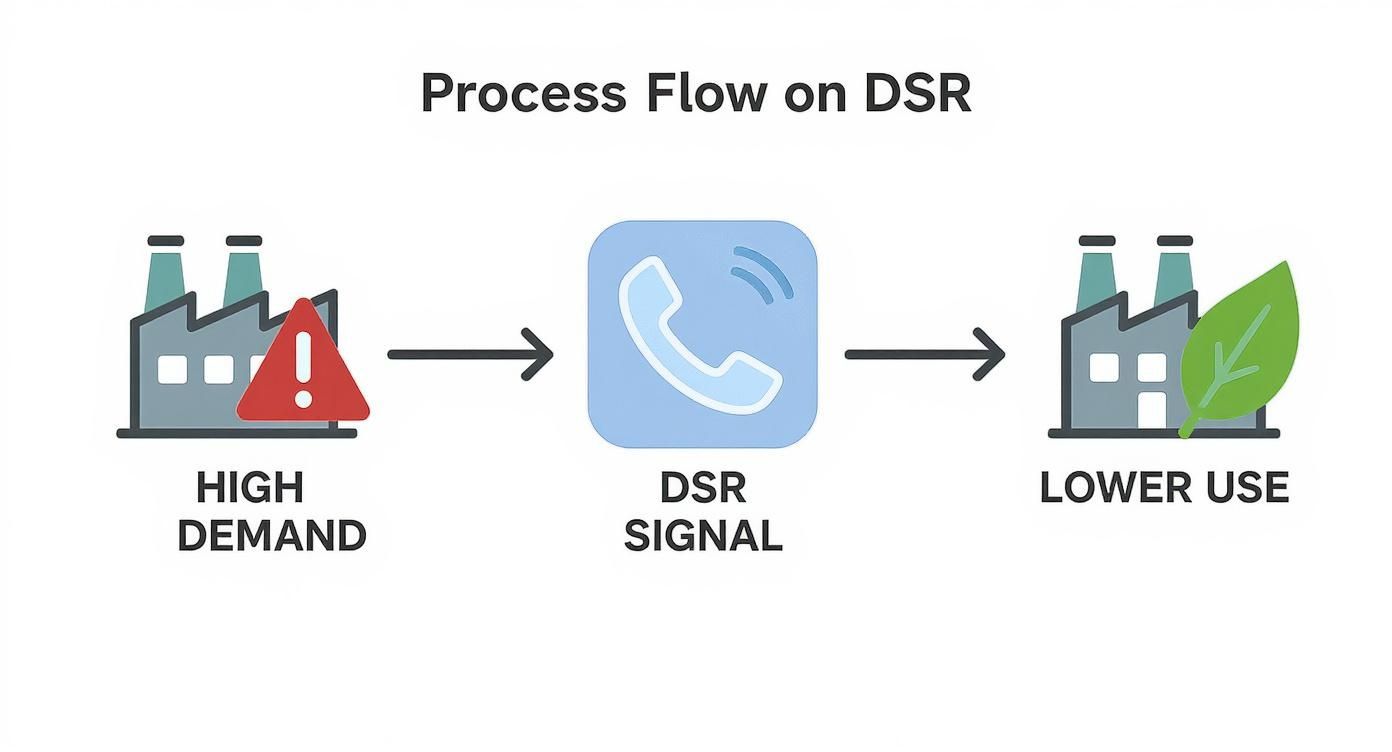
As you can see, DSR is a direct answer to a grid problem, turning a potential headache for the operator into a paid solution for flexible energy users.
The Role of Aggregators and Technology
Jumping directly into national grid services can be a bit much for many businesses. That's where an aggregator steps in. Think of them as a team captain who gathers up the flexibility from lots of smaller energy users and bundles it into one significant block of power that’s useful to the grid.
Aggregators handle all the tricky bits for you, from figuring out which of your assets are flexible to managing the bidding process and making sure you get paid. They make DSR a realistic option for a much wider range of businesses.
This is all made possible by some clever technology:
- Smart Meters: These give you the half-hourly data needed to accurately measure exactly how much energy you’ve saved.
- Automated Controls: These systems can automatically adjust equipment like your HVAC or pumps the moment a DSR signal comes in, so you don't have to lift a finger.
These automated systems are often part of a bigger picture. By integrating DSR capabilities, a modern building energy management system can transform your property into an active grid asset, optimising your own efficiency while generating revenue.
In the end, whether you respond manually or let automation handle it, the outcome is the same. The grid operator gets the stability it needs, and your organisation gets paid for providing that crucial flexibility. It’s a powerful, symbiotic relationship between energy consumers and the national power infrastructure.
The Real Benefits of DSR for Businesses and the Planet
Jumping into Demand Side Response (DSR) isn’t just about being a good citizen and helping the grid. It’s a genuinely smart business move with tangible financial and environmental payoffs. When you offer up your energy flexibility, you’re not only making a real contribution to the UK’s decarbonisation goals but also unlocking some serious commercial advantages. It’s a powerful one-two punch of profit and planetary progress.
For most businesses, the most obvious win is creating a new and reliable revenue stream. DSR lets you get paid for the energy flexibility you probably already have. Things you might see as simple operational costs—like refrigeration units, HVAC systems, or industrial pumps—can be turned into income-generating assets that help keep the grid stable.
This goes way beyond just shaving a bit off your energy bills. We’re talking about earning direct payments for being on standby and for stepping up when the grid needs you.
Unlocking Financial Incentives
The UK energy market has several well-established programmes specifically designed to reward this kind of flexibility. This opens up multiple avenues for businesses to generate income, building a solid financial case for getting involved.
Let’s break down the key financial benefits:
- Capacity Market Payments: You can earn steady, predictable payments just by committing to be available to reduce your energy use if needed. Think of it as a retainer – you’re paid simply for being on standby, which provides a reliable baseline income.
- Balancing Service Revenue: When you actually act on a DSR signal, you’re paid for the specific adjustment you make. This revenue is often much higher during periods of major grid stress, rewarding you handsomely for helping out when it matters most.
- Reduced Network Charges: By helping to bring down peak demand, businesses can often see lower transmission and distribution charges on their energy bills, adding another welcome layer of savings.
DSR fundamentally changes your relationship with energy. Instead of being a passive consumer with fixed costs, your organisation becomes an active, paid participant in maintaining a stable and efficient national grid.
The financial upside is pretty compelling on its own, but the benefits of DSR stretch far beyond the balance sheet. They’re absolutely central to building a cleaner, more sustainable energy future for us all.
Powering a Greener Planet
On the environmental side of things, Demand Side Response is a complete game-changer for decarbonisation. Its biggest impact is its ability to smooth out the peaks and troughs in energy demand, which is crucial for integrating large-scale renewable power sources like wind and solar into the grid.
When renewable generation is high, DSR participants can be encouraged to use more power, soaking up all that clean, cheap energy. And when the wind isn’t blowing or the sun isn’t shining, DSR helps reduce demand. This means we don’t have to fire up those polluting, fossil-fuel ‘peaker’ plants that are not only expensive to run but also pump out huge amounts of carbon. These environmental advantages, like cutting our reliance on fossil fuels, fit hand-in-glove with the crucial role of electric vehicles in achieving net zero emissions to create a healthier planet.
By making the grid more flexible and responsive, DSR paves the way for a system that can reliably run on a much higher percentage of renewable energy.
Exploring UK Demand Side Response Schemes
Understanding the benefits of Demand Side Response is one thing; figuring out how to actually take part is another entirely. The good news is the UK has a well-developed market for DSR, with several established schemes run by the National Energy System Operator (NESO).
These programmes are the gateways for businesses to earn serious revenue by offering their flexibility to the grid.
Each scheme is designed to solve a different problem for the grid, from providing long-term security against blackouts to making split-second adjustments to maintain balance. This means they all have different requirements for commitment, response times, and technical setup. For any business, the key is to find the programme that best fits its unique operational rhythm.
Key NESO Programmes
At the heart of the UK's DSR market are a few core services, each playing a distinct role in keeping our national energy system stable and secure.
The Capacity Market (CM) is best thought of as an insurance policy for the grid. Participants get paid simply for being available to reduce their demand if a rare system-wide stress event occurs. It’s all about ensuring there’s always enough capacity to meet the UK's peak electricity needs.
The Balancing Mechanism (BM) is NESO’s primary tool for real-time grid management. It lets participants offer to increase or decrease their energy use at very short notice, helping to smooth out the minute-by-minute bumps between electricity supply and demand.
Frequency Response Services like Dynamic Containment are the sprinters of the DSR world. They react within a second to stabilise grid frequency, a critical task for preventing power cuts. These are perfectly suited for assets like batteries that can respond in the blink of an eye.
For many organisations, the simplest path into these schemes is by working with an aggregator. These specialists bundle flexibility from multiple sites together, handle the complex bidding processes, and make it straightforward for businesses of all sizes to access these lucrative revenue streams.
Comparison of UK Demand Side Response Schemes
To get a clearer picture, it helps to see how the main schemes stack up against each other. Each one serves a unique purpose and looks for a different type of participant.
| Scheme Name | Primary Purpose | Ideal Participant | Response Time |
|---|---|---|---|
| Capacity Market (CM) | Long-term security of supply | Large energy users with predictable, schedulable loads (e.g., cold storage, manufacturing). | Hours to Days |
| Balancing Mechanism (BM) | Real-time grid balancing | Businesses with flexible processes that can be adjusted on the fly (e.g., pumps, industrial heating). | Minutes |
| Frequency Response | Instant frequency stabilisation | Sites with battery storage, fast-ramping generators, or specific industrial processes. | Sub-second to seconds |
| Demand Flexibility Service (DFS) | Reducing peak demand during winter | A wide range of businesses and domestic users who can shift consumption away from peak times. | Minutes to Hours |
This table shows there isn't a "one-size-fits-all" solution. The right choice depends entirely on your operational profile and the assets you have on-site.
Choosing the Right Scheme for You
The DSR market is only going to get bigger. It’s a key part of the UK’s Clean Power 2030 goals, with national DSR capacity projected to nearly triple to 12 GW by 2030. That’s a huge increase, driven by the simple need for a more flexible power system.
The recent success of the Demand Flexibility Service (DFS), which delivered 7,865 MWh of turn-down capacity in Q2 2025 alone, shows just how big the opportunity already is. You can find more insights on the UK's flexibility market from Drax.
Finding your best fit comes down to your site's assets and daily patterns. For some, upgrading equipment to participate might be a smart investment. It’s always worth exploring the available energy efficiency grants for businesses that can help cover these initial costs and get you into the game sooner.
The Future of DSR in the UK Energy Strategy
Demand Side Response isn't just a clever trick or a niche programme for a handful of large businesses. It's a foundational pillar of the UK's entire future energy strategy. It’s absolutely central to hitting our ambitious net-zero targets and building a resilient, low-carbon grid that will serve us for generations to come.
Frankly, the road ahead for the UK's energy system depends on a massive expansion of this kind of flexibility.
Grid operators and the government are banking on DSR to solve the tricky puzzle of balancing a grid powered by renewables. As we shift away from predictable fossil fuels towards intermittent sources like wind and solar, the ability to tweak demand becomes just as crucial as the ability to generate supply. This is why Demand Side Response is seen as an indispensable, long-term solution.
The Push for Widespread Flexibility
The UK's energy authorities have been crystal clear: demand-side response is a vital resource for the energy transition. This isn't some minor goalpost; it requires large-scale adoption by 2030 and beyond. Projections show that by 2035, a staggering 20% of the UK's total electricity demand will need to be flexible.
The National Energy System Operator (NESO) forecasts that 10-12 GW of DSR capacity can be deployed by 2030, which is a four-fold increase from early 2025 levels. You can dig deeper into the official thinking in the UK's energy flexibility report.
This push reflects a fundamental change in how we think about energy. Instead of a one-way street where power simply flows from giant plants to passive consumers, the future is a dynamic, two-way network. In this new system, consumers become active participants who help maintain grid stability – and get paid for their trouble.
Emerging Technologies Powering the Change
This vision is being brought to life by some exciting technological leaps that are making DSR more powerful, automated, and accessible than ever before. These innovations are turning previously passive energy assets into active, valuable grid resources.
Key technologies shaping the future of DSR include:
- Vehicle-to-Grid (V2G) Technology: This turns parked electric vehicles into a huge, decentralised network of batteries. EVs can charge up when renewable generation is high and feed power back to the grid to support it during peak demand.
- Smart Home and Building Automation: The Internet of Things (IoT) is a game-changer here. Devices from smart thermostats to intelligent building management systems can automatically adjust energy use in response to grid signals, all without anyone needing to lift a finger.
- Battery Energy Storage Systems (BESS): On-site batteries at commercial and industrial sites can store cheap, clean energy and release it during high-cost periods. This provides rapid and precise flexibility that is perfect for grid services.
Ultimately, these technologies are transforming the grid from a centralised, rigid structure into a smarter, more decentralised, and cleaner energy network. This evolution isn't just about efficiency; it's about building a sustainable system that can support our economy and environment for the long term.
Overcoming the Hurdles to DSR Adoption
If Demand Side Response offers such clear financial and environmental wins, you might be wondering why every business isn't already on board. It's a fair question. While the benefits are significant, there are a few real-world hurdles that can seem daunting at first.
For many organisations, the initial concern is almost always operational. There's a natural fear that joining a DSR programme will get in the way of core business activities or compromise production. On top of that, the potential upfront cost for things like advanced meters or control systems can feel like a big ask, especially for businesses managing tight budgets.
Often, these worries are simply down to a lack of clear information, making it tough for decision-makers to build a confident business case.
Clearing the Path to Participation
The good news? These obstacles are well-understood, and there’s a solid support system out there to help businesses navigate them. Most of the perceived risks can be managed with the right strategy and the right partners.
Here are the common solutions:
- Aggregator Support: Think of DSR aggregators as specialists who manage the whole process for you. They’re experts at assessing your operational flexibility without risk, handling the technology, and making sure participation never interferes with your day-to-day business.
- Government Grants and Funding: Various schemes exist to help offset the initial investment in energy-saving technology, making the financial entry point much more manageable. A detailed commercial energy audit is the best way to pinpoint which upgrades will deliver the best return.
- Phased Implementation: You don't have to dive in headfirst. A great way to start is by testing the waters with a small, non-critical asset. This lets you see the process and the financial returns for yourself before scaling up your involvement.
The key takeaway is that you are in complete control. DSR programmes are built around rules that you define, ensuring that your operational integrity is always the top priority.
This is true for households as well, where low awareness and perceived complexity remain big barriers. Research shows that UK households could be missing out on up to £375 annually by not using flexible energy tariffs, often because of doubts about the financial benefits or access to the right tech. You can discover more about the challenges facing household DSR uptake from the MCS Foundation. By tackling these hurdles head-on with clear education and support, DSR can become a practical reality for everyone.
Of course. Here is the rewritten section, designed to match the expert, human-written style of the provided examples.
Common Questions About Demand Side Response
Even when the benefits are clear, it's completely normal to have a few questions before diving into a new energy strategy. We've put together some straightforward answers to the queries we hear most often about what Demand Side Response is and how it actually works on the ground.
The idea here is to give you the confidence to see how DSR could fit into your own organisation.
Will DSR Mess With My Day-to-Day Operations?
In a word, no—not when it’s set up properly. Modern Demand Side Response is designed to fit seamlessly around your operational needs, not interrupt them. You and your aggregator partner will work together to establish firm, clear rules that safeguard all your critical processes and machinery.
You are always in the driver's seat. You get to decide the limits on how often your assets can be used and for how long. The entire point is to unlock the value in the energy flexibility you already have, without ever getting in the way of your core business.
Isn't This Just Another Name for Energy Efficiency?
They're related, but they are two very different things. Energy efficiency is all about using less energy to do the same job—think upgrading to LED lighting or adding better insulation. The result is a permanent drop in how much energy you use overall.
Demand Side Response, on the other hand, is about changing when you use that energy. You might use the exact same amount of electricity over a 24-hour period, but you shift that usage to a different time to help the grid keep things balanced. One is about using less; the other is about using it smarter.
Think of it this way: Energy efficiency is like buying a more fuel-efficient car to use less petrol. Demand Side Response is like choosing to drive that car at night to avoid rush-hour traffic, making the whole road network run more smoothly for everyone.
Do I Need to Install a Load of Special Equipment?
It really depends on the size of your site and the specific DSR scheme you join. Most industrial or commercial businesses will need a smart meter that provides half-hourly data. That’s non-negotiable, as it’s the only way to accurately measure your contribution.
For the automated responses that most businesses prefer, you might need some control systems to adjust equipment like your HVAC or pumps. A good aggregator partner will carry out a full audit of your site and advise on any technology needed. In many cases, they’ll provide or subsidise this kit as part of their service, making it pretty straightforward to get started.
Ready to turn your energy use into a revenue stream? The team at Luths Services can help you assess your flexibility and navigate the opportunities in Demand Side Response. Contact us today to find out how much you could earn.


